Accessibility roi is the measurable business value from making video and audio usable and discoverable.
-
Conversion lift: expect roughly 4% to 15% uplift from captions, transcripts, and localized dubbing.
-
Cost per language: AI dubbing is about 200 to 1,200 for a 10-minute video. Manual dubbing runs 5,000 to 25,000 per language.
-
Pilot ROI threshold: aim for at least 3x ROI within 60 to 90 days before scaling.
Why accessibility is a business priority in 2025
Accessibility is no longer a niche compliance task, it is a core business risk and growth lever. Investors, customers, and enterprise buyers expect usable digital experiences for everyone, and that shift makes an accessibility roi conversation board level. Senior leaders now weigh market reach, legal exposure, and brand trust when they fund product and media work.
Market demand and shifting customer expectations
Large, underserved audiences are ready to engage if content works for them. Older adults, people with sensory or cognitive differences, and global learners all need clearer audio, captions, and localized narration. Teams that fix multimedia accessibility capture more views, higher completion rates, and better retention from these groups. Practical wins include more watch time for video, fewer dropouts in training, and larger addressable markets for localized content.
-
Aging consumers who prefer audio or captions
-
Neurodivergent learners who need clear pacing and transcripts
-
Global audiences who rely on subtitles and dubbed narration
Regulation, legal risk, and rising compliance standards
Public policy and procurement rules make accessibility a financial issue. For example,
Section 508 of the Rehabilitation Act requires federal agencies to make their electronic and information technology accessible to people with disabilities. That rule exposes vendors and suppliers to contract risk when they fail to meet standards. At the same time, courts and regulators in many regions are expanding enforcement of web and multimedia access requirements.
Soft benefits that strengthen the investment case
Accessibility work improves product quality and team efficiency, not just compliance. Clear transcripts and captions improve search, repurposing, and SEO for video and audio. Inclusive design often reduces support tickets and speeds feature adoption, which lowers operating costs. Teams report higher morale and a stronger employer brand when accessibility becomes part of the product roadmap.
Practical next steps for leaders are simple. Start by auditing high-impact media, estimate lost reach from inaccessible assets, and prioritize fixes with the highest reach per dollar. Use accessible-first workflows so each new video or course ships with captions, transcripts, and localized narration. That approach turns risk management into a measurable growth strategy.
Why accessibility is a business priority in 2025
Accessibility is now a board-level concern because it affects growth, risk, and customer reach. Executives want clear return on investment, so measuring accessibility ROI matters. Investing in accessible multimedia today means more customers, fewer legal surprises, and faster time to market.
Meet unmet demand and changing expectations
Many audiences remain underserved by audio and video content. People with permanent or temporary disabilities, older users, and nonnative speakers often skip inaccessible media. Making audio and video usable for these groups unlocks new viewers and learners. That improves engagement and drives incremental revenue from the same content.
Global markets also expect localized, accessible media. Teams that add captions, transcripts, and dubbed tracks reach more regions and platforms. That amplifies existing content value without redoing production from scratch.
Reduce legal exposure and comply with standards
Accessibility is no longer optional for many public and private sectors. Procurement policies and website laws increasingly require accessible digital services. Organizations face complaints, enforcement actions, and contract losses if they ignore accessibility.
Follow established guidance, such as W3C/WAI standards and WCAG (Web Content Accessibility Guidelines), to meet buyer and regulator expectations. Treat compliance as risk management: audits, remediation, and accessible workflows lower legal and operational costs.
Soft benefits that strengthen the business
-
Faster product innovation: Designing for diverse users reveals edge cases early. That leads to simpler, more robust features.
-
Better SEO and discoverability: Transcripts and captions create indexable text for search engines and recommendation systems.
-
Higher employee morale and retention: Inclusive content policies signal care for customers and staff, improving culture.
-
Lower support costs: Clear captions and transcripts reduce repeat questions and support tickets.
Each of these gains adds to the measurable business case. They also compound over time: accessible content keeps working harder as teams reuse and localize it.
Why multimedia-first matters
Video and audio are now primary channels for training, marketing, and product help. Making them accessible multiplies their value. Captions and transcripts improve search and ad targeting. Dubbing and TTS (text to speech) expand markets with less production overhead.
In 2025, accessibility ties directly to growth and risk. That makes it a strategic investment, not just a compliance task. Teams that plan for accessibility early save time and money, reach wider audiences, and reduce legal urgency.
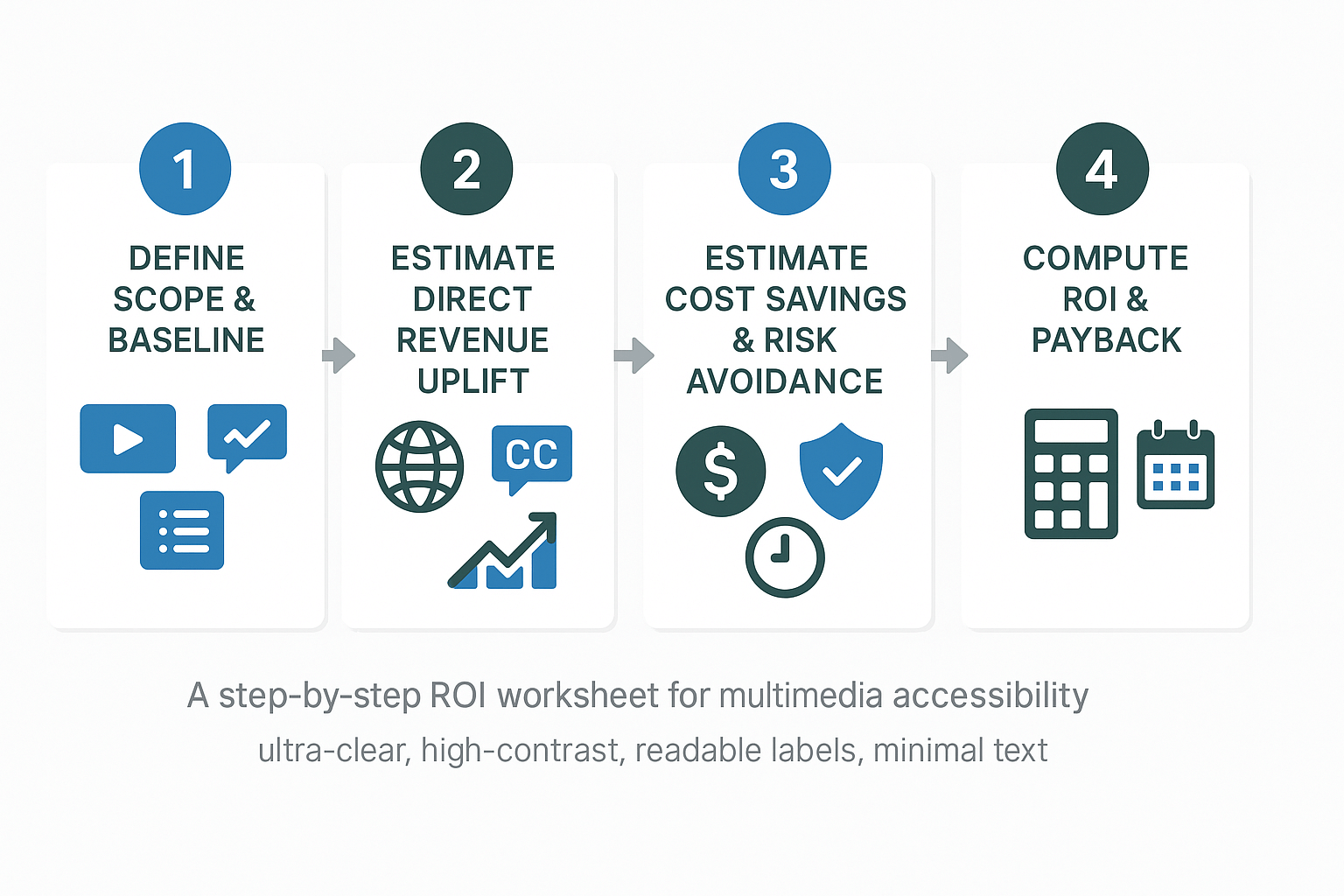
How to calculate accessibility ROI (step-by-step)
Start with a clear scope and simple math. This section gives a reproducible formula and a worksheet style approach for computing accessibility ROI for multimedia. You will see how to set baselines, count direct revenue uplift, add cost savings and risk avoidance, then compute ROI and payback. The phrase accessibility roi is central, so use real traffic, conversion and cost numbers from your analytics.
Step 1: Define scope and baseline metrics
Choose the content set you will measure, for example five marketing videos. Record baseline metrics for each item. Required baselines include views, watch time, current conversion rate, average order value, and current localization or captioning costs. Capture support tickets and complaint counts if available. These numbers are your worksheet inputs.
Step 2: Estimate direct revenue uplift
Translate accessibility fixes into measurable lifts. Common uplifts for multimedia include:
-
Increased reach from translated audio and subtitles, which grows views.
-
Higher conversion from captions and synced audio, which improves completion and trust.
-
More repeat visits from user satisfaction, which lifts lifetime value.
Use conservative uplift rates. For example assume localization grows reachable audience by 20 percent and captions raise conversion by 10 percent. Apply those percents to baseline views and conversions to get incremental conversions. Multiply incremental conversions by average order value to get incremental revenue.
Step 3: Estimate cost savings and risk avoidance
List cost avoidance categories and assign annual savings values. Typical lines include:
-
Lower human dubbing costs, when automated TTS or voice cloning replaces studio time.
-
Reduced translation turnaround and agency fees.
-
Fewer support calls and compliance penalties avoided.
Add one-off savings like content repurposing. Sum annual cost savings and add to incremental revenue to form total benefits.
Step 4: Compute ROI and payback
Use simple formulas. Keep the worksheet transparent so others can review assumptions.
-
Net Benefit = Total Annual Benefits - Total Annual Costs
-
ROI% = (Net Benefit / Total Annual Costs) * 100
-
Payback Months = (Total Initial Investment / Monthly Net Benefit) rounded up
Include initial project costs, tooling fees, and any setup hours. For tools with monthly plans, annualize subscription fees.
Worked example: video localization and dubbing
Inputs (single hero video, annual):
-
Baseline views: 100,000
-
Baseline conversion rate: 1.2% (1,200 conversions)
-
Average order value: $50
-
Current localization cost: $4,000 one-time for manual dubbing and subtitles
-
Automated solution cost: $800 per year (tooling and credits)
Assumptions:
-
Reach uplift from translated subtitles and dubbing: 25% (adds 25,000 views)
-
Conversion lift from captions and synced audio: 12% relative (from 1.2% to 1.344%)
Calculations:
-
New conversions from uplifted views = 25,000 * 1.344% = 336 incremental conversions
-
Incremental revenue = 336 * $$50 =$$16,800
-
Annual cost savings = $$4,000 one-time replaced by$$800 yearly, so first-year savings = $3,200
-
Total first-year benefit = $$16,800 +$$3,200 = $20,000
-
Total first-year cost = $$800 (tool) +$$1,200 (implementation hours at $$100/hr) =$$2,000
-
Net benefit = $$20,000 -$$2,000 = $18,000
-
ROI = ($$18,000 /$$2,000) * 100 = 900 percent
-
Payback = $$2,000 / $$18,000 / 12) ≈ 1.3 months
This example shows how modest uplifts and lower tooling costs create rapid payback. Replace each assumption with your real analytics to get your number.
Quick tips for accuracy
-
Use conservative lift estimates and test a pilot to validate them.
-
Annualize one-time costs over a sensible period, like three years.
-
Track actual conversion changes after rollout, and update the model.
Multimedia accessibility: why video and audio amplify ROI
Accessible multimedia often returns more value, faster, than many traditional fixes. Video and audio reach attention-rich moments, and a single captioned clip can drive views, conversions, and reuse. This section shows how captions, transcripts, localization, and voice cloning multiply returns, and why teams should prioritize multimedia-first accessibility investments.
Increase watch time and conversions with captions and transcripts
People watch more when video is easy to follow. Captions and clear transcripts make content usable in noisy places, at work, and for non-native speakers. As shown by
Transcriptions Boost Video Engagement by 50%—Stats Revealed, a study by Discovery Digital Networks found a 13.48% increase in view duration for videos with transcriptions compared to those without. Longer watch time usually lifts conversion rates, because engaged viewers are likelier to click calls to action or finish tutorials.
Multiply addressable markets with localization and AI dubbing
Localization turns one asset into many revenue streams. Subtitles extend search and discovery in foreign markets. Dubbing reaches viewers who prefer native audio. AI dubbing and voice cloning cut per-video localization cost and time compared to manual workflows. The net effect is faster market entry, more impressions, and lower cost per localized minute.
Benefits at a glance:
-
Reach new audiences with subtitles and translated metadata.
-
Lower localization costs with synthetic voices and aligned subtitles.
-
Maintain brand voice across languages with cloned voices.
-
Improve SEO when transcripts create crawlable text.
Repurpose assets, lower ongoing costs, improve training outcomes
Accessible media creates reusable building blocks. Transcripts feed microclips, summaries, and social cuts. Captions improve retention for online courses and reduce support tickets. Voice clones let training teams produce consistent narration in multiple languages without rebooking talent.
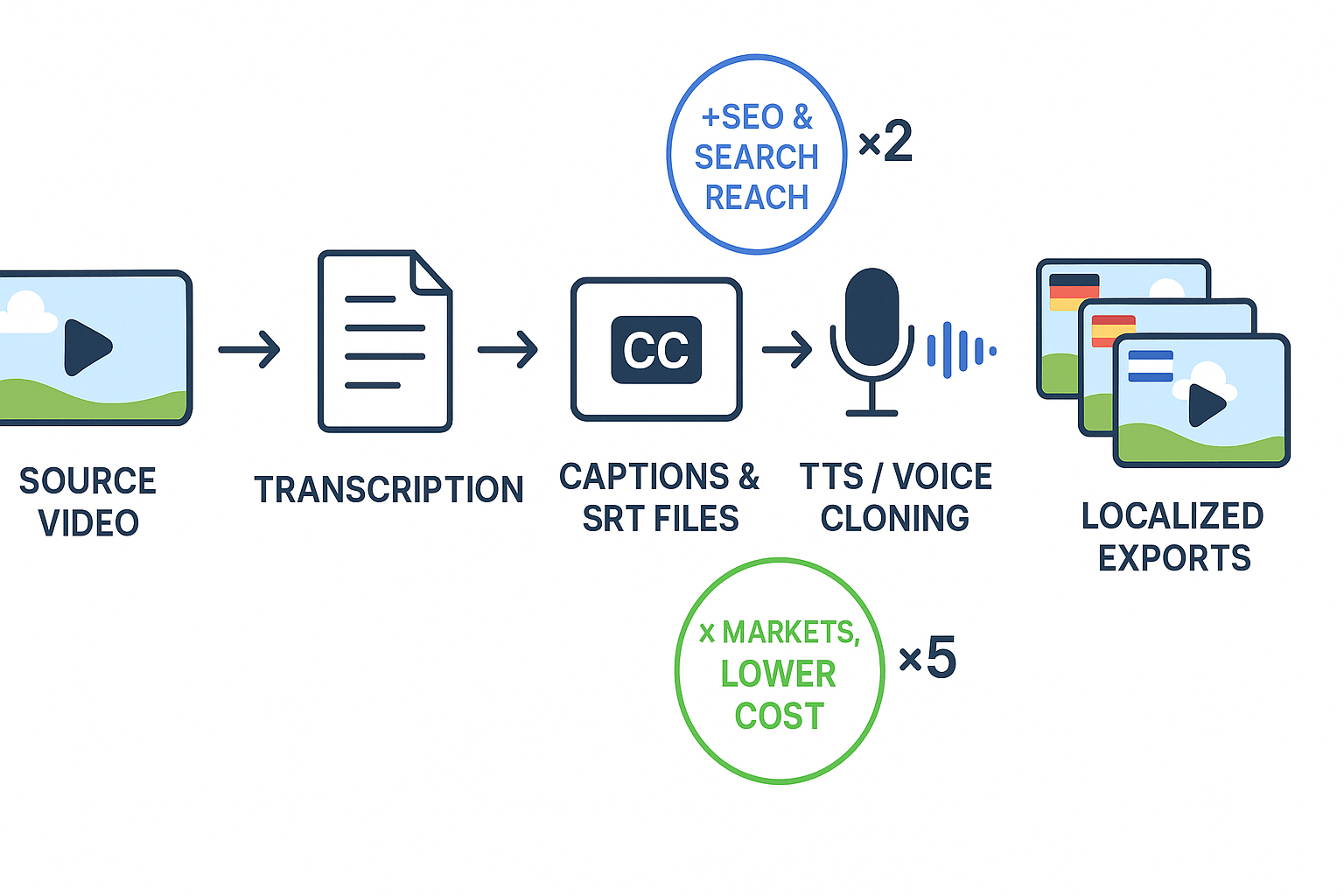
Repurposing workflow (typical):
-
Transcribe source audio to create a master text file.
-
Generate captions and SRT for web and platforms.
-
Use TTS or voice cloning to produce dubbed audio tracks.
-
Export localized videos for each market.
Each step multiplies value. A single transcription yields captions, SEO copy, chapter markers, and translated scripts. That lowers marginal cost per new market and speeds time to publish.
Why this beats many classic accessibility fixes
Multimedia fixes are visible, measurable, and fast to iterate on. You can track view duration, completion rate, click-through, and course pass rates. That gives clear input to ROI models and makes it easier to win stakeholder buy-in. For creators and learning teams, the yield is both immediate and compounding: one accessible video fuels months of content and training gains.
Mini case studies (enterprise, SMB, creator) — realistic examples
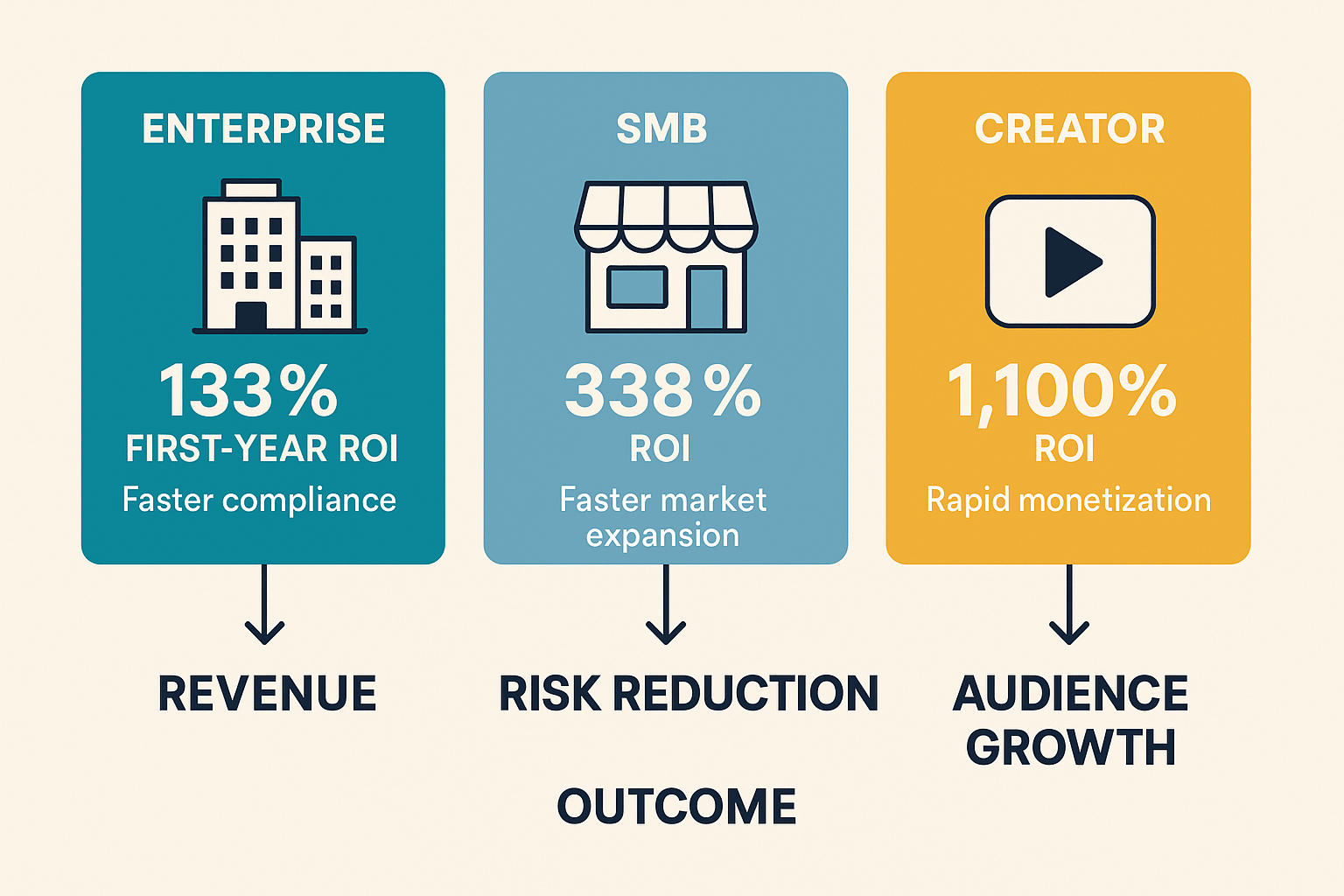
These three short case studies show real paths from accessibility investment to measurable returns. Each example states the initial problem, the multimedia accessibility actions taken, and the quantified outcomes used in an ROI model. Read them to see how captions, transcripts, and AI dubbing drive savings, growth, and risk reduction for different budgets.
Enterprise: Global training program, faster compliance
Problem: A global firm had 5,000 hours of training video. Local teams complained about slow localization and inconsistent compliance. The company faced audit risk and high external dubbing costs.
Multimedia interventions:
-
Auto-generate captions and aligned transcripts for all videos.
-
Use AI dubbing for top 6 languages to replace manual dubbing.
-
Centralize subtitle templates and TTS voice clones to keep brand voice.
Quantified outcomes: The initial project cost was $$150,000 for tooling and migration. Annual savings were$$200,000 from lower localization spend and $$150,000 from faster onboarding (fewer support tickets). Total annual benefit =$$350,000. First-year ROI = (350,000 - 150,000) / 150,000 = 133% and payback in 5 months. The ROI inputs were captioning hours, per-minute dubbing cost delta, and measured onboarding time saved.
SMB: Localized product videos, higher conversion
Problem: A SaaS startup had one explainer demo per market. Low watch rates outside the home country limited leads. Manual subtitle and dubbing costs blocked scaling.
Multimedia interventions:
-
Auto-transcribe and publish English captions immediately.
-
Translate and align subtitles for three target markets.
-
Add short AI-dubbed voiceovers for the best-performing pages.
Quantified outcomes: One-time setup plus credits cost $$8,000. Localized videos increased demo views by 25% and demo-to-trial conversion by 15. That produced an extra$$30,000 ARR. Platform efficiency gains cut ad spend waste by $$5,000. Annual benefit =$$35,000. ROI = (35,000 - 8,000) / 8,000 = 338% with a payback of about 3 months. The model used view lift, conversion delta, and average customer value.
Creator: YouTube channel, doubled global reach
Problem: A niche creator had 200 videos, mostly in one language. International search and watch time were underdeveloped. Sponsorships stalled because audiences were small.
Multimedia interventions:
-
Batch-transcribe videos and publish accurate captions.
-
Translate subtitles into five languages for key markets.
-
Use AI dubbing selectively for top 10 high-retention videos to expand reach.
Quantified outcomes: Annual costs for tools and credits were $$300. Watch time increased 20% and ad plus sponsorship revenue rose by$$3,600. Net benefit = $3,600. ROI = (3,600 - 300) / 300 = 1,100% and payback under 1 month. The creator tracked watch-time lift, RPM (revenue per mille), and new subscriber conversion to build the ROI line items.
|
Case
|
Cost
|
Annual benefit
|
Payback months
|
|
Enterprise
|
$150,000
|
$350,000
|
5.2
|
|
SMB
|
$8,000
|
$35,000
|
2.7
|
|
Creator
|
$300
|
$3,600
|
1.0
|
These mini cases use the same ROI template: list direct costs, measure yearly benefits (revenue lift, cost savings, avoided risk), then compute first-year ROI and payback. For multimedia teams, focus on caption accuracy, subtitle alignment, and selective AI dubbing to get the biggest gain per dollar. DupDub style TTS, voice cloning, and subtitle alignment tools make these steps repeatable at scale.
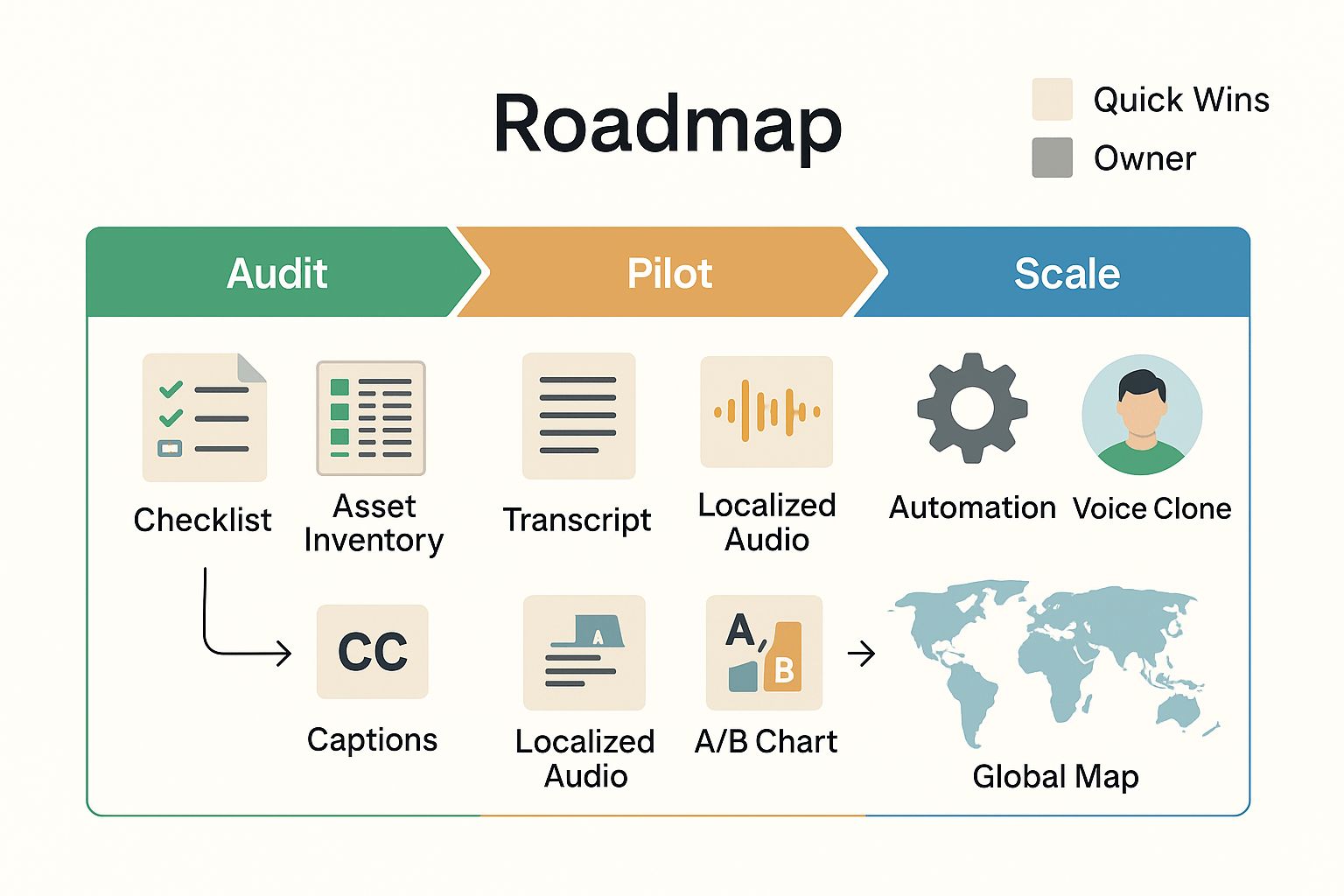
Implementation checklist & 90‑day roadmap
Start with a clear plan that turns your accessibility ROI model into action. This roadmap focuses on multimedia wins, simple ownership rules, and measurement from day one. It sets priorities so teams can show value quickly and scale work that improves reach, risk, and user experience.
Quick prioritized checklist
-
Assign an owner for accessibility measurement and outcomes. Make them responsible for reporting and demos.
-
Run a lightweight multimedia audit: inventory videos, podcasts, caption status, languages, and transcripts.
-
Score assets by impact and effort, using reach, revenue, and legal risk as criteria.
-
Pick a pilot set (5–10 high-impact videos) for captions, transcripts, and translated audio.
-
Define success metrics: views from new regions, watch time lift, complaint reduction, and cost per localized minute.
-
Set up tracking: UTM tags, analytics events, and a simple dashboard.
-
Plan handoffs: who creates subtitles, who reviews, and who publishes final assets.
Audit phase: week 1 to week 4
Run a quick inventory. Log formats, lengths, and current accessibility features. Use a spreadsheet so you can sort by reach and cost. Do spot checks on caption accuracy and transcript completeness.
Milestones:
-
Complete asset inventory and impact scoring.
-
Measure baseline metrics like average watch time and drop rates.
-
Identify 5 pilot assets with the highest ROI potential.
Quick wins:
Pilot phase: week 5 to week 8
Execute on the pilot set. Focus on speed and measurement. Deliver captions, verbatim transcripts, and at least one translated or dubbed version per asset.
Pilot checklist:
-
Generate auto-transcripts and correct errors.
-
Add aligned captions and timecodes.
-
Produce a single translated audio track or TTS dub for each pilot video.
-
Run A/B tests on thumbnail, caption presence, and localized audio.
Measure weekly. Track incremental views, watch time, and engagement from new locales.
Scale phase: week 9 to week 12
If pilot moves metrics, scale the process. Automate repetitive tasks and lock down roles. Create templates for caption styles, QA steps, and publish scripts.
Scale actions:
-
Automate transcription and subtitle alignment where possible.
-
Add voice cloning or TTS for brand consistency across languages.
-
Build a monthly cadence to localize top-performing content.
Ownership, handoffs, and measurement
Define three roles: creator, accessibility owner, and publisher. Make the accessibility owner the keeper of the measurement dashboard. Require signoff for captions and localized audio before publish.
Use this 90-day plan to deliver measurable gains fast, then turn the process into repeatable sprints. The result is clearer metrics, fewer compliance risks, and faster global growth for multimedia content.
Tools, metrics and an accessible measurement plan
Start with a clear goal: show how accessibility investments move business metrics. You can measure accessibility roi by tracking revenue, traffic, conversions, support load, and legal incidents. The plan below explains what to capture, how to instrument dashboards, and how to run simple A/B and cohort tests to prove uplift from captions, transcripts, and localized audio.
Track five core metrics first
Focus on these metrics, and instrument them consistently.
-
Revenue per user: track revenue changes by cohort after adding captions or localized audio. Short tests can show lift in purchases or subscriptions.
-
Traffic and engagement: page views, video plays, watch time, and session duration. These signal discoverability and retention gains.
-
Conversion rate: signups, form completions, course enrollments, or clicks to purchase. Measure at the event level in your analytics tool.
-
Support load: ticket volume, average handle time, and repeat contacts. Good captions and transcripts reduce questions about content.
-
Legal incidents: number and cost of accessibility complaints or remediation requests. This is a risk metric that affects total cost of ownership.
Instrument dashboards and reporting cadence
Build a live dashboard with these tools: Google Analytics or GA4, your product analytics (Mixpanel, Amplitude), and a BI tool for executive views. Tag media assets and experiments with consistent UTM and event names. Log transcription and subtitle availability as content properties so you can segment by assets with and without accessibility features. Update the dashboard weekly during experiments, then move to monthly for program reporting.
According to
Research Report on Web Accessibility Metrics (2013), the W3C's "Research Report on Web Accessibility Metrics" outlines a framework emphasizing validity, reliability, sensitivity, adequacy, and complexity as essential qualities for effective accessibility metrics.
Test to validate uplift: A/B and cohort approaches
Keep tests simple and repeatable. A/B test two groups for the same asset: one with captions or localized audio, one without. Use random assignment at the user or session level. Run tests for at least one content lifecycle (for example two weeks for marketing videos).
Cohort tests are useful for slower signals. Create cohorts by publish date or region and compare week-over-week revenue, retention, and support trends. For creators and SMBs, run within-channel tests (YouTube thumbnail plus captions) to isolate effect. For enterprise, roll out by country or product line and measure lift in adoption or training completion.
Practical checklist: tag assets, capture pre-test baselines, set clear success metrics, run the experiment long enough for statistical confidence, and report results with effect size and business impact.
This measurement plan helps you prove value and scale wins across teams. Track the five metrics, automate dashboards, and validate with A/B and cohort tests to make measured, repeatable decisions about multimedia accessibility.
Overcoming stakeholder objections and internal barriers
Start with a short rebuttal bank and a low-risk pilot you can present to finance and product. This section gives concise language to counter common pushback on accessibility investments. It also shows a staged pilot that limits spend and proves quick wins, so leaders can approve without large upfront risk. Use the term accessibility roi early to anchor the business case.
Rebuttal bank: short answers for finance and product
-
Cost too high: Frame accessibility as an investment with measurable returns. Show a simple payback: reduction in support tickets, extra reach from translated video, and lifted conversions from captions. Use year 1 and year 3 projections.
-
Scope creep: Start small and target high-impact assets, like top-performing training videos or marketing hubs. Define clear entry criteria: video length, views, and conversion potential.
-
Uncertain ROI: Offer conservative, mid, and optimistic scenarios. Use three levers: reach (new viewers), engagement (minutes watched), and conversion lift. Small percentage gains in each create compound ROI quickly.
-
Compliance risk: Quantify potential fines, remediation cost, and brand damage. Show remediation time and cost per asset to compare to proactive investment.
Low-risk pilot framework executives can approve
-
Pick 3 assets: choose one high-traffic promo video, one course module, and one creator clip. Limit hours to under 10 total.
-
Define success metrics: views uplift, watch time, conversion rate, and support ticket reduction. Set target thresholds for each metric.
-
Use inexpensive tooling: run a 7 to 14 day test with auto captions, translated subtitles, and one dubbed language. Measure before and after performance.
-
Calculate quick ROI: tally incremental revenue or cost savings over 12 months against pilot cost. Present a 3-scenario sensitivity table.
-
Scale plan: if pilot hits targets, expand to a prioritized 90-day rollup for the top 20 assets.
How to present numbers to get buy-in
-
Keep slides tight: one page for problem, one for pilot plan, one for 3-scenario ROI.
-
Lead with dollars per month and months-to-payback.
-
Show nonfinancial wins too: accessibility also improves SEO, localization speed, and brand trust.
Narrow scope, clear metrics, and a time-boxed pilot remove most executive objections. Mention that many teams reduce localization cost by using AI tools that include TTS, subtitles, and fast transcription during the pilot.
Next steps & conversion path for multimedia teams
Start a focused 30 to 90 day pilot that proves accessibility ROI with video and audio. This plan shows what to measure, how DupDub features map to cost and reach gains, and clear success criteria you can present to stakeholders. It’s practical, repeatable, and aimed at multimedia teams that need fast wins.
Pilot plan: 30, 60, 90 day milestones
-
Days 1–14: baseline and quick wins
-
Pick 3 representative videos (marketing, training, product). Tag goals: reach, watch time, re-use.
-
Run speech-to-text (auto-transcript) and auto-subtitles. Measure baseline captions accuracy and publish time.
-
Quick metric: time-to-publish lowered, caption coverage percent increased.
-
Days 15–45: implement TTS and subtitle translation
-
Generate translated subtitles and test AI dubbing on one language per video.
-
Measure change in views, engagement rate, and new market traffic.
-
Quick metric: percent lift in international views and play-through rate.
-
Days 46–90: voice cloning and scale
-
Use voice cloning for branded narration and bulk re-voicing.
-
Automate subtitle alignment and integrate into publishing workflow.
-
Quick metric: cost per localized minute, time per video reduced, and incremental revenue or learner completion rate.
Map features to measurable ROI levers
-
Transcription (STT): reduces manual captioning hours, lowers labor cost per video.
-
Subtitles and alignment: increases discoverability, search impressions, and non-native retention.
-
Text-to-speech (TTS): enables low-cost narration, faster local launches, and consistent brand voice.
-
Voice cloning: preserves brand tone across languages, cuts per-minute dubbing fees.
Success criteria to validate ROI
-
25% drop in localization time per minute.
-
40% reduction in manual captioning cost for pilot assets.
-
10–30% lift in views or course completions in target locales.
How to scale and get help
If the pilot meets these metrics, expand to 10x more content and add API automation. For help mapping results to your P&L, request a consultation and start a hands-on trial.
FAQ — quick answers to top 'People Also Ask' questions
-
How quickly will I see accessibility ROI for video content?
Most teams see measurable gains in 3 to 12 months, depending on scope and distribution. For short pilots that focus on high-traffic videos, payback can arrive inside 90 days when you track reach, engagement, and incremental revenue. See the worked example for a step-by-step ROI calculation that uses real numbers.
-
Are accessibility requirements legally required for websites and multimedia?
Regulations vary by country and sector, but many markets require reasonable accessibility for public-facing services. Treat legal risk as part of your ROI: reduced fines, lower litigation cost, and smoother procurement. Use the pilot plan to map rules that matter to your region and sector.
-
How much does accessibility cost for video and audio per minute?
Costs vary by method: basic captions and transcripts are low cost, while professional dubbing or custom voice cloning is higher. Typical ranges: $5–$40 per finished minute for captions and translation, and higher for full human dubbing. The worked example shows how to plug your rates into a cost vs benefit table for accurate estimates.
-
Which metrics prove multimedia accessibility success?
Track both business and compliance metrics: incremental views and watch time, conversion lift, reduced support tickets, and WCAG audit scores (conformance checks). Also monitor localization reach (new markets) and re-use rates for training content. The measurement plan section gives a short list of KPIs and how to collect them.
-
Can accessible video increase conversions and reduce churn?
Yes. Accessible content reaches more users and keeps them engaged longer, which raises conversion rates and lowers churn for training and subscription products. The mini case studies show real percent lifts and how to model those gains in your forecasts.
-
What size pilot gives fast wins for accessibility ROI?
Pick 3 to 10 high-impact videos or courses, run a 60 to 90 day pilot, and measure reach and conversion changes. Keep the scope tight: one platform, one language set, and defined KPIs. The 90-day roadmap section has a ready pilot checklist you can copy.
-
Who should own accessibility ROI in a company?
Make it a cross-functional program with a single sponsor: typically product or marketing for customer-facing content, and L&D for internal training. Give the owner clear KPIs and a small cross-team squad for fast execution. See the implementation checklist for roles and handoffs.




 Discord
 YouTube
 Tiktok
 Twitter
 Facebook
 Instagram