This AI dubbing price benchmark gives quick per-minute ranges. Automated dubbing typically costs 1 to 25 per minute. Human studio dubbing often costs 50 to 400 per minute. Final cost varies by language, voice cloning, and post-edit needs.
-
Creators and social clips: AI for low cost and fast turnaround.
-
E-learning and internal training: AI fits standard narration and saves money.
-
Films, ads, and emotive scripts: prefer human dubbing for nuance and legal safety.
AI wins on cost and speed for large libraries and iterative edits. Use AI for bulk subtitling, quick A/B tests, and iterative regional releases. Human talent still matters for tone, timing, and cultural adaptation.
If you need low cost and fast scale, start with AI tests. Reserve human dubbing for high stakes projects and final releases. Plan hybrid workflows: AI first pass, human polish for critical scenes. Budget models should include licensing, reviews, and localization QA time. Start small, measure voice quality, then scale.
Why 'Cost per Minute' Matters for Video Localization
Cost per minute is the dominant budgeting metric for video localization because it translates runtime into a predictable line item. An ai dubbing price benchmark helps teams compare vendors quickly, estimate translation budgets, and model total cost of ownership (TCO) across catalogs. Per-minute rates map directly to media length, which makes forecasting and stakeholder approvals easier.
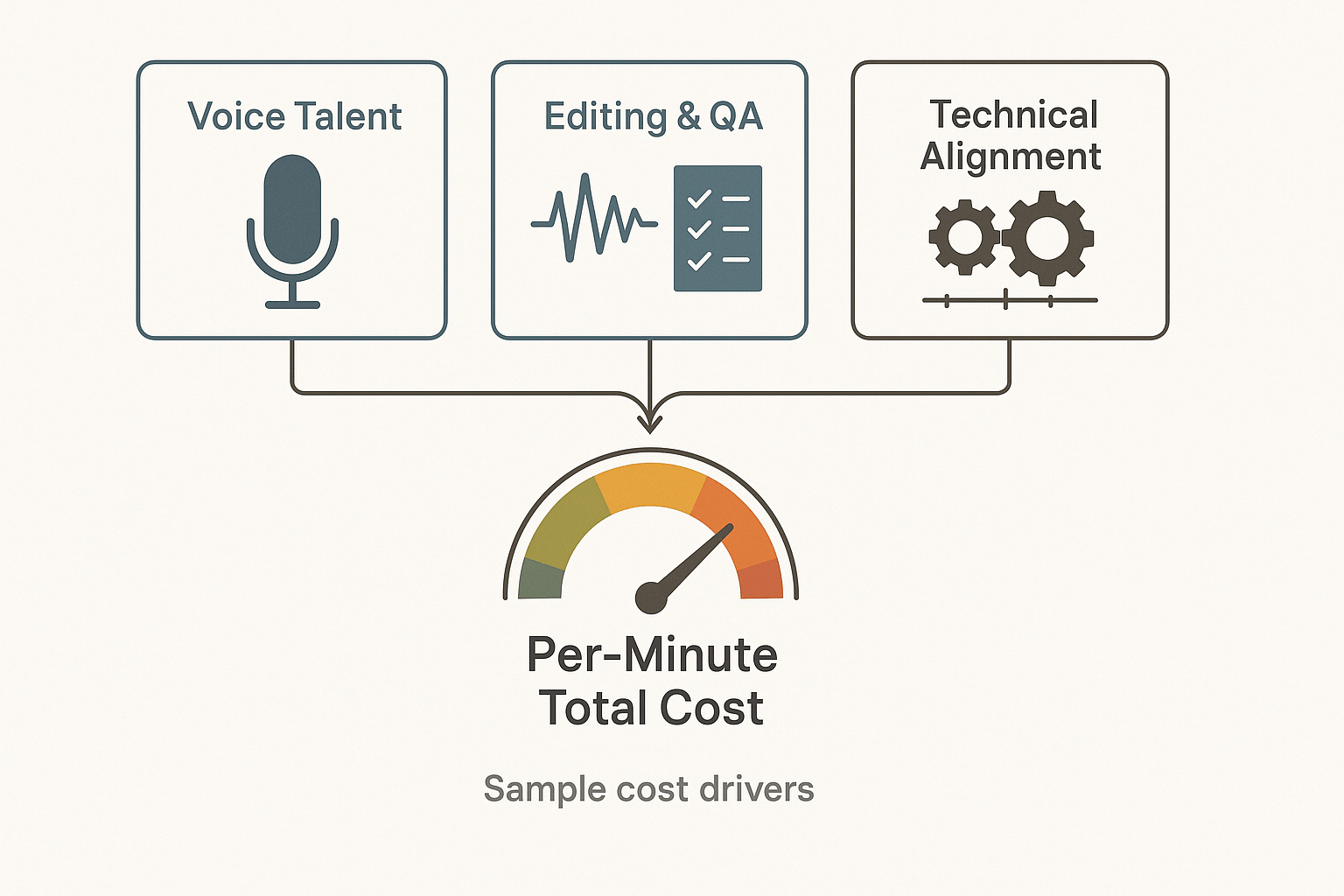
Key cost drivers
-
Voice talent: casting, union fees, and bespoke voice cloning add big one-time or per-use costs. For human talent, rates multiply when multiple languages are needed.
-
Editing and QA: alignment, timing, and audio mixing take studio time. Small timing fixes can add minutes per file but big costs overall.
-
Technical alignment: subtitle sync, lip-sync, and platform integration require engineering or manual time, and that raises TCO for complex formats.
When per-minute pricing can mislead
Per-minute rates hide prep work, revisions, rights clearance, and complex sync tasks. For animated scenes, compliance reviews, or multi-speaker interviews, total cost often grows far above the simple per-minute quote. Low per-minute pricing benefits high-volume creators, e-learning teams, and agencies who standardize assets and accept minimal revisions. If you need high fidelity or heavy creative direction, factor fixed setup and QA into your estimate.
Understanding these drivers makes hourly and per-minute comparisons fairer, and helps you pick the right vendor for scale and quality.
How We Benchmarked AI Dubbing Prices (Methodology)
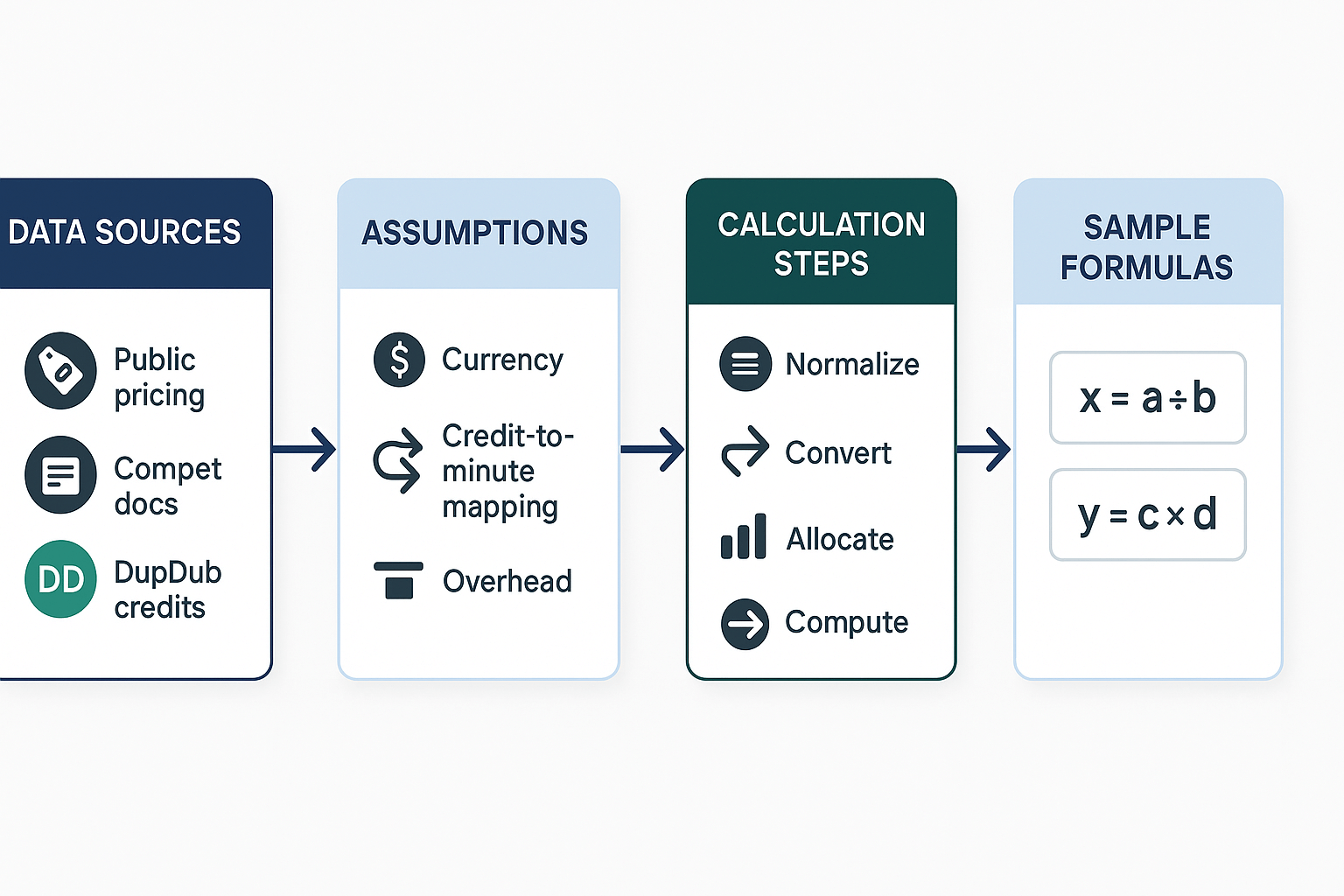
This note describes our data, assumptions, and calculation steps so you can reproduce the ai dubbing price benchmark. We converted vendor plans and credit buckets into a single cost per minute so readers can compare options apples to apples. Inputs included public pricing, competitor plans, and product credits like DupDub tiers.
Data sources and inputs
-
Public vendor pricing pages and plan documents.
-
Competitor credit mappings and pay-as-you-go rates.
-
DupDub plan credit-to-hours summaries used to derive minutes from credits.
-
Market reports and analyst notes, plus usage-model examples such as
VOCALLS AI Automation Platform Reviews & Ratings 2026 that state: The VOCALLS AI Automation Platform employs a usage-based pricing model, with costs varying based on factors such as interaction volume, selected features, and organizational needs.
Normalization and sample formulas
-
Normalize currency and billing period to USD per year when needed.
-
Convert plan credits or quotas to total usable minutes using vendor-provided mappings.
-
Allocate fixed overheads like transcription or alignment as per-minute addons.
-
Compute per-minute benchmarks:
-
For subscription credits: per_min = plan_price_usd / total_minutes_from_credits + addons_per_min
-
For pay-as-you-go: per_min = credits_per_min * credit_price
-
Run sensitivity ranges using low/median/high usage to show break-even points.
This method yields repeatable, auditable per-minute numbers you can recompute for your content.
AI Dubbing Pricing Models Explained
AI dubbing vendors price services in a few clear ways, and knowing the model changes your per-minute math. This section explains subscription, usage-based, and pay-as-you-go options, shows how voice cloning or premium "ultra" voices shift costs, and flags the hidden line items that push a project beyond the headline rate.
Subscription plans: predictable monthly cost
Subscription plans bundle minutes, voices, and other features into a single fee. You pay a flat monthly or annual price for a set number of credits or hours. Subscriptions work best when you localize steady, predictable volumes because they lower the per-minute cost and include extras like transcription or avatar hours.
Usage-based and pay-as-you-go: pay for what you use
Usage-based pricing charges per minute, per word, or per credit. Pay-as-you-go gives flexibility, with one-time credit purchases. These models suit sporadic creators or agencies that don’t want a recurring bill. They can be cheaper for low volume, but costs jump when volume grows or when you need premium voices.
Voice cloning and premium voices: extra cost layers
Cloning a specific voice or using higher-fidelity voices usually costs more or consumes extra credits. That raises the per-minute price for polished brand narration or talent replication. Always check whether cloning is a one-time fee, a credit-per-minute surcharge, or tied to a higher subscription tier.
Hidden costs to budget for
Common add-ons and time sinks often missing from headline rates:
-
Manual alignment and subtitle fixes (human time)
-
Editing and quality review cycles (re-record or tweak)
-
Language QA and cultural review (native speaker costs)
-
Licensing or talent release fees for cloned voices
Plan for these costs as a percentage of your audio budget, typically 10 to 40 percent depending on quality needs.
Use this checklist when comparing offers: per-minute base rate, credit-to-minute conversion, premium voice surcharges, included QA minutes, and export limits. That makes the total cost clear, and helps you pick the right model for your volume and quality goals.
DupDub: Cost-Per-Minute Benchmark & Example Calculations
This section turns DupDub plan details and pay-as-you-go credit packs into clear per-minute rates you can use to budget projects. It shows how Personal, Professional, Ultimate, and credit packs map to dollars per minute for standard TTS, and it walks three concrete scenarios: a weekly 10-minute creator series, a 50-hour e-learning course, and a 500-hour enterprise program. The numbers use the plan hour mappings and amortize subscription cost over a year, so you get repeatable math.
How the math works
We use each plan's yearly cost and the plan-provided hours for standard TTS to compute credits per minute, cost per credit, and then cost per minute. Ultra voices, avatars, and special features use smaller hour allowances, so they consume more credits per minute and raise marginal cost. All sample prices below assume standard TTS unless noted.
|
Plan
|
Yearly price
|
Credits
|
Std TTS $/min
|
Ultra $/min (approx)
|
|
Personal
|
$132
|
1,800
|
$0.09
|
$0.44
|
|
Professional
|
$360
|
6,000
|
$0.07
|
$0.38
|
|
Ultimate
|
$1,320
|
30,000
|
$0.05
|
$0.27
|
|
PAYG 500 credits
|
one-off $68
|
500
|
$0.16
|
n/a
|
|
PAYG 1,000 credits
|
one-off $128
|
1,000
|
$0.15
|
n/a
|
|
PAYG 6,000 credits
|
one-off $698
|
6,000
|
$0.14
|
n/a
|
Numbers rounded to two decimals. Ultra figures are approximate because each plan gives a much smaller Ultra allowance, so Ultra minutes burn more credits per minute.
Example 1: Weekly 10-minute creator series
Scope: 10 minutes per episode, weekly (40 minutes/month, 480 minutes/year). Using a Personal plan at about 0.09 per minute, your yearly dubbing cost is roughly 42. Monthly spend is about $3.50. If you use voice cloning (included in plan clones), there’s little to no extra per-minute charge. If you choose Ultra voices for key episodes, multiply minutes at the Ultra rate shown above.
Example 2: 50-hour e-learning course
Scope: 50 hours equals 3,000 minutes. On a Professional plan at roughly 0.07 per minute, the base cost is about 217. If you need Ultra narration for higher fidelity, that same 3,000 minutes at the Ultra rate could run near $1,125, so pick Ultra only for parts that need premium quality.
Example 3: 500-hour enterprise localization
Scope: 500 hours equals 30,000 minutes. On Ultimate plan pricing near 0.053 per minute, base cost is about 1,587. For large programs this shows the value of higher-tier plans, because per-minute credit pricing falls as credits scale.
Notes on cloning and avatars
Voice cloning is often included as a limited plan feature, so once you create a clone the marginal per-minute cost is the plan rate. Avatars and avatar video slots have much smaller included hours, so they can cost several times more per minute than standard TTS. Always check the hours-per-feature in plan details before final budgeting.
(Assumptions: calculations use the plan hour mappings and yearly amortization. Actual costs vary with feature mix, Ultra usage, and file length.)
Comparing DupDub vs. Traditional Dubbing & Top AI Competitors
This section compares per-minute cost ranges, speed, and quality tradeoffs across DupDub, other AI dubbing platforms, and traditional human dubbing. It shows where AI gives the best ROI, and where human talent still pays off for performance-critical projects. Use this to match budget, timeline, and quality needs.
Cost and speed comparison
According to
Verbalate AI (2025), Traditional human dubbing services typically cost between
75 and 150 per finished audio minute, whereas AI-generated dubbing can reduce these costs by 80–90%, bringing them down to approximately
10 15 per finished minute.
|
Provider
|
Typical per-minute range (USD)
|
Turnaround for a 10-min video
|
Best for
|
|
DupDub (AI)
|
3 to 15
|
10–60 minutes (cloud processing)
|
Fast multilingual repurposing, brand voice cloning
|
|
ElevenLabs / Murf / Play.ht
|
5 to 20
|
30 minutes to a few hours
|
High-quality TTS, narration workflows
|
|
Traditional human dubbing
|
75 to 150
|
Days to weeks
|
Character performance, broadcast-level projects
|
Where AI wins and where humans still lead
Quality-by-use-case
|
Use case
|
Quality priority
|
Recommended option
|
|
YouTube creator scaling
|
Moderate, consistent voice
|
AI (DupDub) for speed and cost savings
|
|
E-learning compliance training
|
Clear intelligibility, consistency
|
AI for speed, human for final voice checks
|
|
High-emotion scripted film
|
Natural acting, lip-sync accuracy
|
Traditional human dubbing
|
AI tools like DupDub give the best ROI when you need fast, low-cost localization at scale. Choose human dubbing when nuanced acting, cultural adaptation, or union rules matter. For mixed needs, consider AI first, then human polish for key segments.
3 Short Case Studies: Realistic Cost Outcomes
This section shows three quick, real-user micro-case studies that map the ai dubbing price benchmark to concrete projects. Each example gives an estimated per-minute cost, the effect on turnaround, and a short note on quality tradeoffs. Use these to judge which scenario most closely matches your project.
Creator: Low-volume, fast turnaround
A solo creator has a 10-minute YouTube video and needs a fast multilingual cut. Traditional studio dubbing often runs about 100 per minute, so a 10-minute job can cost roughly 1,000 and take several days to two weeks. Using an AI platform with a small plan, platform cost can be about 0.05 to 0.16 per minute, and total delivered cost is roughly 0.50 to 2 per minute after quick review. Turnaround falls to hours instead of days. Quality tradeoff: near-natural voices work well for off-camera narration but may need a human pass for humor or timing tweaks.
L&D team: Converting 50 hours of training
A training team must localize 50 hours (3,000 minutes) of e-learning. Traditional localization with voice actors, studio time, and QA can exceed 20 to 50 per minute, and take months when scaled. With an enterprise AI plan, platform costs fall to roughly 0.05 to 0.08 per minute. With reviewers and QA, expect 1 to 3 per minute total. That cuts total spend from tens of thousands to a few thousand and compresses delivery from months to weeks. Quality tradeoff: AI handles bulk narration well, but subject-matter reviews stay critical for accuracy and tone.
Agency: High-volume, brand-preserving localization
An agency localizes 20 hours for multiple clients, needing a consistent brand voice. Traditional brand-preserving dubbing can cost 150 to 300 per minute when casting and studio time are included. Using voice cloning and a higher-grade AI workflow, estimate 5 to 20 per minute plus a cloning setup fee. Total savings scale dramatically at volume. Turnaround moves from weeks per language to days. Quality tradeoff: AI clones can match timbre, but for on-camera lip sync or cinematic ADR, human actors still outperform.
|
Scenario
|
Traditional (per min)
|
DupDub-style est. (per min)
|
Typical turnaround
|
|
Creator, low volume
|
$100
|
0.50 to 2
|
Hours
|
|
L&D, 50 hours
|
20 to 50
|
1 to 3
|
Weeks → Days
|
|
Agency, brand voice
|
150 to 300
|
5 to 20
|
Weeks → Days
|
Limitations, Legal & Ethical Risks, and When Traditional Dubbing Wins
AI dubbing lowers cost, but it has limits you must weigh when reading an ai dubbing price benchmark. Models still struggle with emotive delivery, cultural nuance, and idioms. Those faults can harm brand tone, learner comprehension, or comic timing. Know when cost savings trade quality for risk.
Quality limits to watch
AI often flattens emotion, misses local references, and mistranslates idioms. Fast edits or poor audio make lip sync and timing worse. For high-stakes voice roles, that matters. When authenticity matters, human actors still lead.
Legal and ethical risks
Voice rights, consent, and privacy are top concerns. For privacy, note
EDPB adopts pseudonymisation guidelines (2025), which clarifies pseudonymisation under GDPR and affects how you store voice data. Always verify speaker consent and written license for voice likeness. Watch for deepfake misuse and unexpected copyright claims.
When traditional dubbing wins
Choose humans for high-emotion ads, nuanced drama, comedy with timing, or legal and medical content. Also pick human dubbing when contracts or regulators require explicit performance attribution.
Short QA checklist for sensitive content:
-
Confirm written voice rights and license.
-
Get explicit, recorded consent for cloning.
-
Define retention and deletion rules for voice data.
-
Run a quality review with native speakers.
-
Keep a human fallback plan.
DupDub notes: voice cloning is locked to the original speaker, processing is encrypted, and data is not shared with third parties. Procurement teams should weigh these controls against cost and use case risk.
Choosing a Vendor: Checklist & Decision Matrix
Choosing the right dubbing vendor saves money and time while protecting your content. This checklist helps teams compare features and costs for an ai dubbing price benchmark, and it points to specific modules like TTS, voice cloning, and API access. Use the checklist to short‑list vendors, then apply the decision matrix to match your volume, quality, and turnaround needs.
Vendor checklist
-
-
Data handling: Who owns voice data, and is processing encrypted at rest and in transit?
-
Voice cloning policy: Is cloning locked to the original speaker, and are consent controls clear?
-
Pricing clarity: Get per‑minute examples for common use cases, and ask about overage rules.
-
Trial and credits: Test real files with the vendor's free trial or pay-as-you-go credits.
-
API and workflow: Confirm API docs and webhook support for batch localization jobs.
-
Languages and voices: Check language coverage and available voice styles.
-
SLAs and support: Turnaround guarantees, revision limits, and enterprise terms.
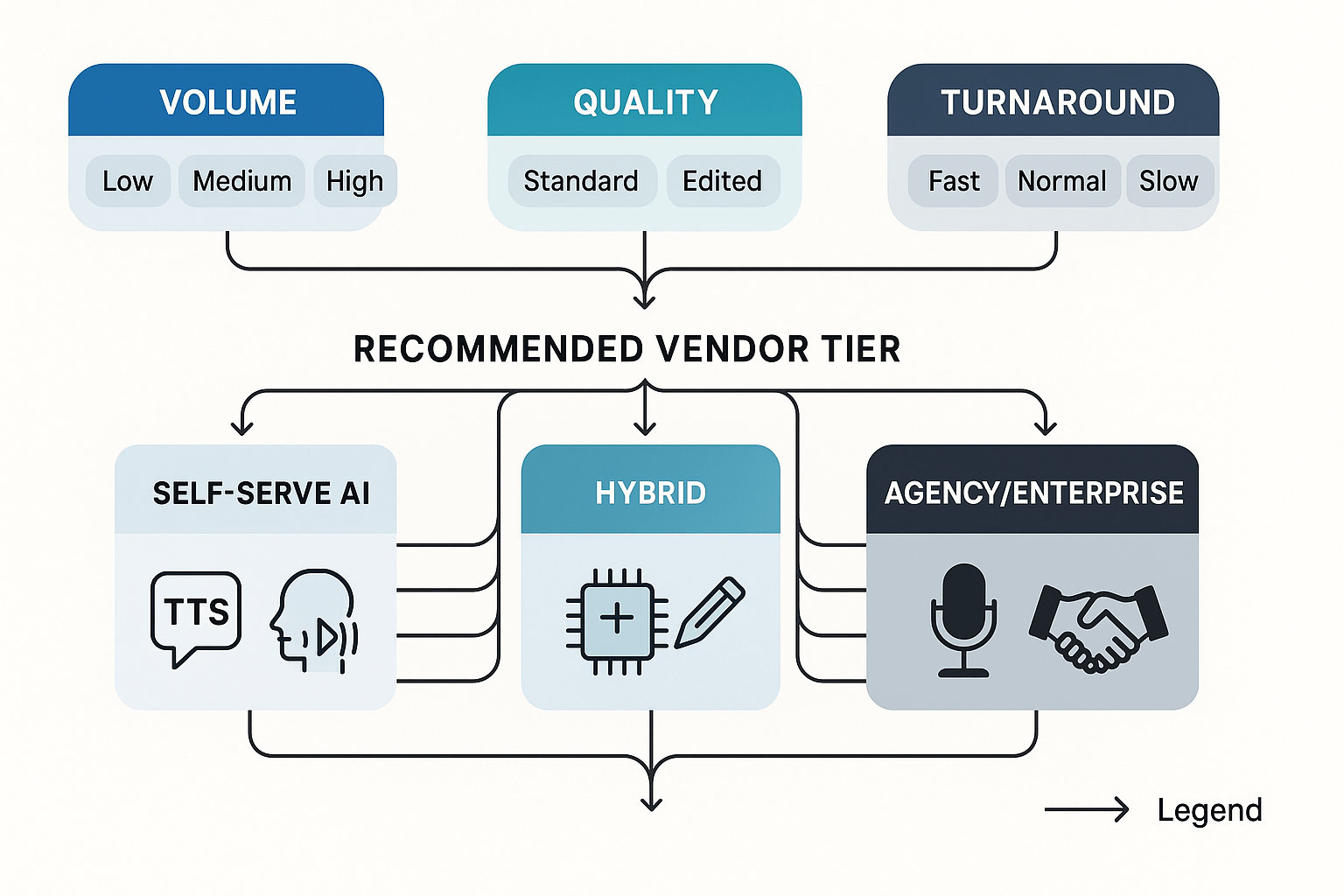
Decision matrix: volume, quality, turnaround
Match needs to vendor type using these simple rules.
-
Low volume, fast turnaround: Use self-serve AI platforms with TTS and cloning. They cost less per minute and let you iterate quickly.
-
Medium volume, brand consistency: Use AI plus human post-editing or managed plans. This balances cost and quality for training and marketing.
-
High volume, premium fidelity: Choose agency or enterprise solutions with dedicated QA, studio actors, and SLAs when accuracy is critical.
Follow this checklist, run a short pilot, and compare per-minute outputs before committing.
FAQ — People Also Ask & Decision Questions
-
What is the average AI dubbing cost per minute today?
Average AI dubbing benchmarks typically range between $3 and $45 per finished minute. Basic TTS voices on self-service credit plans sit near the low end, while voice cloning, premium voices, multi-pass editing, and human review push costs higher. Final pricing depends on platform credits, turnaround time, and quality control requirements.
-
How do I estimate total project cost for AI dubbing per minute?
Use a simple checklist: total runtime of the final video, selected voice tier (standard TTS, premium, or cloned), and added services such as subtitle translation, alignment, sound design, or revision rounds. Factor in delivery speed and the number of target languages. Add these line items together, convert platform credits or hourly labor into a per-minute rate, and multiply by total runtime to estimate overall cost.
-
Is voice cloning legal for dubbing projects?
Voice cloning is legal when you have explicit consent and the necessary usage rights from the speaker. Secure a signed release defining scope and distribution, follow platform terms, and respect privacy and trademark rules. For commercial publishing, obtain legal approval before release.
-
When should I choose human dubbing over AI dubbing?
Choose human dubbing for high-stakes scripts, emotionally complex performances, regulated or union-bound productions, and sensitive legal content. A hybrid approach often works well: use AI for first-pass localization, then have professional voice actors refine the final mix. For enterprise planning, compare total cost of ownership, evaluate plan tiers, or request custom pricing for large-scale projects.




 Discord
 YouTube
 Tiktok
 Twitter
 Facebook
 Instagram