


-
0 to 30 days: Request the SOC 2 summary and ISO scope statement; update your vendor intake to flag voice cloning and TTS projects.
-
31 to 60 days: Map where voice and transcript data flow in your systems; add required contract clauses and a data protection addendum if missing.
-
61 to 90 days: Run a small pilot under the new contract terms, test incident response playbooks, and record retention settings for cloned voices.
Background: Compliance landscape for TTS & voice cloning in 2025
EU baseline and global milestones
Emerging guidance outside the EU and US
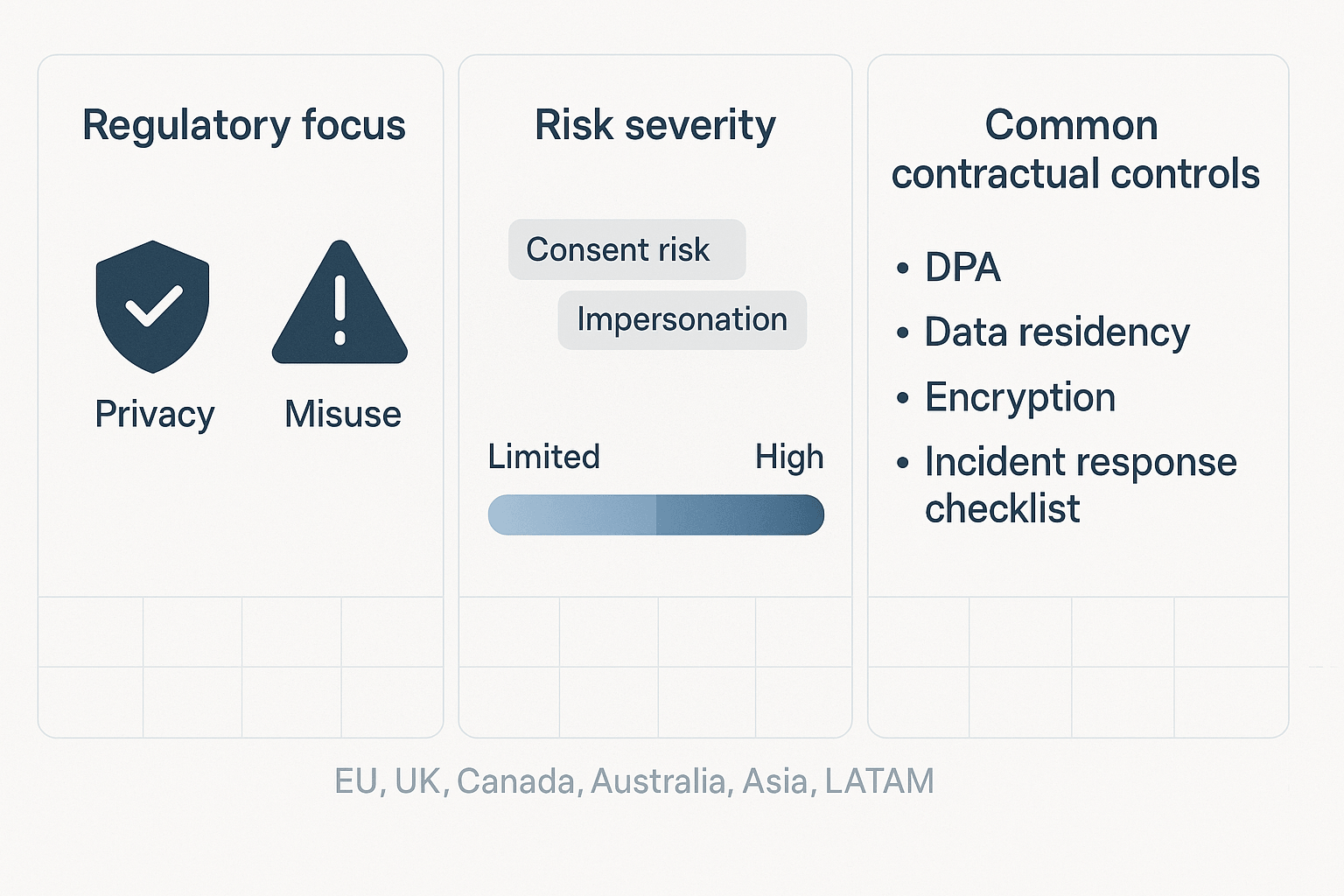
Main risk categories
-
Privacy and data protection: voice samples are biometric data, so handle them under DPAs (data processing agreements) and strong encryption.
-
Impersonation and misuse: cloned voices can enable fraud and reputational harm; consent and playback labels help reduce risk.
-
Intellectual property and rights clearance: validate speaker rights and third-party content licenses before cloning.
-
Operational security: secure models and APIs to prevent unauthorized exports or model stealing.
What DupDub is announcing: SOC 2 & ISO 42001 (scope and highlights)
Scope: which services and environments were assessed
Key control highlights and what changed
-
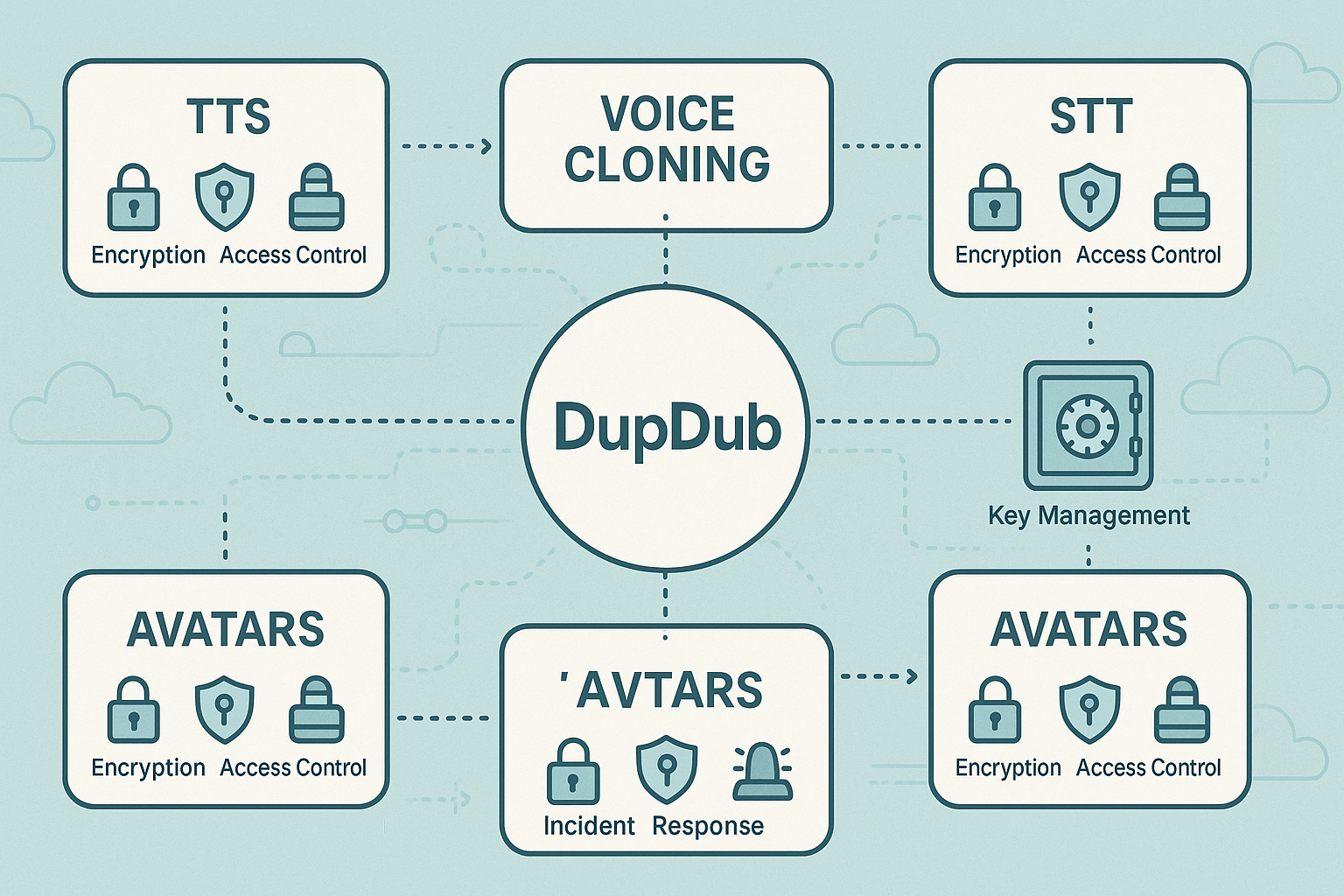
Access control: role-based access and least privilege applied to production systems. Admin and developer access require MFA (multi-factor authentication) and scoped service accounts.
-
Encryption: data is encrypted in transit and at rest using approved industry ciphers. Key management practices were reviewed and formalized.
-
Incident response: a documented playbook, defined escalation paths, and runbooks for model-related incidents were audited. Post-incident reporting timelines were tightened.
-
Data retention and deletion: retention windows are now explicit by product module, with processes for customer-triggered deletion and export.
-
Logging and monitoring: centralized logs with tamper-evident storage and alerting for anomalous model or API behavior.
How customers verify evidence and expected timelines
-
Request process: contact the enterprise team or your account manager to start a compliance request. Expect an initial acknowledgment within 3 business days.
-
Documentation delivered: SOC 2 report excerpts and ISO certificate can be shared under an NDA, or accessed via a secure customer portal.
-
Review window: allow 2 to 4 weeks for legal and security reviews depending on scope.
How these updates affect typical TTS/voice-cloning workflows
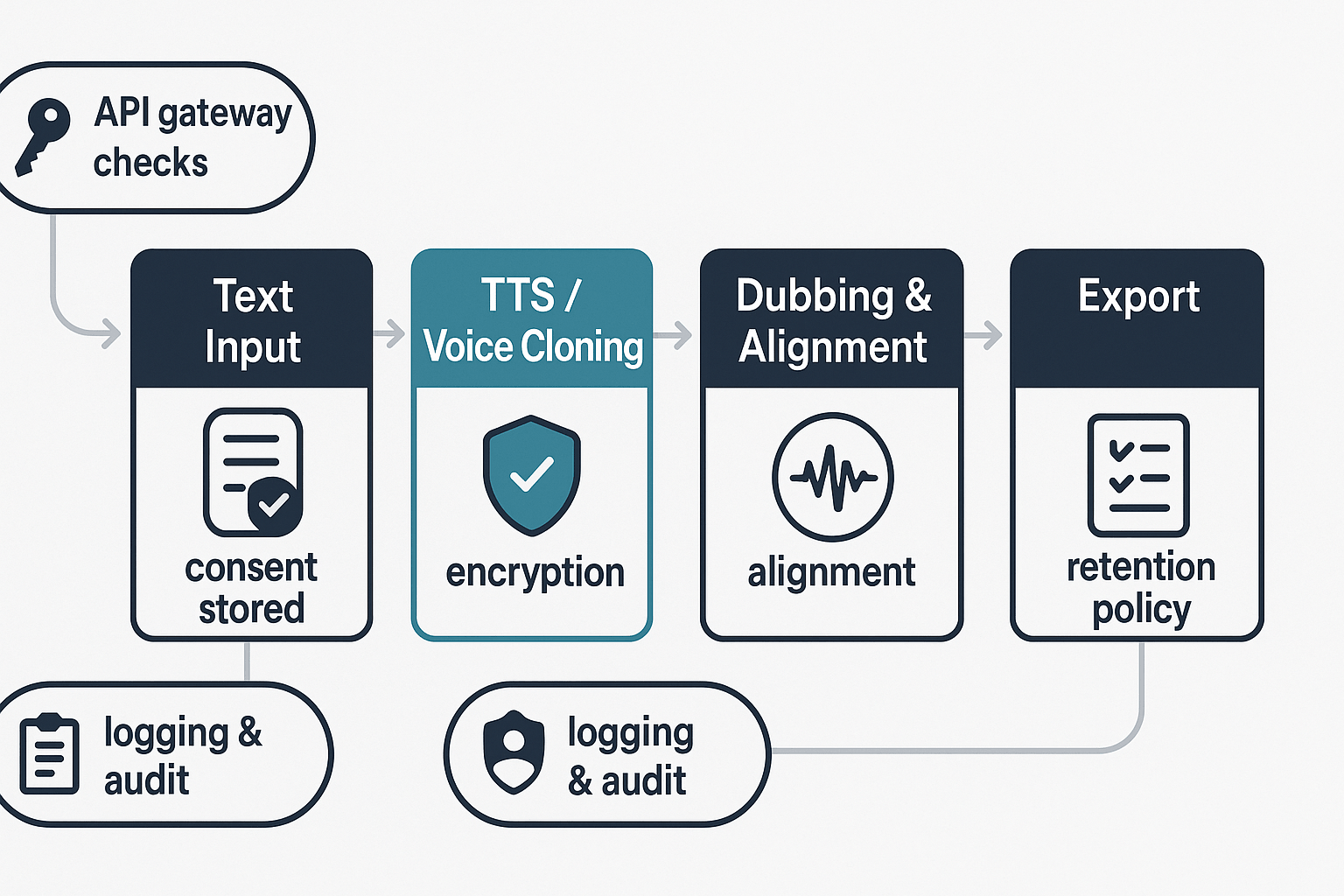
Studio and creator flows: explicit consent and audit logs
Enterprise localization pipelines: gated production
Voice cloning lifecycle: consent, training, retention
-
Consent capture and verification.
-
Model training with encrypted artifacts.
-
Labeling and access controls (role-based).
-
Retention and deletion workflows tied to contracts or laws.
Integration and API considerations
-
API key scoping and rotation, enforce least privilege.
-
Request/response logging and exportable audit trails.
-
Webhook delivery retries and signed payloads for integrity.
-
Rate limits and schema validation to prevent data leaks.
Quick checklist
-
Capture and store consent metadata before cloning.
-
Route sensitive processing through encrypted, audited endpoints.
-
Use scoped API keys and RBAC for team access.
-
Add pre-export compliance validation for large jobs.
Practical compliance checklist for DupDub customers
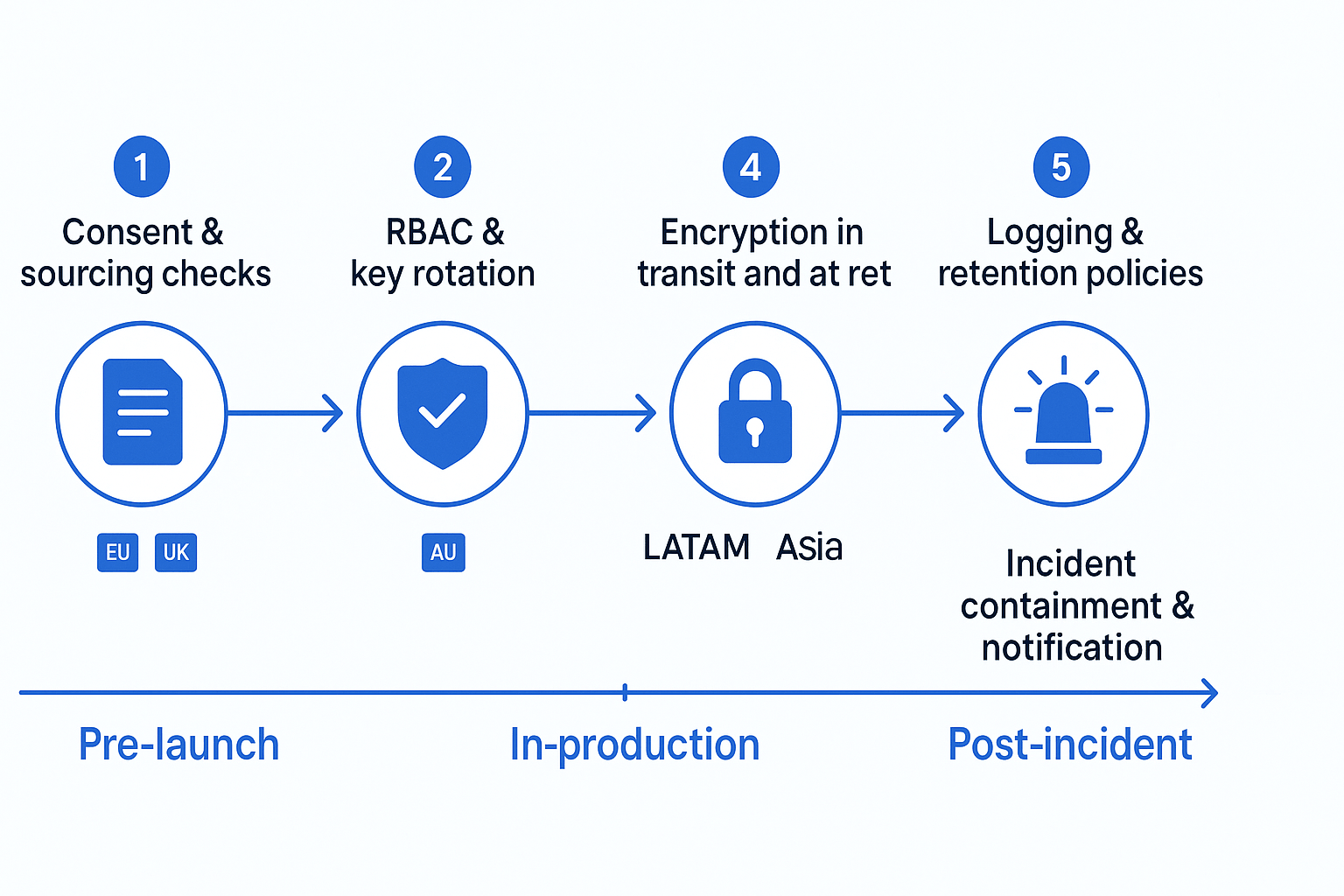
Pre-launch: verify voice sourcing and consent
-
Consent and provenance. Keep a signed consent record for every voice clone. Record speaker identity, date, permitted languages, and permitted uses. Store consent in encrypted form and link it to each voice asset.
-
Minimum data checklist. Capture source file IDs, recording timestamps, and sample metadata. Confirm samples meet your country consent rules before onboarding.
-
Consent template snippets. Use plain language that covers synthetic use, distribution channels, retention periods, and revocation rights. Add a checkbox for commercial use and a contact for withdrawal.
In-production: enforce access, encryption, and least privilege
-
Access management. Use role-based access control and short-lived credentials for engineers and reviewers. Review permissions quarterly.
-
Key and data encryption. Encrypt voice samples at rest and in transit. Rotate keys on a schedule and log all key access.
-
Operational logging and retention. Log creation, cloning, and export events with actor ID and IP. Retain logs per policy, usually 6 to 24 months depending on region.
-
Monitoring and anomaly detection. Alert on bulk export, mass cloning, or unexpected language pairs.
Post-incident: simple response playbook
-
Containment. Revoke affected keys and suspend related voice assets immediately.
-
Triage. Map the incident to affected users and consent records within 24 hours.
-
Notification. Follow regional breach rules and your DPA terms. Prepare a short public statement and a customer notification template.
-
Remediation. Restore least privilege, patch gaps, and run a focused audit of similar assets.
Auditing, documentation, and contractual ties
-
Audit pack checklist. Maintain: system architecture, data flow diagrams, consent registry, logs, and change history.
-
Evidence for questionnaires. Export role lists, key rotation logs, and sample retention records for security reviews.
-
Contract items to confirm. Include a DPA, processing scope, subprocessor list, and SLA for breach notification.
-
Standards alignment. As a controls reference, note that ISO/IEC 27001:2022 Annex A Controls Implementation Checklist states ISO/IEC 27001:2022 Annex A includes 93 controls categorized into four themes: Organizational, People, Physical, and Technological.
Quick region notes and common pitfalls
-
EU, UK, Canada, Australia: keep explicit consent records for cloning.
-
LATAM and Asia: check local biometric and voice laws before wide release.
-
Common pitfalls: vague consent, missing export logs, and unlimited retention policies.
Risk scenarios and mitigation: real-world examples
Best practice: secure voice cloning for a global e-learning rollout
-
Clear consent and recordkeeping for voice use.
-
RBAC and short-lived API keys for cloning and exports.
-
Encryption in transit and at rest, plus audit logs.
-
Revoke any unused keys and rotate credentials.
-
Reconfirm consent records for legacy clones.
-
Run an access log review and export the trail for legal review.
-
Automated export logging and alerting.
-
Regular key rotation and MFA for console access.
-
Watermarking or metadata markers for synthetic audio.
Failure: marketing clone leaked due to weak controls
-
No documented consent and informal credential handling.
-
No export controls or audit trail.
-
Weak supplier contract terms on IP and liability.
-
Take the content offline and revoke the clone.
-
Notify stakeholders and counsel, and preserve logs.
-
Patch access gaps: enforce MFA, rotate keys, and update contracts.
-
Enforce documented consent for every voice clone.
-
Apply RBAC, MFA, and short-lived API tokens.
-
Keep a searchable audit trail of cloning and exports.
-
Add contractual clauses for IP, data handling, and breach notification.
-
Detect and contain: revoke keys and take assets offline.
-
Assess: collect logs and scope impact.
-
Notify: inform legal, partners, and affected users as required.
-
Remediate: patch controls and rotate credentials.
-
Review: update policy and run a post-incident audit.
Vendor compliance comparison: what to look for in TTS/voice vendors
Core controls to compare
-
Certification coverage, why it matters: Ask for SOC 2 Type II evidence and the specific ISO variants the vendor holds. ISO/IEC 27001:2022 is the world's best-known standard for information security management systems (ISMS) ISO/IEC 27001:2022.
-
Data residency and processing locations: Verify where audio and training data are stored and processed. Region-specific controls can affect lawful transfer and retention rules.
-
Consent enforcement tools: Look for built-in consent capture, provenance metadata, and revocation options for cloned voices.
-
Encryption in transit and at rest: Expect TLS for transport and AES-256 or equivalent for storage. Ask for key management details.
-
Audit logging and provenance: Demand immutable logs for uploads, cloning, and synth requests with retention windows.
-
Access and segregation: Confirm RBAC (role based access control), least privilege, and tenant separation for multi-tenant platforms.
-
Model governance: Check for policies on fine-tuning, third-party model use, and safe-speech controls.
-
Interoperability: Prefer APIs, standard export formats, and SSO for enterprise integration.
Use a neutral feature matrix
|
Feature
|
Must-have signal
|
What it proves
|
|
SOC 2 Type II
|
Auditor report, date range
|
Operational controls tested over time
|
|
ISO 27001
|
Certification scope
|
Formal ISMS and continuous improvement
|
|
Data residency
|
Region options, contract clause
|
Local legal alignment
|
|
Consent tools
|
Audit trail, UI/SDK hooks
|
Usable compliance for end users
|
|
Encryption
|
KMS details
|
Data protection at scale
|
|
Audit logs
|
Immutable, exportable
|
For forensics and audits
|
How to request DupDub compliance documents and start an enterprise review
What you can request
-
SOC 2 Type II attestation or redacted report
-
ISO 42001 scope statement and control maps
-
DPA and data handling summary (storage, retention, encryption)
-
Pen test executive summary and remediation status
-
Subprocessor list and privacy controls
How to start the review
-
Submit an enterprise request via the web form or email enterprise@dupdub.com.
-
Expect an acknowledgement within 48 business hours.
-
Sign an NDA if needed, commonly returned in 3 to 5 business days.
-
Receive redacted artifacts within 5 to 10 business days, depending on scope.
What to expect during review
Questions security and legal teams should ask
-
What is the SOC 2 report period and scope?
-
Which systems are covered by ISO 42001?
-
How is voice-clone data isolated and deleted?
-
Who are the subprocessors and where is data stored?
-
What incident notification SLAs apply to enterprise contracts?
Enterprise support contacts
FAQ — common customer questions on DupDub compliance
-
What is DupDub compliance data sharing policy for customer audio?
DupDub does not share raw audio, voice clones, or project files with third parties for marketing or model training without consent. Data is encrypted in transit and at rest, and subprocessors are only used when necessary for hosting or support. Enterprise customers can review subprocessor lists during compliance checks.
-
How does DupDub protect cloned voice and voice models in production?
Voice clones are treated as customer-owned assets and restricted to the originating account. Protections include encryption, role-based access control, usage logging, export restrictions, and retention or deletion options. Enterprise customers can request stricter controls such as dedicated environments.
-
Is DupDub GDPR compliant for voice cloning and TTS projects?
DupDub aligns with GDPR principles such as data minimization, purpose limitation, and user rights support. Enterprise users can request a Data Processing Addendum and handle data subject requests through formal compliance processes.
-
Can I require local data residency in the UK, Canada, Australia, or LATAM?
Yes, region-specific data residency options are available for many enterprise deployments, depending on contract and infrastructure. You should specify required regions during procurement and confirm details in a data residency agreement.
-
What are DupDub liability limits and penalties for misuse of generated voices?
Liability terms are defined in the master services agreement and vary by plan and negotiation. DupDub requires proper consent for voice cloning and may offer indemnities or custom protections for enterprise contracts.
-
Are there special rules for non-commercial or hobbyist voice cloning use with DupDub?
Non-commercial use is allowed under standard platform terms, provided consent and content policies are followed. For commercial or production use, you should upgrade plans and ensure licensing and consent requirements are met.
-
How do I get DupDub compliance documents or start an enterprise review?
Request compliance documents such as SOC 2, ISO certifications, and DPA agreements through the procurement or support process. You can also start an enterprise review by contacting sales or opening a compliance request during evaluation.

 Discord
 YouTube
 Tiktok
 Twitter
 Facebook
 Instagram