


TL;DR: What this guide covers and quick action plan
-
Week 1, Define and set up: pick a niche, map 10 story ideas, choose a consistent voice style, and set up accounts and a simple content calendar.
-
Week 2, Create and batch: write 10 short scripts, record or generate voiceovers, add subtitles, and batch edit three videos for posting.
-
Week 3, Publish and test: post daily for seven days, A/B test two thumbnail styles, and watch retention and engagement metrics.
-
Week 4, Optimize and scale: double down on formats that hit retention, repurpose top clips, and automate voice dubbing or translation for reach.
Why faceless TikTok narration works (psychology + platform trends)
Voice builds trust and personality fast
Short clips favor story beats and retention
-
Strong opening line that names the benefit.
-
One clear fact, tip, or twist in the body.
-
A tight close that rewards the viewer.
-
Consistent voice that ties clips together.
-
Refillable formats, so you can repurpose long content.
Algorithm signals to watch and exploit
Concrete trend signals and audience behaviors
-
Hook retention: Test opening lines to see which keep people past three seconds. Short A/B tests reveal what phrase works.
-
Rewatch triggers: Use small reveals, pauses, or edits that push viewers to rewatch. Rewatches are gold for distribution.
-
Sound affinity: Track how often viewers click a sound to see other clips. If they do, double down on that voice style.
-
Comment prompts: A short voice prompt that asks a simple question drives replies and saves.
-
Cross-format interest: Note which long-form videos get repurposed well into short narrated clips.
What to plan for in your content calendar
Quick checklist to apply now
-
Write three hooks for a single idea and test them.
-
Record a 15- to 30-second narration and track completion rate.
-
Add one rewatch trigger, like a pause or a quick reveal.
-
Repurpose one longer video into five narrated shorts.
Best faceless niches and example content ideas (with sample scripts)
Proven faceless niches that scale
-
Reviews and comparisons: Short product breakdowns, pros and cons, and a final verdict. These clips build authority and convert well when you add links.
-
Lifehacks and quick tips: One clear problem, one fast fix. These are shareable and repeatable.
-
Guided micro-meditations and sleep clips: Calm narration, music, and simple visuals. Perfect for evergreen views.
-
Gaming highlights and explainers: Clip commentary, tips, and quick patch notes summaries for viewers who skip long videos.
-
Micro-education and explainers: One concept, one example, one result. Think quick history facts, language hacks, or math tricks.
10 ready-to-record micro-scripts (15–60 seconds)
-
Quick product review (30s) "I tested this wireless charger for a week. It charges at full speed for most phones and stays cool. The cable sits flat so it won’t slip. If you want fast charging without the bulk, this is worth it. Save this clip for shopping tips."
-
Lifehack: kitchen shortcut (20s) "Stop scrubbing burnt pans with a sponge. Add a cup of hot water and one tablespoon of baking soda. Let it soak five minutes, then wipe clean. Works on most stuck-on foods. Try it tonight."
-
1-minute meditation (45s) "Close your eyes and breathe in for four counts. Hold for two. Exhale slow for six. Picture your shoulders dropping. Repeat three times. Open your eyes and notice lower stress. Use daily before work."
-
Gaming quick tip (25s) "Want faster XP in this map? Focus on the blue crates and use the grappling hook to avoid fights. Stealth route nets double XP with less risk. Try it on your next run."
-
Micro-lesson: language hack (30s) "Struggling with past tense in Spanish? Use ‘ayer’ for yesterday clues, then choose the past form. Example: ‘Ayer comí’ means I ate yesterday. Practice three times with your own verbs."
-
Comparison: two cheap gadgets (40s) "Model A is lighter and lasts longer on a charge. Model B has better materials but costs more. If you travel a lot choose A. If you want build quality and longevity choose B. Short list: battery, weight, price."
-
Quick myth-buster (20s) "You don’t need to wait 24 hours before charging a new phone. Modern lithium batteries don’t require it. Charge when low, unplug at full. Simple routine keeps battery healthy."
-
Productivity tip (30s) "Use a two-minute rule: if a task takes under two minutes, do it now. This stops small tasks from piling up. Over a day, you save time and reduce mental clutter. Start with emails."
-
Sleep clip with ambient cue (50s) "Lie down, soften your jaw, and breathe slow. Count down from ten with each exhale. Feel your body sink into the mattress. If the mind wanders, return to counting. Drift when you’re ready."
-
Curiosity hook: fun fact (25s) "Octopuses have three hearts and blue blood. Two hearts pump to the gills, one pumps to the body. That helps them survive cold deep water. Save this to wow a friend."
How to stretch one idea into 3–5 clips for batching
-
Break the core idea into parts: hook, proof, result, call to action. Each part becomes a separate short clip.
-
Reuse assets: keep the same background music, subtitle template, and voice to keep brand consistency.
-
Vary pacing: make one clip a quick hook, one a detailed tip, and one a summary with a CTA.
-
Localize: translate or dub the best clip for another language to double reach.
-
Bundle: combine 2 or 3 short parts into a single longer edit for a different platform.
Tools & tech stack: Why DupDub fits and how it compares (no screenshots)
Core toolset by task
-
Recording: Browser studio or phone voice memo for quick takes; USB mic and DAW (digital audio workstation) for high quality.
-
Editing: Clip editors (CapCut, Premiere Rush) for cuts; audio editors (Audacity, Descript) for cleanup and noise reduction.
-
Voice & dubbing: TTS (text-to-speech) and voice cloning for scalable narration and localization.
-
Subtitles and captions: Automated subtitle generation with manual review for accuracy.
-
Hosting and scheduling: TikTok app for publishing, plus scheduling tools for batch posting and calendar views.
-
Analytics: Native TikTok Analytics plus a simple dashboard to track retention, CTR, and views by topic.
Why an all-in-one platform speeds growth
-
Speed: one pipeline from script to final file.
-
Consistency: same synthetic voice and subtitle timing per brand.
-
Scale: faster localization into multiple markets.
How DupDub solves common bottlenecks
|
Task
|
DupDub
|
Manual workflow
|
Notes
|
|
Narration creation
|
Fast TTS and voice clones, many voices
|
Record or hire voice actor each time
|
DupDub scales voices across languages
|
|
Dubbing / localization
|
Auto-translate, auto-sync audio and subtitles
|
Translate, timecode, re-record, then align
|
Manual has better nuance but costs more time
|
|
Subtitle generation
|
Auto-subtitle with edits
|
Manual transcription or separate STT tool
|
DupDub keeps text and timing in one file
|
|
Iteration speed
|
Quick re-voices and edits in browser
|
Multiple file versions and uploads
|
Reduces version control problems
|
Where manual workflows still make sense
-
High-stakes branded ads that need a human actor’s nuance.
-
Legal or privacy constraints that forbid synthetic voices.
-
Very short runs where setup overhead outweighs automation.
-
Complex audio design with layered live foley and mixing.
Quick decision checklist
-
Need many languages or consistent brand voice? Pick a platform with TTS and cloning.
-
Want faster publishing? Consolidate subtitle, TTS, and dubbing in one tool.
-
Require studio-level audio or bespoke acting? Keep a manual recording path.
-
Are you repurposing long videos? Automate transcription and chunking.
-
Budget constrained? Compare time saved to subscription costs.
-
Prefer control? Use hybrid: DupDub for drafts, local DAW for final mix.
Step-by-step production workflow for 1 viral faceless TikTok (prep → publish)
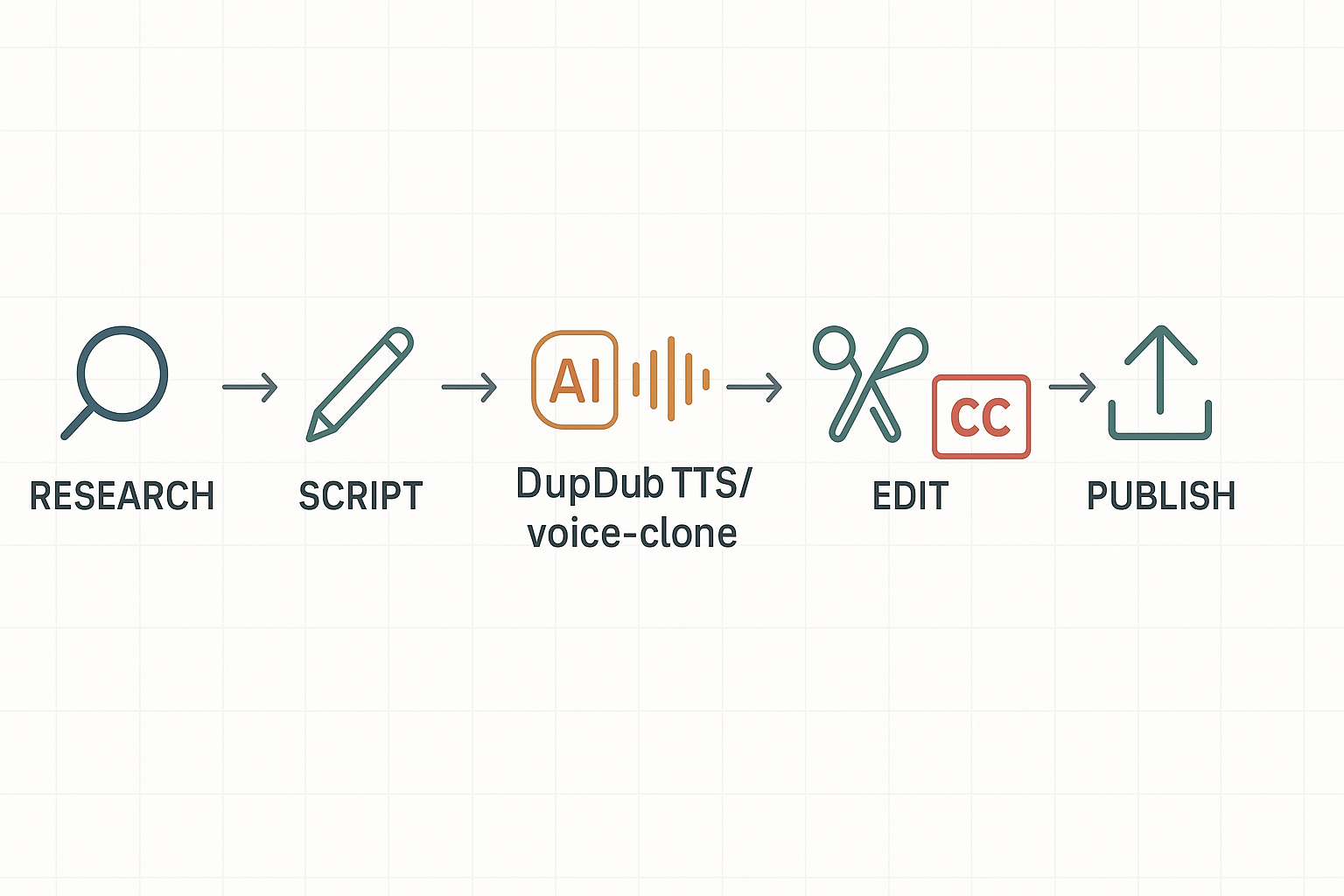
1) Research the idea, quick validation
2) Plan the hook and beats
-
Hook: "Stop scrolling if you want passive income from your phone."
-
Beats: 1) Quick stat or pain point. 2) One real tactic. 3) How to start today.
-
Payoff: "Try this for one week and report back."
3) Script templates you can reuse
4) DupDub trigger points: TTS vs voice clone, subtitles
-
Fast test post: TTS.
-
Series/brand voice: clone (30s sample to create).
-
Multilingual dub: TTS with translated script, then auto-align subtitles.
5) Record and edit workflow
-
Create visuals: screen record, stock clips, or animated text scenes.
-
Generate voice: run script through DupDub TTS or voice clone.
-
Rough edit: align voice, trim to hook, tighten pauses.
-
Add music and SFX, keep music <50% volume under voice.
-
Final polish: captions, thumbnail frame, and 1:1 or 9:16 crop.
6) Captions, thumbnails, and upload checklist
-
Hook lands in first 1.5s.
-
Total length 15 to 60s depending on format.
-
Captions uploaded as SRT and burned or native TikTok captions.
-
Hashtags: 3 specific + 2 broad.
-
Description: 1-line teases, 1 CTA.
-
Thumbnail: clear text, strong contrast.
7) Example DupDub prompts (quick)
Voice options, optimization & sample DupDub prompts
When to use TTS, voice cloning, or your own voice
-
TTS: fast, cheap, easy translation. Best for listicles, facts, and evergreen content.
-
Voice cloning: fast once set up, consistent brand character, multilingual support. Requires a clear sample and consent.
-
Own voice: highest authenticity, flexible emotion, higher time cost.
Pick tone, pace, and accent to match niche and audience
-
Tone: neutral, warm, or animated. Pick one that fits your niche persona.
-
Pace: words per minute. For tutorials aim 120 to 150 WPM. For short hooks try 160 to 190 WPM.
-
Accent and pronunciation: choose an accent your audience understands, not necessarily your own. Global audiences often prefer near-neutral accents.
Micro-optimization tips
-
Use short sentences for hooks. They boost retention.
-
Emphasize key words with slight pauses. Pauses give viewers time to read captions.
-
Avoid monotone: add micro-variation in pitch or speed on important lines.
-
Use contextual SFX sparingly to highlight punchlines or transitions.
Quick checks before you publish
-
Audio clarity: no background hum or clipping.
-
Lip-sync and subtitle alignment: words match the waveform.
-
Voice consistency: same voice for a series episode.
-
Legal: you have rights for any voice clone and music. Get written consent when cloning a real person.
Exact DupDub prompt templates
-
Neutral TTS for list videos
-
Expressive TTS for hooks and comedy
-
Voice clone for consistent brand voice
-
Dubbing existing video into another language
-
Subtitle alignment and short-form optimization
-
Listen at 1x and 1.5x to spot stilted intonation.
-
Scan SRT for split words and punctuation errors.
-
Verify cloned voice comfort: play samples next to earlier episodes to confirm consistency.
Growth strategies, analytics & scheduling (advanced tips)
Focus on the signals that move the algorithm
-
Watch time and average view duration (how long people watch).
-
Completion rate (percent who watch to the end).
-
Rewatch rate and shares (strong signals for virality).
Watch-time hacks that work for faceless creators
-
Hook styles: question, bold claim, or micro-story.
-
Clip length: 15s vs 30s vs 60s.
-
CTA placement: early micro-CTAs vs end CTAs.
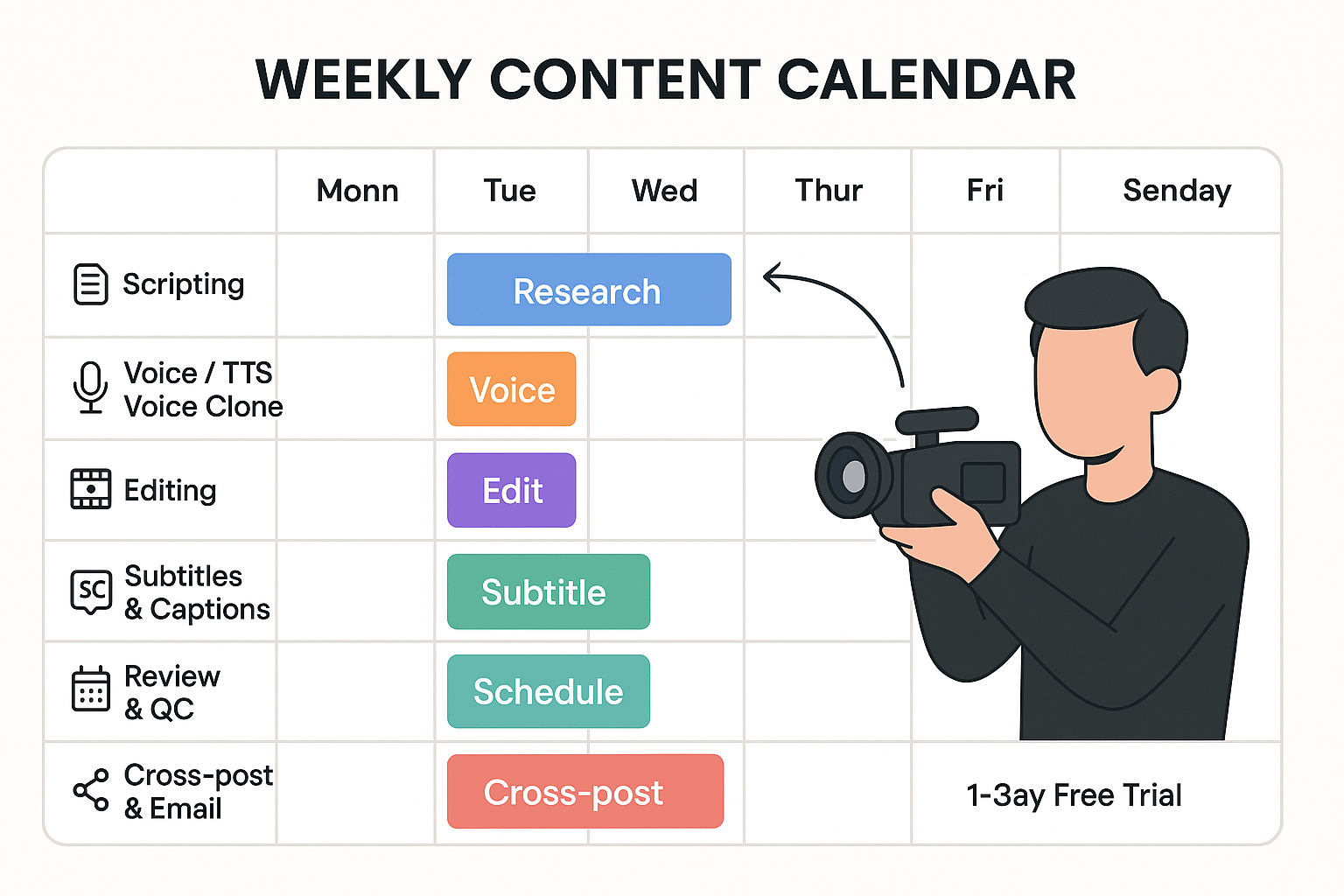
Ideal posting cadence and batching workflow
-
Monday: Research and script 5 short ideas.
-
Tuesday: Record narration (or generate with TTS/voice clone).
-
Wednesday: Edit video clips, add SFX and motion.
-
Thursday: Auto-generate and tweak subtitles.
-
Friday: Schedule posts and create cross-post variants.
Read analytics to iterate faster
-
Pick your two best videos each week.
-
Reverse-engineer the hook, pacing, and thumbnail.
-
Create 3 new clips that reuse that winning structure.
Repurposing and cross-platform funnels that scale community
-
Email: weekly digest with best clips and a lead magnet.
-
Discord or Telegram: behind-the-scenes, AMAs, and prompt testing.
-
YouTube Shorts and Instagram Reels: repurpose vertical edits to widen reach.
Measurement dashboard and iteration cadence
Quick checklist before you publish
-
Hook in first 3 seconds.
-
Trim all dead air and filler.
-
Add captions and readable thumbnail text.
-
Schedule cross-posts and email drop.
Monetization & scaling: From hobby to income (concrete models)
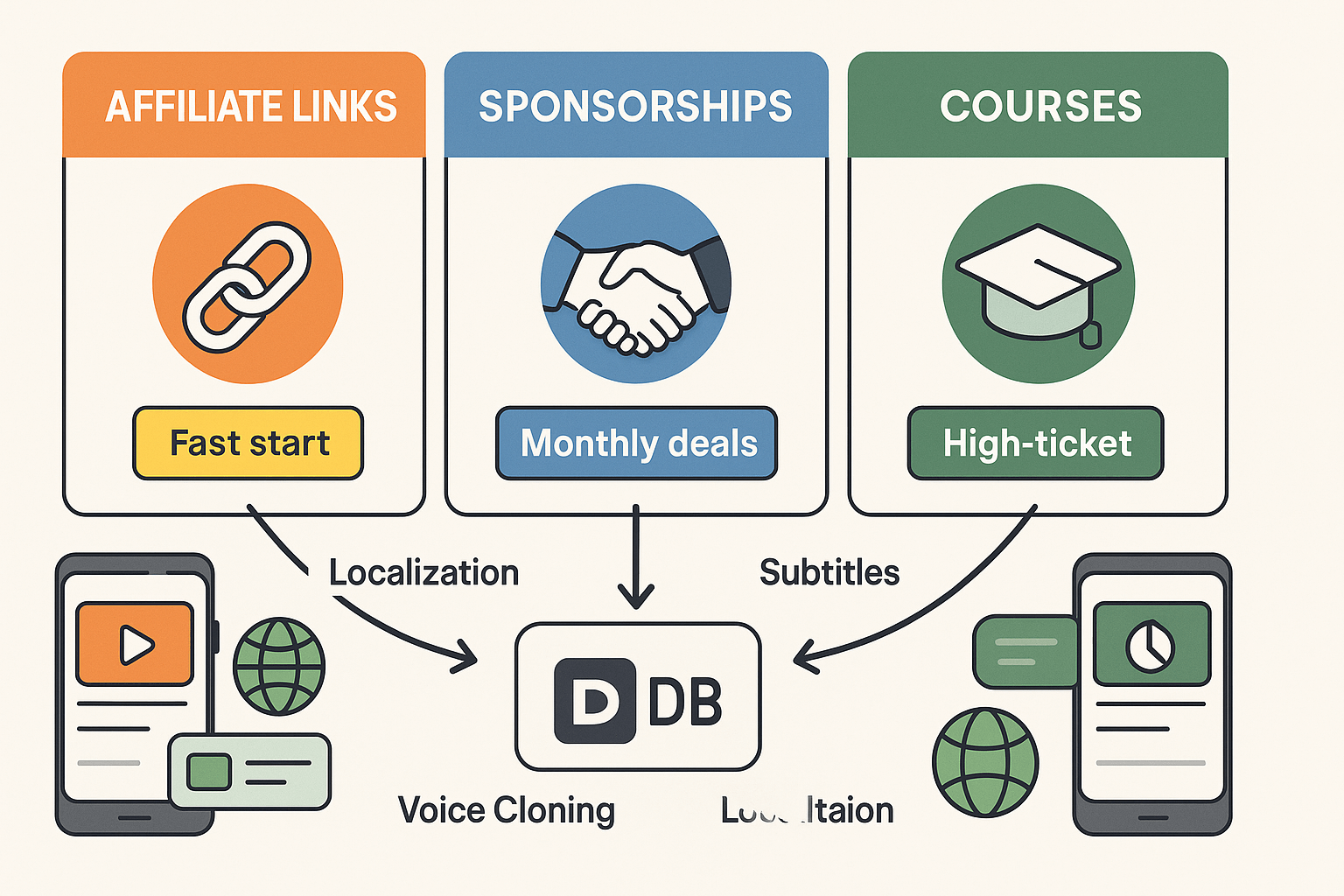
Short-term wins: Affiliate links and product funnels
-
1–3 targeted affiliate products per week.
-
15–45 second review or demo videos, posted twice weekly.
-
A simple bio link with UTM tracking and product pages.
Mid-term growth: Sponsorships and paid content
-
Media kit with niche stats and rate card.
-
Three bundled deliverables: short clip, follow-up video, and repurposed audio.
-
Offer multilingual dubbed versions to add value for global brands.
Long-term scale: Courses, memberships, and an agency model
-
Validate course idea with a low-cost beta cohort.
-
Build evergreen course material from your best videos.
-
Offer done-for-you dubbing and repurposing services to scale income.
Repurposing and localization, multiply income with less work
-
Native post with affiliate link.
-
Sponsored localized clips for regional brands.
-
Course modules built from long-form episodes.
Quick comparison of revenue lanes
|
Timeline
|
Typical work
|
Typical revenue
|
Best use case
|
|
Short-term
|
Weekly affiliate posts
|
Low to medium
|
Product demos and reviews
|
|
Mid-term
|
Sponsored bundles
|
Medium to high
|
Niche authority and steady views
|
|
Long-term
|
Courses or agency
|
High, recurring
|
Expert content and B2B services
|
Practical metrics to track and test
Legal, ethics & community: music, disclosures, privacy + FAQ
-
How do I handle disclosure on a faceless TikTok channel?
You must clearly disclose sponsored content or material connections. The FTC’s Endorsement Guides require disclosure when a relationship could affect how people evaluate an endorsement. Add short text in the caption, a pinned comment, and a clear on-screen label within the first 1–3 seconds. If using voiceover, include a brief verbal disclosure such as, “This post is sponsored by X.”
-
What music licensing rules apply to faceless TikTok videos?
Music rights are a common cause of takedowns. Use TikTok’s in-app music library for organic posts or license tracks for commercial use. Options include platform-licensed music, royalty-free libraries, or purchasing sync/master licenses. Keep receipts and license documentation for proof.
-
Can I use voice cloning ethically for faceless TikTok narration?
Yes, with clear written consent and defined usage limits. Permission should specify platforms, languages, duration, compensation, ownership, and revocation terms. If offering cloned voices publicly, disclose that the voice is synthetic.
-
Do I need consent to clone a voice for narration?
Always obtain written consent before cloning a real person’s voice. A proper release should state the speaker’s identity, scope of use, commercial rights, and expiration or revocation terms. Store signed releases and source recordings securely to reduce legal risk.
-
What privacy rules should I follow for community and DMs?
Collect only the minimum necessary data and be transparent about usage. Never request or share personal ID numbers, full addresses, or financial details in comments or DMs. For off-platform groups, publish a privacy notice and moderation rules. Use two-factor authentication and restrict access to member data.
-
How do I avoid copyright takedowns when repurposing clips?
Do not assume short clips qualify as fair use. Obtain written permission or a license from the original creator. If you significantly transform the content, document your edits and creative rationale. When unsure, replace the audio or use royalty-free alternatives.
-
What disclosure templates work for sponsored faceless TikTok posts?
Use clear, simple language that fits TikTok’s format. Examples:
“Paid partnership with [Brand].” (caption + pinned comment)
“Sponsored: I was paid to review this.” (on-screen + audio)
“Ad: promo code inside.” (first-frame text)
Place disclosures within the first 3 seconds and retain contracts and payment records. -
How do I build a safe off-platform community for my faceless TikTok audience?
Set clear rules and enforce them with trusted moderators. For sensitive groups, require verified email or identity checks. Publish reporting procedures and privacy guidelines, and pin them prominently. Audit moderators regularly and remove accounts that violate policies.
-
Quick legal FAQ: common questions creators ask about faceless TikTok
Q: Do I need a business entity? A: It helps with sponsorship contracts and taxes.
Q: How do I handle taxes? A: Track income and expenses and report earnings under local law.
Q: Who owns a cloned voice? A: Ownership and usage rights must be defined in the contract.
Q: Can I monetize repurposed clips? A: Only with permission or a valid license.
Q: Where can I get templates? A: Use simple written releases and maintain organized consent records.

 Discord
 YouTube
 Tiktok
 Twitter
 Facebook
 Instagram