


TL;DR: Quick takeaways
-
Content creators: Roll English and Spanish voice variants across your top 10 videos to test global lift.
-
YouTubers and podcasters: Pilot Mandarin and Portuguese on high-engagement episodes to find new audiences.
-
Localization managers: Add Mandarin and Brazilian Portuguese to cut vendor costs and speed delivery.
-
E-learning producers: Localize core courses in Hindi and Mandarin to unlock large learner pools.
-
Marketing teams: Translate and dub hero ads in Spanish and Portuguese first for quicker ROI.
-
Product managers: Request voice clones in the top five languages and track retention by locale.
-
Accessibility leads: Deploy neutral English and Hindi narrators to improve clarity and compliance.
Why language coverage expansion matters in 2026
Market forces driving rapid adoption
Creator economics: reach, revenue, repeatability
-
Small creators need low-cost, fast options to test foreign markets. They prefer per-minute credit or trial credits to reduce risk.
-
Mid-size channels scale localization when a single translated video reliably brings new subscribers or higher watch time.
-
Enterprise publishers treat localized audio as a growth lever, not just a nice-to-have, because each language multiplies reach and ad inventory.
Enterprise localization budgets and measurable ROI
-
Faster global launches for product videos and training.
-
Unified brand voice across markets, protecting brand equity.
-
Lower cost per localized asset, freeing budget for more languages.
Why audiences prefer localized audio
Concrete pain points localization must solve
-
Slow turnaround: manual dubbing adds weeks to timelines.
-
Inconsistent voice: different voice actors change tone across markets.
-
High cost: studio rates and coordination push budgets past ROI thresholds.
-
Fragmented tools: teams juggle separate vendors for TTS, subtitles, and sync.
What to prioritize when expanding language coverage
-
Start with audience data: local watch time and search traffic matter most.
-
Add regional lingua francas next, then local dialects for priority markets.
-
Focus on high-value use cases: product tutorials, evergreen courses, and flagship videos.
-
Test with a low-cost pilot using a single cloned voice across 3 markets.
Near-term trends teams should watch
-
Demand for regional accents and dialects will rise, not just standard varieties.
-
Voice cloning accuracy will improve in more languages, enabling brand-consistent narration globally.
-
API-first solutions will make localization part of automated publishing pipelines.
Quick takeaways for decision makers
-
Prioritize languages that match real audience signals, not vanity metrics.
-
Measure localization ROI with watch time, retention, and conversion lift.
-
Pick a platform that unifies cloning, TTS, transcription, and subtitle sync to save time.
Why language coverage expansion matters in 2026
Creators need speed and scale to grow revenue
-
Faster go to market for translated videos and courses.
-
Lower per-language cost compared with human dubbing.
-
Consistent tone and brand voice across languages.
Enterprises prioritize consistent brand voice and compliance
-
Brand safety and consistent messaging.
-
Faster localization of training and compliance videos.
-
Predictable costs for global programs.
Global video consumption keeps rising, and language is the bottleneck
Pain points that slow localization adoption
-
High costs for quality human dubbing.
-
Long turnaround times for vendors.
-
Loss of brand voice across languages.
-
Fragmented toolchains and manual subtitle syncing.
How language expansion ties to monetization
-
Ad and sponsorship uplift from longer watch time in local markets.
-
Course and product sales from localized landing pages and narration.
-
New channel monetization when creators publish region-specific content.
-
Reduced churn for global customers who prefer native-language support.
Why multilingual TTS and voice cloning matter technically
-
Subtitle alignment that matches lip sync cues.
-
Style controls to keep tone consistent across scripts.
-
Faster iteration cycles because audio changes are cheap.
DupDub solves the most common localization bottlenecks
-
Faster go to market: automated dubbing and subtitle sync speed up release schedules.
-
Consistent brand voice: voice cloning creates a single, reusable persona across languages.
-
Lower costs: AI voices and credits reduce per-minute expenses compared to studio dubbing.
Prioritizing which languages to add first
-
Market size and growth potential.
-
Existing audience data and watch time by region.
-
Revenue or strategic goals in target countries.
-
Cost and complexity of localization for the language.
What to expect in the next 12 to 18 months
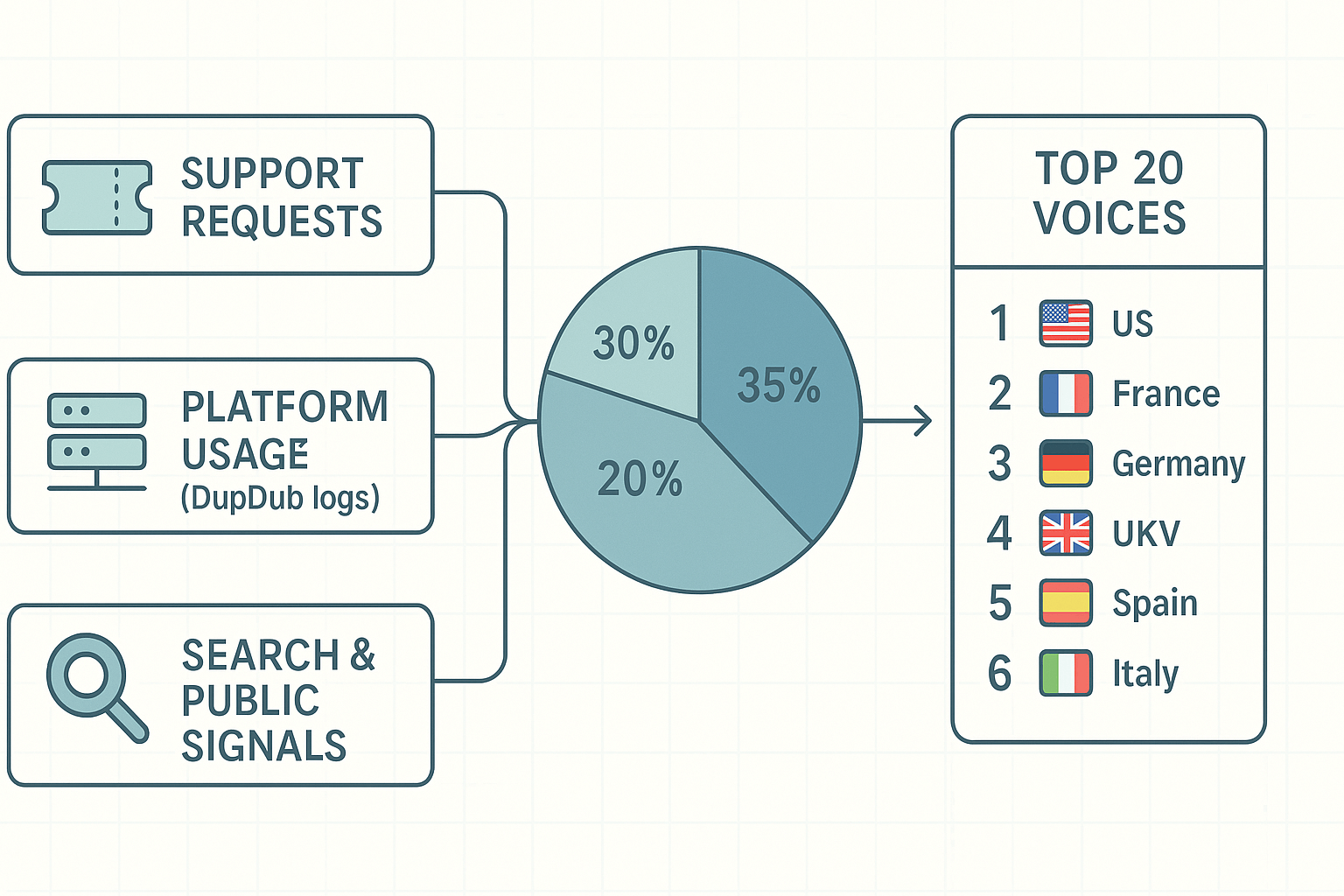
Data & methodology: How we built the Top 20 requested voices list
What data we used
-
Support requests and language requests. These are ticket tags and free-text requests from users asking for specific voices, accents, or languages. We counted mentions and normalized for duplicates.
-
DupDub platform usage logs. These include voice selection events, TTS minutes consumed, voice-clone activations, and API calls. We aggregated anonymized, daily event counts by language and voice family.
-
Search trends. We used relative search volume and related query patterns as a public proxy for intent. This helps catch markets that request languages outside platform activity.
-
Public demand indicators. These are industry reports, forum signals, job postings for localization, and creator community polls. They add context, especially for enterprise or emerging-market demand.
Data processing and normalization
-
De-duplication. We merged requests that referenced the same voice or language with variant names. For example, "Spanish (Spain)" and "Castilian Spanish" were unified.
-
Timestamp alignment. All signals were windowed to the same 12-month period ending March 2026.
-
Normalization. Each source was scaled to a 0 to 1 range per language or voice. This avoided domination by high-volume logs alone.
-
Language mapping. We mapped dialects and accents to parent language codes where appropriate. We kept separate tags when the dialect affected utility, like Brazilian Portuguese vs. European Portuguese.
Scoring model and weights
-
Support requests: 30% — direct user asks are high signal. They often indicate unmet demand.
-
Platform usage: 35% — actual consumption shows clear product-market fit.
-
Search trends: 20% — public interest matters, especially for new markets.
-
Public indicators: 15% — industry signals add context but are noisier.
Inclusion criteria
-
Minimum mentions: at least 15 unique support requests in the period, or
-
Minimum usage: at least 10 hours of TTS / dubbing consumption, or
-
Minimum search interest: a relative search volume above the 25th percentile in our dataset, or
-
Strategic overrides: enterprise demand flagged by sales and product teams.
Validation and sanity checks
-
Cross-source agreement. We flagged entries where one input was high but others were near zero. Those entries got manual review.
-
Temporal stability. We checked that high-ranking candidates had sustained interest across multiple months.
-
Expert review. Product managers and localization leads reviewed edge cases. They adjusted for known technical constraints, like cloning coverage limits.
Biases and limitations
-
Platform bias. Using DupDub logs favors voices already available on the platform. Emerging offline demand can be undercounted.
-
Requester bias. Support tickets over-represent engaged creators and enterprise customers. Casual users may not file tickets.
-
Search noise. Search trends capture interest, not purchasing intent. Some queries are academic or exploratory.
-
Language conflation. Mapping dialects to parent languages risks hiding local nuance.
Reproducibility checklist
-
Export support ticket text and tags for the chosen time window.
-
Aggregate platform logs by voice ID and language code, then sum daily events.
-
Pull relative search volume and related queries for each language and voice term.
-
Collect public indicators like forum thread counts or localization job openings.
-
Normalize each input to 0–1 per candidate.
-
Apply the weights listed above and sum weighted scores.
-
Apply inclusion cutoffs and generate the final ranking.
-
Run the three validation checks and annotate uncertain items.
What this method is good for
What this method is not
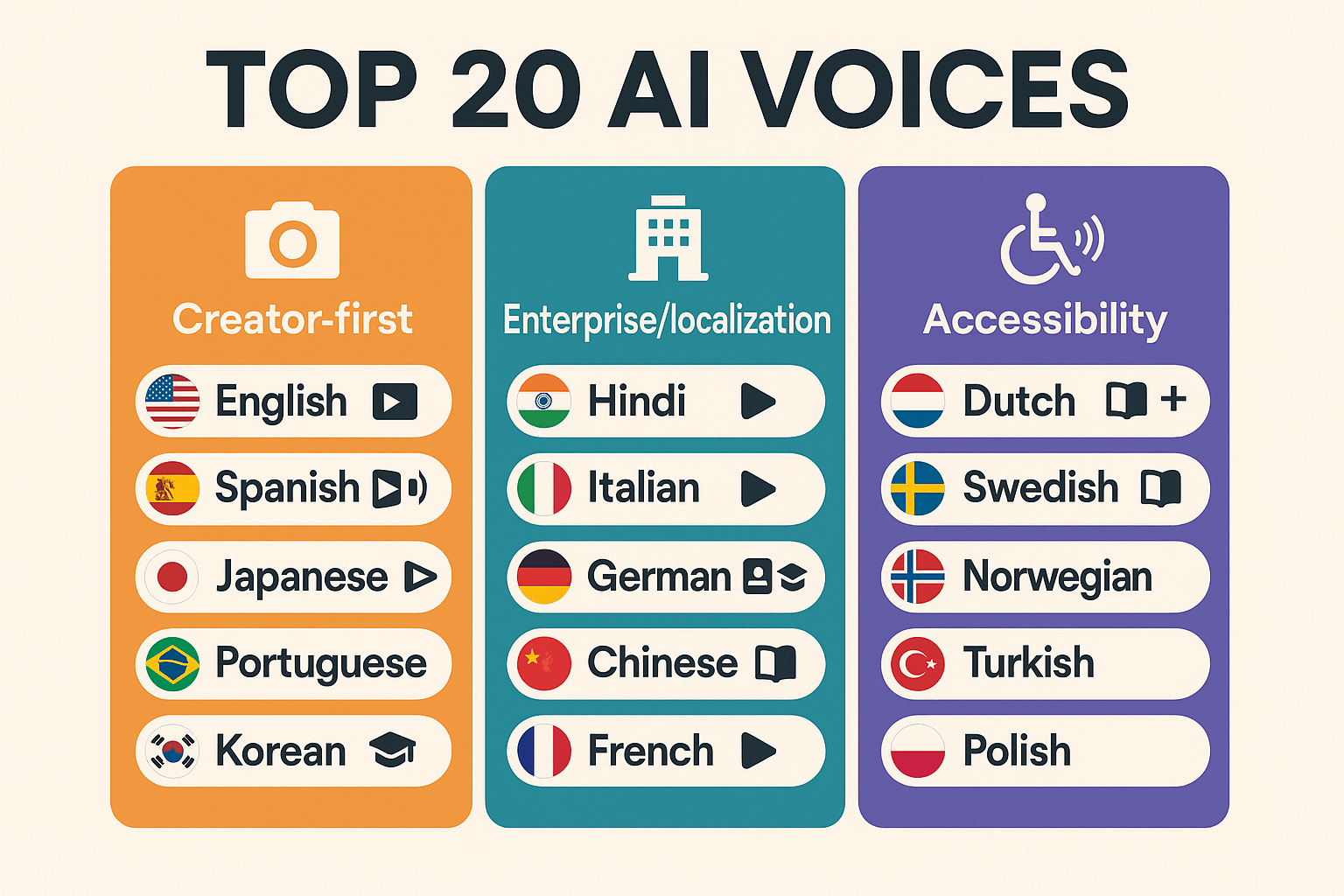
Top 20 requested AI voices (ranked) — the list and short profiles
Ranked Top 20 voices
-
English (US), high-demand neutral voice for global reach. Cover British, Australian, and Indian English variants. Use cases: YouTube dubbing, ads, e-learning, and audiobooks.
-
Spanish, neutral Latin American variant preferred by creators. Add Mexican, Castilian, and Colombian accents for regional fit. Use cases: creators, marketing localization, and social shorts.
-
Portuguese, Brazilian Portuguese leads requests. Include European Portuguese for EU audiences. Use cases: product explainers, podcasts, and regional ads.
-
Mandarin Chinese, standard Putonghua for Mainland audiences. Add Cantonese for Hong Kong and southern China. Use cases: e-learning, app narration, and video localization.
-
Hindi, growing demand for native conversational voices. Support Hinglish (Hindi-English mix) for creators. Use cases: short-form video, kiosks, and training modules.
-
Japanese, natural rhythm and polite/formal styles matter. Offer casual and formal tone variants. Use cases: anime localization, tutorials, and IVR (phone) prompts.
-
French, Parisian French is primary demand drivers. Provide Canadian French as a top regional variant. Use cases: e-learning, corporate narration, and ads.
-
Arabic, Modern Standard Arabic (MSA) for wide reach. Include Egyptian and Levantine dialects for regional authenticity. Use cases: social dubbing, news summaries, and accessibility.
-
German, clear standard German is in steady demand. Add Swiss and Austrian variants for regional nuance. Use cases: technical training, product demos, and podcasts.
-
Korean, natural conversational tone is key. Offer formal and casual registers for different formats. Use cases: creator dubbing, tutorials, and consumer apps.
-
Russian, clear standard Russian for CIS audiences. Include softer regional accents for authenticity. Use cases: e-learning, audiobooks, and regional advertising.
-
Indonesian, Bahasa Indonesia for Southeast Asia creators. Use neutral Jakarta accent for mass appeal. Use cases: short videos, educational content, and marketplaces.
-
Turkish, Istanbul Turkish is most requested. Offer both formal and friendly voice styles. Use cases: product explainers, localization, and podcasts.
-
Vietnamese, Northern and Southern variants both matter. Prioritize Ho Chi Minh and Hanoi tones for local reach. Use cases: social media clips, training, and IVR
-
Italian, standard Italian for creators and brands. Offer regional warmth for storytelling use. Use cases: narrations, travel content, and ads.
-
Polish, standard Polish drives demand in EU markets. Add casual and professional styles for e-learning. Use cases: corporate localization and audiobooks.
-
Thai, Bangkok Thai is the primary request. Tone and politeness register are important. Use cases: app narration, creator clips, and training.
-
Dutch, Netherlands Dutch is most requested. Add Belgian Dutch (Flemish) for regional campaigns. Use cases: podcasts, product videos, and e-learning.
-
Bengali, Bangla for Bangladesh and West Bengal audiences. Prioritize natural conversational delivery. Use cases: community content, short courses, and voice assistants.
-
Swedish, clear neutral Swedish for Nordic markets. Support both formal and friendly tones. Use cases: corporate e-learning, product demos, and podcasts.
Quick rollout checklist for these voices
-
Start with neutral standard variants for the largest markets. Keep the voice natural and consistent.
-
Add 2 regional accents per language for high-engagement markets. Test with small creator cohorts.
-
Match voice style to use case, for example warm tones for audiobooks, crisp tones for e-learning.
Language & regional insights — accents, dialects, and priority markets
EMEA: Prioritize local variants, not just languages
APAC: Coverage breadth matters more than a single premium voice
LATAM: One language, many accents and use-case drivers
North America: Accent diversity and accessibility focus
High-demand non-English languages and underserved markets
-
Yoruba and Swahili for African education and commerce.
-
Bengali and Tamil for South Asian e-learning.
-
Bahasa Minang and Tagalog regional variants for Southeast Asian creators.
Why accent and dialect support matters for adoption
-
Higher engagement: audiences respond better to familiar rhythms and vocabulary.
-
Faster approvals: reviewers approve localized drafts without major edits.
-
Brand trust: consistent local tone protects brand voice across markets.
Headroom for product and go-to-market choices
-
Tier 1: Large markets with many creators and limited local voices. Example: Hindi, Indonesian, Brazilian Portuguese.
-
Tier 2: Medium markets with strong creator communities. Example: Mexican Spanish, Egyptian Arabic, Vietnamese.
-
Tier 3: Niche but strategic markets. Example: Swahili, Bengali, regional Indian languages.
|
Region
|
Top immediate languages
|
Product action
|
|
EMEA
|
Arabic (Egyptian, Levantine), French (EU & Africa), Spanish (Castilian)
|
Dialect packs, glossary support, audition tool
|
|
APAC
|
Mandarin, Hindi, Indonesian, Vietnamese
|
Script support, tonal tuning, style presets
|
|
LATAM
|
Mexican Spanish, Colombian Spanish, Brazilian Portuguese
|
Country-tagged voices, creator-focused samples
|
|
North America
|
US English variants, Canadian French, US Spanish
|
Accessibility presets, regional accent options
|
Implementation tips for roadmaps and GTM
-
Run short A/B tests on voice variants for the same script.
-
Offer a quick audition panel in the product and in marketing pages.
-
Track request volumes by country, not just language.
Final take
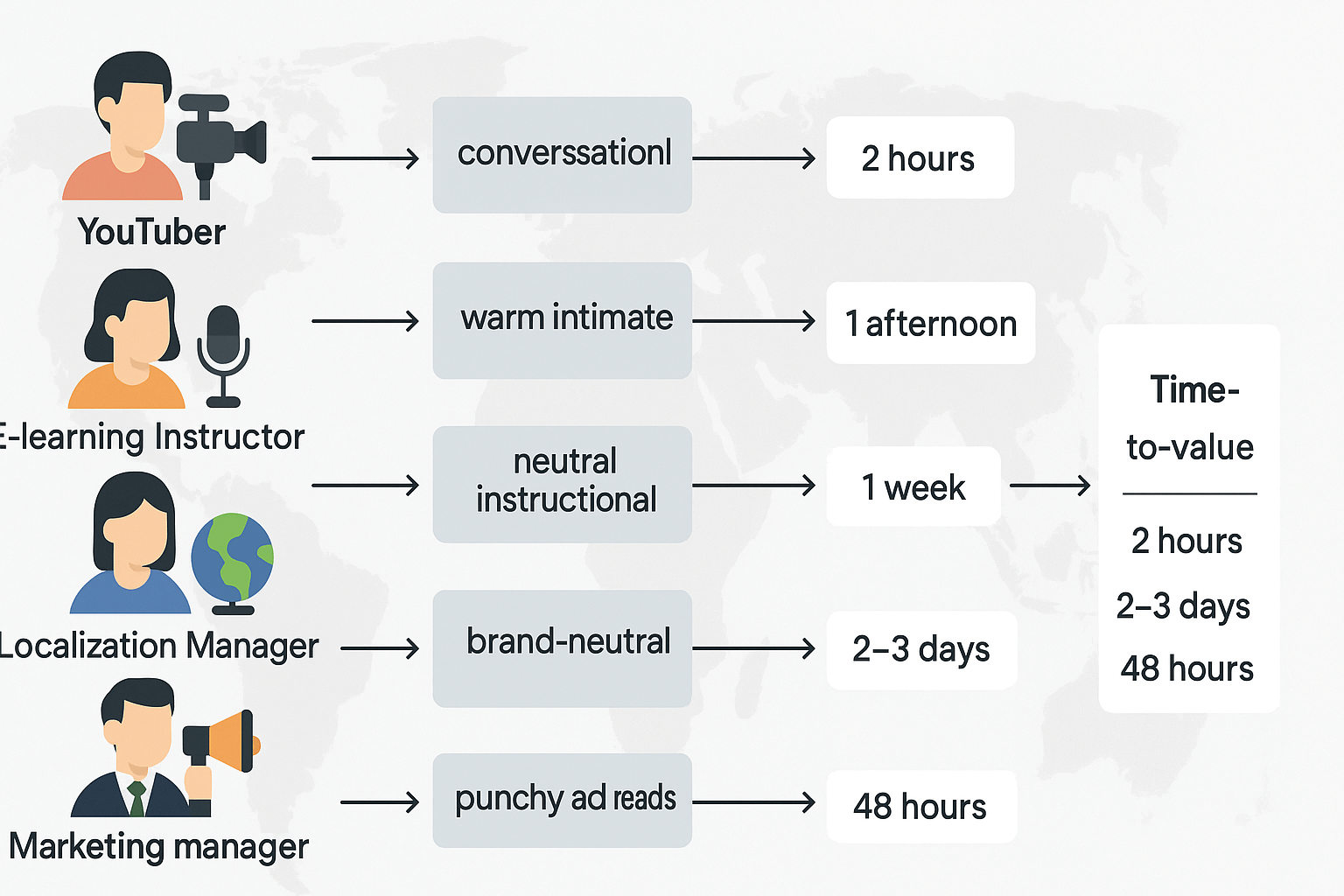
Use cases and personas — matching voices to producer needs
YouTubers: fast localization for evergreen content
-
Voice styles: upbeat conversational, character voices, neutral narrators.
-
Languages to prioritize: Spanish (Latin America), Portuguese (Brazil), Mexican Spanish, Hindi, Indonesian.
-
DupDub modules: AI Dubbing, TTS, AI Subtitles and Alignment.
Podcasters: clarity, intimacy, and consistent brand voice
-
Voice styles: warm narrators, interview read style, branded promos.
-
Languages to prioritize: English (US/UK), German, Japanese, Brazilian Portuguese.
-
DupDub modules: Voice Cloning, TTS, Record & Edit studio.
E-learning producers: clarity, pacing, and accessibility
-
Voice styles: neutral instructional, patient slow read, multilingual narrator.
-
Languages to prioritize: English, Spanish, French, Mandarin, Arabic.
-
DupDub modules: TTS (long-form), Voice Cloning, AI Subtitles, Speech-to-Text for captioning.
Localization managers: scale, control, and brand matching
-
Voice styles: brand-compliant neutral voices, locale-specific accents, legal/tone variants.
-
Languages to prioritize: English variants, Spanish variants, French (EU/CA), Portuguese (BR), Hindi, Arabic.
-
DupDub modules: API Access, Voice Cloning, AI Dubbing, Subtitles and Alignment.
Marketing teams: short-form ads and global campaigns
-
Voice styles: punchy ad reads, conversational influencers, authoritative announcers.
-
Languages to prioritize: English, Spanish, Brazilian Portuguese, German, Korean.
-
DupDub modules: TTS, AI Sound Effects, Talking Photo & Avatars for social formats.
Quick persona table
|
Persona
|
Recommended voice types
|
Top languages
|
Primary DupDub modules
|
|
YouTubers
|
Conversational, character, neutral narrator
|
Spanish (LatAm), Portuguese, Hindi
|
AI Dubbing, TTS, Subtitles
|
|
Podcasters
|
Warm intimate, promo reads
|
English variants, German, Japanese
|
Voice Cloning, TTS, Record & Edit
|
|
E-learning
|
Neutral instructional, paced reads
|
English, Spanish, Mandarin, Arabic
|
TTS (long-form), Voice Cloning
|
|
Localization managers
|
Brand-neutral, locale accents
|
English, Spanish variants, French, Hindi
|
API, Voice Cloning, AI Dubbing
|
|
Marketing teams
|
Punchy ad reads, influencer style
|
English, Spanish, Portuguese, Korean
|
TTS, AI SFX, Avatars
|
Matching voice features to workflows
-
TTS for drafts and short-form content, because it’s fast and cheap. Tip: generate A/B variants to test tone before cloning.
-
Voice cloning for branded reads, because it preserves your host identity. Tip: start with one signature voice, then expand to language variants.
-
AI dubbing for lip sync and video localization, because it keeps alignment intact. Tip: use subtitles alignment to speed editing.
-
API automation for volume workflows, because it reduces manual steps. Tip: build a simple pipeline to push translations, then pull localized files.
How to prioritize voices to add next
-
Map audience size by language. Pick the top three languages with the highest reach and engagement. Collect watch or play data first, not just assumptions.
-
Match voice style to top use case. If most content is tutorial video, prioritize neutral instructional voices. If short social ads drive revenue, pick punchy ad reads.
-
Run a 2-week pilot. Localize a sample video or episode, measure engagement lifts, and scale winners.
Final tips for fast wins
-
Start with TTS for non-customer facing assets, then swap to clones for final releases. This lowers risk and speeds QA. Keep pronunciation guides handy for brand names.
-
Use one cloned voice per persona to keep consistency. Don’t clone every variant at once. Focus on markets that prove lift.
-
Track outcomes. Measure watch time, completion, and conversion in each language. Small wins justify more localization.
Head‑to‑head comparison: DupDub’s language coverage & features vs. alternatives
Quick feature summary and what matters
Side-by-side vendor comparison table
|
Vendor
|
TTS languages
|
Voice catalog
|
Voice cloning
|
Dubbing / video
|
Avatars & visuals
|
Exports & workflows
|
Best fit
|
|
DupDub
|
90+ languages and accents
|
700+ voices
|
Multilingual clones, ~47 languages supported
|
End-to-end AI dubbing with subtitle alignment
|
Talking photo + avatars, 40+ languages
|
MP3, WAV, MP4, SRT, API, Canva integration
|
Fast video localization and creator workflows
|
|
ElevenLabs
|
50+ TTS languages (focus on English variants)
|
Large expressive catalog
|
Strong high-quality cloning, commercial focus
|
Basic integrations for audio, video via export
|
Limited native avatar features
|
Audio-first exports, API, fine-grained voice control
|
Audiobooks, podcasts, voice-first projects
|
|
Murf AI
|
40+ languages
|
Focused catalog for narration
|
Cloning available, business oriented
|
Integrates with simple video editors
|
Limited avatar features
|
Standard audio exports, simple studio workflow
|
E-learning, corporate narration
|
|
Play.ht
|
60+ languages
|
Many voices with custom styles
|
Paid cloning features
|
Exports for video projects via downloads
|
No native avatars
|
Audio and subtitle exports, simple API
|
Blogging, articles to audio, lightweight dubbing
|
|
HeyGen / Synthesia
|
30–60 languages depending on plan
|
Voice catalog tied to avatar library
|
Cloning limited, vendor-specific
|
Strong video dubbing, lip sync, avatar-led video
|
Rich avatar ecosystems
|
MP4-first, subtitle workflows, enterprise APIs
|
Marketing videos, avatar-led branded content
|
Why these differences matter
When DupDub accelerates localization
-
You need many target languages fast, plus aligned subtitles and re-voicing. DupDub reduces manual syncing.
-
You want to keep a brand voice across languages using voice cloning. DupDub supports cloning in many major languages.
-
You produce creator content and want avatars or talking photos, without multiple vendors and exports. DupDub bundles these features.
-
You need API-driven batch jobs to localize many videos. DupDub supports automation and direct integrations.
When a specialized vendor is a better fit
-
You need the very highest fidelity audiobook voice for long-form narration. Vendors focused on single-voice realism can outperform generalist platforms.
-
You require advanced voice-style transfer or custom acoustic modeling. Research-grade cloning vendors may offer deeper control.
-
You need enterprise-grade compliance beyond standard claims, with audited certifications. Some large vendors offer dedicated compliance and contract terms.
-
Your workflow is audio-first and you don’t need video or avatars. An audio specialist often offers a more focused studio and fine-tuned controls.
Pricing and plan fit for localization projects
Practical buying checklist
-
Language coverage match: Do they cover all target locales and accents?
-
Cloning scope: Can they clone your brand voice in needed languages?
-
Video tooling: Is subtitle alignment, lip sync, and re-voicing built in?
-
Output formats: Do they export the audio and subtitle formats you need?
-
Automation: Is there an API and batch processing for scaling?
-
Quality trade-offs: Is breadth more important than single-voice fidelity?
-
Compliance: Are contracts and privacy terms sufficient for your use case?
-
Cost model: Is it per-minute, per-credit, or subscription? Which is cheaper at scale?
Quick implementation tips
Closing comparison takeaway
Accessibility, ethics, and legal considerations for voice expansion
Require clear consent for cloning and voice reuse
-
Who gave consent (name, account, or company).
-
Date, scope, and permitted languages or channels.
-
Allowed uses: marketing, e-learning, accessibility, or internal demos.
-
Retention period and revocation method.
Make accessibility a first-class benefit
-
Better reach for neurodiverse learners and low-literacy audiences.
-
Faster consumption for commuters and mobile users.
-
Improved compliance for public sector and education projects.
Watch intellectual property and reputational risks
-
Unintended imitation of a celebrity, influencer, or actor: block or require written rights.
-
Unauthorized persona use in commercial ads: require legal sign-off.
-
Deepfake complaints: maintain takedown and dispute processes.
Follow region-specific data rules and pseudonymisation guidance
-
EU: Treat voice patterns as personal data. Keep records of processing, legal basis, and impact assessments. Offer data subject rights like deletion and portability.
-
UK: Mirror many EU rules, but watch local guidance for biometric and voice data.
-
US: Rules vary by state. Some states require consent for biometric voice data. Maintain per-state compliance checks.
-
APAC: Several countries have specific consent laws for voice and biometric data. Local counsel review is common.
Practical mitigation steps and consent workflows
-
Intake and risk triage: capture request metadata and risk level.
-
Consent capture: present plain-language consent and record the signer.
-
Processing controls: label the cloned voice with scope and retention tags.
-
Access controls: restrict production use to approved projects.
-
Audit and revocation: log usage and provide a clear revocation path.
-
Opt-in recording controls in UIs, with audio preview and clear consent buttons.
-
Watermarking or metadata flags embedded in generated files.
-
Role-based access and time-limited API keys.
-
Encrypted storage and authenticated export flows.
Corporate policy templates and example clauses
-
Consent clause: "I grant Company X the right to create and use a synthetic voice from my provided recording for the agreed uses. I can revoke this permission in writing."
-
Usage scope clause: "Synthetic voice may be used for [channels], in [languages], for up to [time period]. Commercial use requires additional written permission."
-
Revocation and deletion: "On revocation, Company X will stop issuing new content using the voice and will securely delete cloning artifacts within [30] days. Previously published material may not be retractable."
Quick checklist before launching a new language or voice
-
Signed consent exists for every cloned voice.
-
Legal reviewed likeness and IP risk for external voices.
-
Data handling meets regional laws and retention rules.
-
Accessibility tests pass screen reader and caption checks.
-
A revocation and takedown process is documented.
How to choose which voices to add next, a practical buyer’s guide
Use four scoring axes, and keep scores simple
-
Volume (demand): Estimate request share, support tickets, and inbound asks for the language. Higher request share earns a higher score.
-
Revenue potential: Estimate addressable revenue from that market or channel. Consider paid subscribers, ad rates, and partner demand.
-
Brand fit: Rate how well a voice supports brand tone, regional persona, and content types like e-learning or audiobooks.
-
Production complexity: Rate engineering, cloning, licensing, and QA effort. Lower complexity increases priority.
|
Axis
|
Weight (example)
|
|
Volume
|
35%
|
|
Revenue potential
|
30%
|
|
Brand fit
|
25%
|
|
Production complexity
|
10%
|
Quick scoring checklist you can use in a review meeting
-
Collect raw signals: request volume, search trends, and customer asks.
-
Pull revenue signals: subscribers, ARPU, ad CPMs, partnership leads.
-
Evaluate brand fit: legal, tone, dialect match, and existing voice family.
-
Estimate production complexity: minutes of training audio, STT/TTS quality, and QA hours.
-
Fill a 1–5 score for each axis, apply weights, and rank candidates.
-
Do we have at least three current requests or partner asks for this language?
-
Is the expected localization cost per minute below your threshold?
-
Can we deliver a brand-safe voice within two sprints?
-
Will this voice unlock a measurable revenue or engagement channel within 90 days?
Recommended metrics to gather and track
-
Request share: percent of total language requests for this language. Track weekly.
-
Engagement lift: change in watch time, completion rate, or clickthrough after localization, measured as percent change.
-
Localization cost per minute: all-in cost to produce localized content, in USD. Include voice engineering and QA.
-
Time to publish: elapsed days from request to first localized asset.
-
Conversion impact: change in trial or paid signups attributed to localized content.
Rollout roadmap: pilot, validate, scale
-
Pilot: pick 1 to 3 high-score languages for a controlled test. Localize 3 to 5 representative assets. Measure request share, cost per minute, and engagement lift. Run pilots for 4 to 8 weeks.
-
Validate: expand to 10 to 20 assets if pilots hit targets. Add A/B tests and regional ads. Validate brand fit and operational handoffs. Update scoring weights based on pilot results.
-
Scale: automate ingestion, add voice variants (accents/dialects), and train customer-success teams. Roll voice support into product plans and pricing tiers.
-
Engagement lift >= target (for example 5 percent).
-
Localization cost per minute below threshold.
-
No critical legal or brand safety blockers.
Prioritization formula, plain and repeatable
Implementation tips and governance
-
Create a language intake form. Capture request source, business owner, target assets, and urgency.
-
Use a central dashboard, updated weekly, with the recommended metrics.
-
Assign a triage owner who runs pilots and tracks costs.
-
Document legal checks and any required consent for voice cloning.
-
Run post-launch reviews after 30 and 90 days to update your priority list.
FAQ — People Also Ask, legal Qs, and implementation tips
-
Cloning availability by language for AI voice cloning
Most platforms support voice cloning in a subset of languages. Major languages are typically available first, with regional languages added over time. If you need a specific language, confirm support early and prioritize languages that match your target audience.
-
Data privacy safeguards for AI voice cloning and TTS
Look for vendors that offer encryption in transit and at rest, speaker-lock mechanisms, and clear data retention policies. Ensure cloning requires consent and that voice data is tied to the original account. Always verify how long raw audio is stored.
-
Estimated time to localize a video with AI dubbing
Short clips (1–5 minutes) can often be processed within an hour once scripts are ready. Longer videos or projects requiring manual review typically take several hours to a full day. Always include time for quality checks and subtitle alignment.
-
Credits and pricing basics for DupDub localization
Credits are usually charged per minute or per word, depending on the feature. Free trials provide starter credits, while paid plans increase available usage and voice quality options. Track usage with small test files to estimate ongoing costs.
-
Best practices to preserve brand voice in TTS and dubbing
Create a clear voice brief covering tone, pacing, and example lines. Use the same voice or clone across projects, review outputs in context, and adjust prosody or style settings. Maintain a short style guide for translators and editors.
-
Legal considerations: consent and rights for voice cloning
Always obtain written consent from the speaker before cloning a voice. Review local laws regarding voice and likeness rights, especially for commercial use. Keep a permissions log and store signed releases for compliance.
-
How to request a new language or voice for localization
Contact your vendor with details such as target language, use case, and sample scripts. Ask about roadmap timelines and API support if needed. Tracking requests helps you plan localization rollouts more effectively.

 Discord
 YouTube
 Tiktok
 Twitter
 Facebook
 Instagram