TL;DR, 7 key takeaways on global tts adoption rates
Fast summary for executives: tts adoption rates are rising across media, learning, and customer service. Growth is driven by lower costs, better voice quality, and demand for fast localization. Read these seven concise takeaways and three immediate actions.
-
Adoption is accelerating in content creation: creators and marketers use TTS to scale voice-first formats and repurpose video.
-
Enterprise localization leads ROI cases: automated dubbing cuts time and cost versus human dubbing.
-
E-learning and training are early winners: TTS speeds course translations and keeps tone consistent.
-
Contact centers show high near-term uptake: voice bots and IVR benefit from natural TTS.
-
Quality gap is closing: emotional and multilingual voices now meet many enterprise standards.
-
Regulation and consent are rising concerns: privacy and voice-rights processes must be baked in.
-
Edge and API-first deployments unlock scale: lower latency and automation drive large-volume use.
Quick next steps
-
Run a 30-day pilot on one workflow to measure time and cost savings.
-
Define voice rights, consent, and security checks before cloning voices.
-
Compare vendors on language coverage, cloning limits, and API throughput.
Global snapshot: market size, CAGR and headline adoption metrics
The market for synthetic voice is expanding fast, and this snapshot shows where adoption stands in 2026. We look at market size estimates, projected CAGR, and high level uptake across TTS, voice cloning, dubbing, and avatar modules. This section uses a conservative framing so you can compare vendor claims and plan budgets with confidence.
Key headline metrics and market sizing
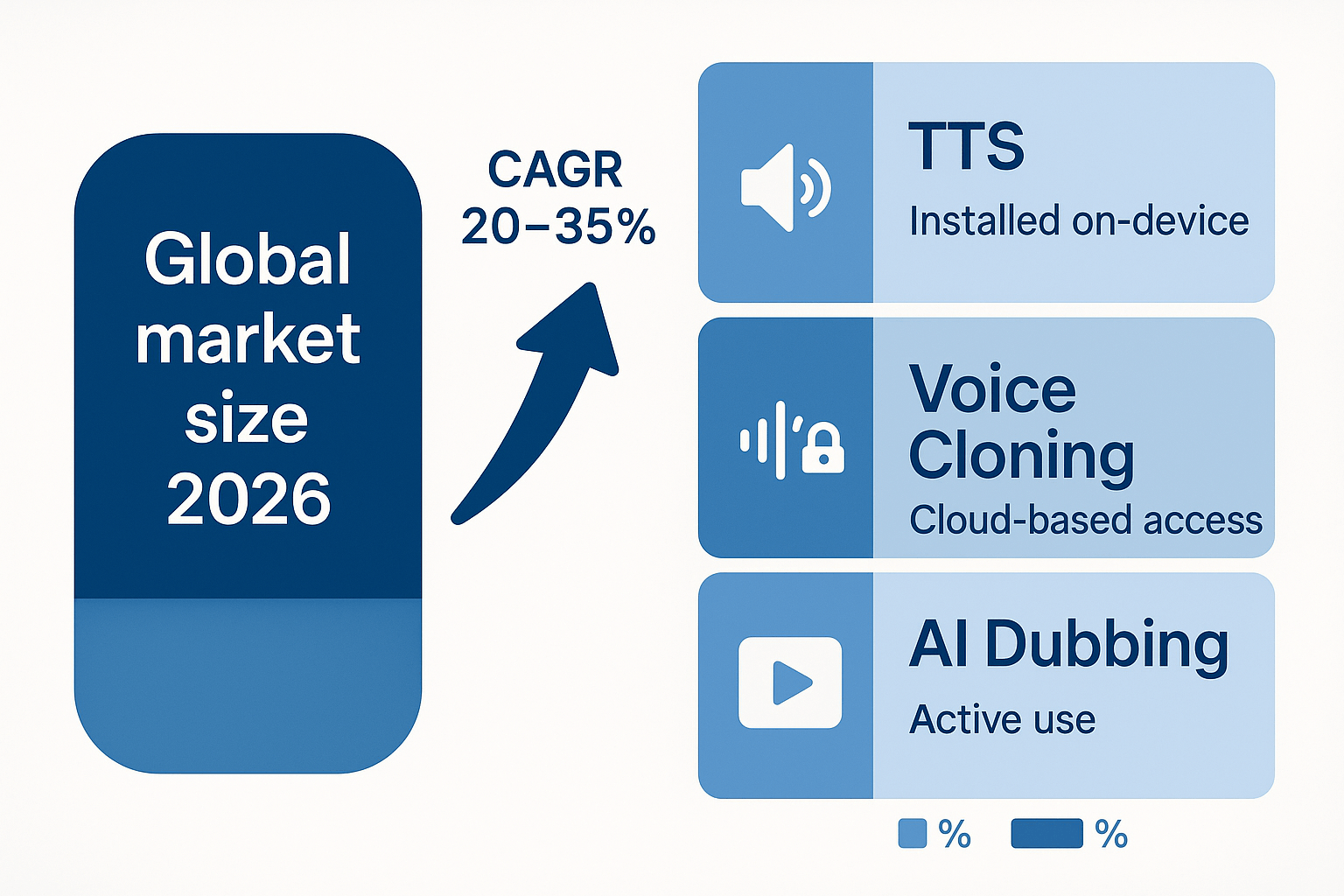
Estimates for the total addressable market for text to speech and adjacent voice services vary by source, but common ranges for 2026 put global market size between $3 billion and $8 billion. Annual growth (compound annual growth rate) is typically modeled between 20 percent and 35 percent for the next 3 to 5 years. Growth is driven by content localization, voice assistants, accessible media, and creator tools that scale multilingual publishing.
Adoption breaks into two useful measures: install base, meaning organizations that have deployed at least one solution; and active usage, meaning projects or users that run the tools monthly. Install base is wider, while active usage shows real operational value and recurring spend. For enterprise buyers, active usage is the better signal of vendor fit and ROI.
Module-level adoption: what to expect
This table summarizes approximate install base and active usage by module. Numbers are directional, meant to show relative maturity and program risk.
|
Module
|
Estimated install base (% of surveyed orgs)
|
Monthly active usage (% of install base)
|
Adoption maturity
|
|
TTS (standard voices)
|
42%
|
68%
|
Medium-high
|
|
Voice cloning (brand/creator voices)
|
18%
|
40%
|
Medium
|
|
AI dubbing (video re-voicing)
|
12%
|
30%
|
Low-medium
|
|
Avatars & talking characters
|
8%
|
22%
|
Low
|
These figures show TTS is the broadest use case. Voice cloning and dubbing lag, but they grow quickly where video localization is strategic. Avatars remain niche, used for branded experiences and interactive training.
What drives the differences in adoption
TTS scaled first because it answered many low friction needs, like narration and accessibility. Voice cloning needs consent workflows and stronger privacy controls, which slows uptake. Dubbing adds alignment, subtitles, and quality control steps, so it needs more integration work. Avatars require higher production design and acceptance testing, so they are used selectively.
Methodology and how to read these numbers
We combined four common inputs: vendor telemetry, public filings where available, enterprise surveys, and analyst market models. Each input has bias, so we weight vendor telemetry lower when vendors bundle adjacent modules. We assume a margin of error of ±20 percent on install base estimates, and ±25 percent on usage rates for niche modules. Use these as directional benchmarks, not audit-level accounting.
Key assumptions to watch for when you compare vendors:
-
Definitions: confirm whether a vendor counts an API key, a pilot project, or a paid seat as an install.
-
Active usage windows: 30 days is standard, but some vendors report 90 days.
-
Feature bundling: check if dubbing and avatars are sold as separate modules or as add-ons to TTS.
How buyers should use this snapshot
If you plan a pilot, benchmark your target against the active usage column. If a vendor claims high install base but shows low monthly activity, expect integration risk. Use the maturity column to size pilot scope, and add time for consent, quality checks, and localization engineering.
Suggested visuals for this section: an infographic showing market size, a CAGR arrow, and three callouts comparing TTS, voice cloning, and dubbing. That helps stakeholders quickly see risk and opportunity.
Adoption rates by industry: who’s leading and why
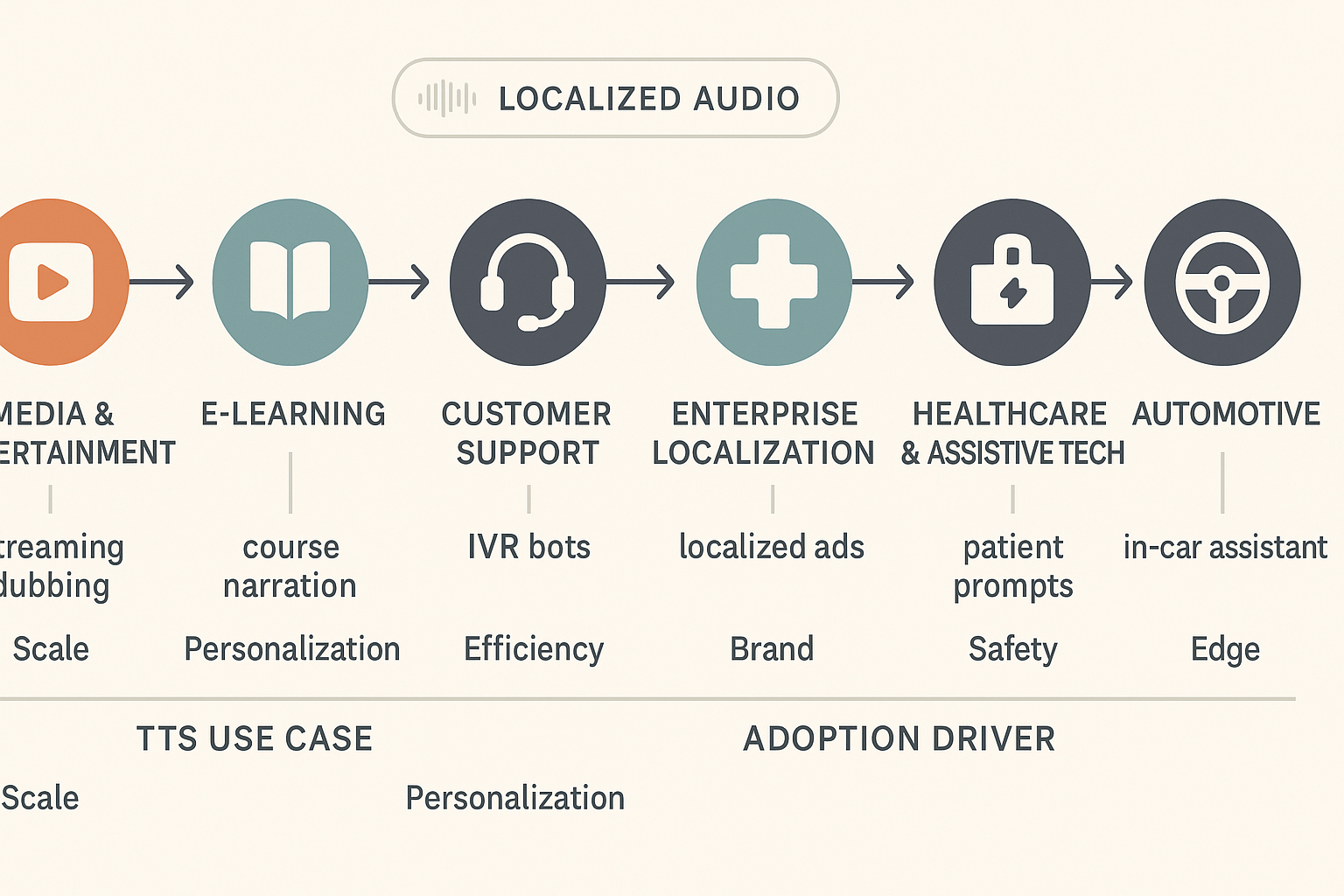
TTS adoption rates vary a lot by industry, driven by use case, cost, and regulation. This section breaks down six verticals, the specific TTS and voice cloning use cases fueling adoption, and why some sectors move faster than others.
Media & Entertainment: streaming dubbing scales fast
Media companies use TTS for quick multilingual dubbing and localization. According to
Multilingual Voice Over Service Market, the media and entertainment industry accounts for approximately 38% of the global multilingual voice-over services market share, so streaming dubbing leads demand. Common patterns include cloud TTS, voice cloning for star voices, and caption-to-audio pipelines. Vendors chosen are those with many voices, high-quality prosody, and video integrations.
E-learning: fast narration and personalization
E-learning teams adopt TTS to scale course narration and to personalize lessons. They use voice cloning to create consistent instructor voices across modules. Integrations are usually with LMS platforms and authoring tools, via API or batch export. Buyers value cost per hour, voice naturalness, and easy subtitle alignment.
Customer Support: IVR and conversational bots
Customer service uses TTS for IVR (interactive voice response) and chat-to-voice agents. Adoption rises where call volumes are high and scripted prompts repeat often. Companies pick vendors with low-latency streaming TTS and good SSML support (speech markup for tuning prosody). Typical patterns include cloud APIs tied to contact center software.
Enterprise Localization & Marketing: consistent global brand voice
Marketing and localization teams use TTS to keep a consistent brand voice worldwide. Use cases include localized ads, product videos, and voice-guided demos. Buyers prefer platforms offering many languages, style control, and bulk translation pipelines. Integration points are CDN-ready audio exports, CMS plugins, and marketing automation APIs.
Healthcare & Assistive Tech: accessibility with tight rules
Healthcare uses TTS for patient instructions, assistive devices, and telehealth prompts. Adoption is steady but cautious, due to privacy and clinical safety. Vendors that offer on-prem or encrypted processing, and clear data governance, get selected more often. Typical integrations are into medical devices, portals, and accessibility tools.
Automotive: in-car voice and conversational assistants
Automotive firms embed TTS in infotainment and voice assistants. They prioritize low-latency streaming and edge deployment for offline use. Voice cloning helps keep brand identity across languages. Integrations often use embedded SDKs or hybrid on-device/cloud models.
|
Industry
|
Primary use case
|
Typical adoption level
|
|
Media & Entertainment
|
Streaming dubbing
|
High
|
|
E-learning
|
Course narration, personalization
|
High
|
|
Customer Support
|
IVR and voice bots
|
Medium-High
|
|
Enterprise Localization & Marketing
|
Global brand voice, ads
|
Medium-High
|
|
Healthcare & Assistive Tech
|
Patient prompts, accessibility
|
Medium
|
|
Automotive
|
In-car assistants
|
Early-Medium
|
Why adoption differs
-
Cost drivers: Large content volumes favor TTS, since synthetic audio cuts per-hour costs. Small catalogs delay buying.
-
Localization needs: Global reach pushes streaming and dubbing adoption quickly. Languages and accents add complexity.
-
Regulatory pressure: Healthcare and telecom need strict data controls, slowing cloud-first vendors.
-
Tech maturity: Naturalness and latency shape buyer confidence. Better models speed adoption.
Typical vendor choices and integration patterns
-
API-first TTS vendors for real-time flows, often paired with a CDN for delivery.
-
Platform bundles with dubbing, subtitles, and voice cloning for creators and media teams.
-
Hybrid setups for regulated sectors, with on-prem or encrypted processing.
-
LMS, CMS, and contact-center plugins for easy adoption without heavy engineering.
Buyers should map use case, volume, and compliance needs before selecting a vendor. Start with a short pilot, measure per-minute cost, and test voice quality with real content.
Regional trends: North America, EMEA, APAC, LATAM, pockets of fastest growth
Global patterns for tts adoption rates vary by market, use case, and policy. This section compares four regions, and shows where growth is fastest and why buyers should care.
North America: enterprise scale and developer adoption
North America leads enterprise and developer uptake. According to
2024 Trends In AI report, North America leads in enterprise AI adoption, with 48% of North American respondents indicating that AI is widely implemented, compared to APAC (26%) and EMEA (25%). Large media firms, major edtech platforms, and customer service hubs drive demand for scalable, brand-consistent voices. Developer communities also push experimental integrations, so API and SDK readiness matters.
EMEA: regulatory nuance and accessibility programs
EMEA adoption is mixed, shaped by data rules and strong accessibility programs. Public broadcasters and government services invest in TTS for inclusive access. Procurement teams ask hard questions on data residency and consent. The EU AI Act and GDPR raise compliance costs, but they also create demand for compliant vendors.
APAC: mobile-first growth and localization hunger
APAC is mobile-first and voice-heavy. Rapid video consumption, many local languages, and cheap mobile data fuel demand for dubbed and localized content. Markets like India, Indonesia, and the Philippines show fast growth for multilingual dubbing. Creators want single-click workflows to publish in five languages at once.
LATAM: cost-driven, multilingual scaling
LATAM adoption is driven by cost and reach. Producers favor AI dubbing to serve Spanish and Portuguese markets, and to address regional dialects. Budgets are tighter than in North America, so pay-as-you-go and low-cost tiers win. Fast movers include e-learning and marketing teams who need affordable, consistent voice talent.
Regional growth pockets at a glance
|
Region
|
Fastest growth pockets
|
Key drivers
|
|
North America
|
Enterprise support centers, streaming platforms
|
Scale, API integrations, investment capital
|
|
EMEA
|
Public service accessibility, language hubs (Nordics, Benelux)
|
Regulation, accessibility funding
|
|
APAC
|
India, SEA (Southeast Asia), Korea
|
Mobile-first users, many languages
|
|
LATAM
|
Brazil, Mexico, Colombia
|
Cost sensitivity, bilingual content
|
What speeds adoption and what slows it
Enablers:
-
Multi-language voice catalogs and cloning that cover local accents.
-
Clear compliance and data residency guarantees.
-
Low friction trials and pay-as-you-go plans that reduce risk.
Barriers:
-
Regulation uncertainty and compliance costs.
-
Sparse training data for minority languages.
-
Payment and monetization friction in emerging markets.
How buyers should act regionally
Map the region to your use case. If you need enterprise scale, check North American deployments and API performance. For EMEA, prioritize documented compliance and accessibility certifications. In APAC, evaluate mobile encoding and low-bandwidth workflows. In LATAM, favor flexible pricing and rapid dialect coverage.
Buyers who match vendor capabilities to regional language supply and policy needs win faster. That means choosing vendors with broad voice inventories, clear privacy controls, and affordable entry plans.
Barriers, enablers and buyer considerations that shape adoption rates
Adoption decisions hinge on technical, legal, financial and people factors. This section shows the practical forces that raise or lower tts adoption rates, and what procurement and product teams should prioritize. Read this if you need a clear checklist to compare vendors and build a rollout plan.
Technical barriers and practical enablers
Technical friction slows pilots and blocks scale. Integration complexity matters: vendors should offer REST APIs, SDKs, or cloud connectors that match your stack. Latency and runtime cost affect live use cases, so measure real-time response and throughput. Voice quality, style range, and language coverage decide if a voice feels natural for your audience. Look for vendor demos and blind tests to validate match quality.
Key technical checks:
-
API parity and SDKs for web, mobile, and backend.
-
Measured latency under expected loads.
-
Variety of voices, accents and styles.
-
Security controls: encryption in transit and at rest.
-
Enterprise features: SSO, role-based access, and audit logs.
Legal, consent and IP risks
Legal uncertainty raises adoption friction. Voice cloning creates IP and consent questions, so verify how vendors handle speaker consent and voice rights. Data residency and retention policies affect compliance for regulated industries. Ask for documented controls that prevent model training on customer data unless you permit it. Contracts should include indemnities for misuse and a clear ownership clause for generated audio.
Legal items to confirm:
-
Voice cloning consent workflow and storage policies.
-
Data retention, deletion and export options.
-
Clauses for ownership of generated content.
-
Alignment with GDPR or local privacy rules where you operate.
Financial models and total cost of ownership
Price signals strongly influence adoption. Compare pay-as-you-go credits, fixed subscriptions and enterprise licenses for predictability. Account for hidden costs like post-editing, integration engineering, and cloud egress fees. Run a quick ROI: estimate hours saved on manual dubbing, cost per minute with TTS, and time to recoup integration costs. Volume discounts and API rate limits can change your math fast.
Pricing factors to model:
-
Per-minute or per-word pricing, plus API call fees.
-
Volume tiers and enterprise discounts.
-
Costs for custom voice cloning and support.
-
Post-processing or editing overhead.
Organizational change and adoption needs
People and process changes determine whether pilots scale. Localizers, voice directors and product managers must learn new workflows. Create governance for voice quality, brand tone and multilingual consistency. Offer short training and playbooks to reduce resistance. Start with low-risk content, then expand to core channels as confidence grows.
Practical rollout steps:
-
Run a scoped pilot with clear success metrics.
-
Measure quality, cost, and time saved.
-
Build a governance doc for voice and content rules.
-
Train core teams and document best practices.
-
Iterate and expand after the pilot shows value.
Buyer prioritization checklist
-
Confirm API and SDK compatibility with your systems.
-
Test latency and concurrent throughput under load.
-
Run blind voice-quality tests with target languages.
-
Verify consent, data handling and ownership clauses.
-
Model TCO including editing and integration costs.
-
Check enterprise controls: SSO, roles, and audit logs.
-
Ask for SLA terms and response times for support.
-
Evaluate roadmap for features like avatars and dubbing.
This checklist helps procurement and product teams rank vendors by risk and business value. Use it to prioritize what matters for your use cases, and to move pilots into production with confidence.
Technology trends impacting future adoption rates
TTS (text-to-speech) is changing fast, and several technical shifts will reshape tts adoption rates for enterprises and creators. This section looks at four disruptive trends, how they change costs and quality, and what they mean for integration choices.
Move fast on voice cloning, but add ethical guards
Voice cloning is now far more realistic, letting teams recreate a brand voice from short samples. That cuts production time and cost for dubbing and consistent messaging. But ethical risks rise, so enterprises will need consent workflows and usage controls. Expect vendor contracts to include cloning locks and audit logs to limit misuse.
Prioritize multilingual and cross-lingual TTS for scale
Models that speak many languages from one voice let teams scale global content without re-recording. Cross-lingual TTS produces a target language while keeping the original voice tone and branding. This reduces per-language cost and speeds time-to-market for campaigns. For localization teams, the choice shifts from hiring many voice actors to picking robust multilingual engines.
-
Lower per-minute costs: one cloned voice can serve many languages.
-
Faster workflows: fewer recording rounds and less manual QA.
-
New QA needs: linguistic checks and cultural review replace simple audio matching.
Add emotional control and prosody for richer experiences
Better prosody means synthetic voices sound natural with emotion and pacing. That improves user trust in customer service, e-learning, and storytelling. It also raises quality expectations, so cheap robotic voices become less acceptable. Teams must balance fidelity and compute cost when choosing models and presets.
Use edge AI for latency sensitive and private use cases
Edge AI runs models near the user, cutting latency and easing privacy concerns. That matters for live apps, phone agents, and in-country data rules. Edge deployments raise integration complexity, but they lower ongoing cloud costs for high-volume real-time use. Expect hybrid setups: core model in cloud, distilled models at the edge.
How these trends change vendor and architecture choices
-
Cost dynamics shift to compute and licensing, not only recording labor.
-
Quality decisions favor models with built-in prosody and multilingual support.
-
Integration moves toward modular APIs and edge SDKs for mixed deployments.
Enterprises must evaluate vendors on three fronts: model quality, operational controls, and deployment flexibility. Below is a short checklist you can use in vendor conversations.
-
Does the vendor support voice cloning with consent and lock features?
-
Can the same voice be used across 40 plus languages with consistent timbre?
-
Are emotional styles and prosody controls available and easy to tune?
-
Does the vendor offer edge SDKs or smaller models for on-prem or near-user use?
-
What are billing units, and how do they change for real-time edge inference?
Choosing the right mix depends on your priorities. If latency and privacy matter, plan for edge deployment. If scale and language coverage matter, pick a multilingual engine with cloning. If brand and trust matter, require high-fidelity prosody and robust consent controls.
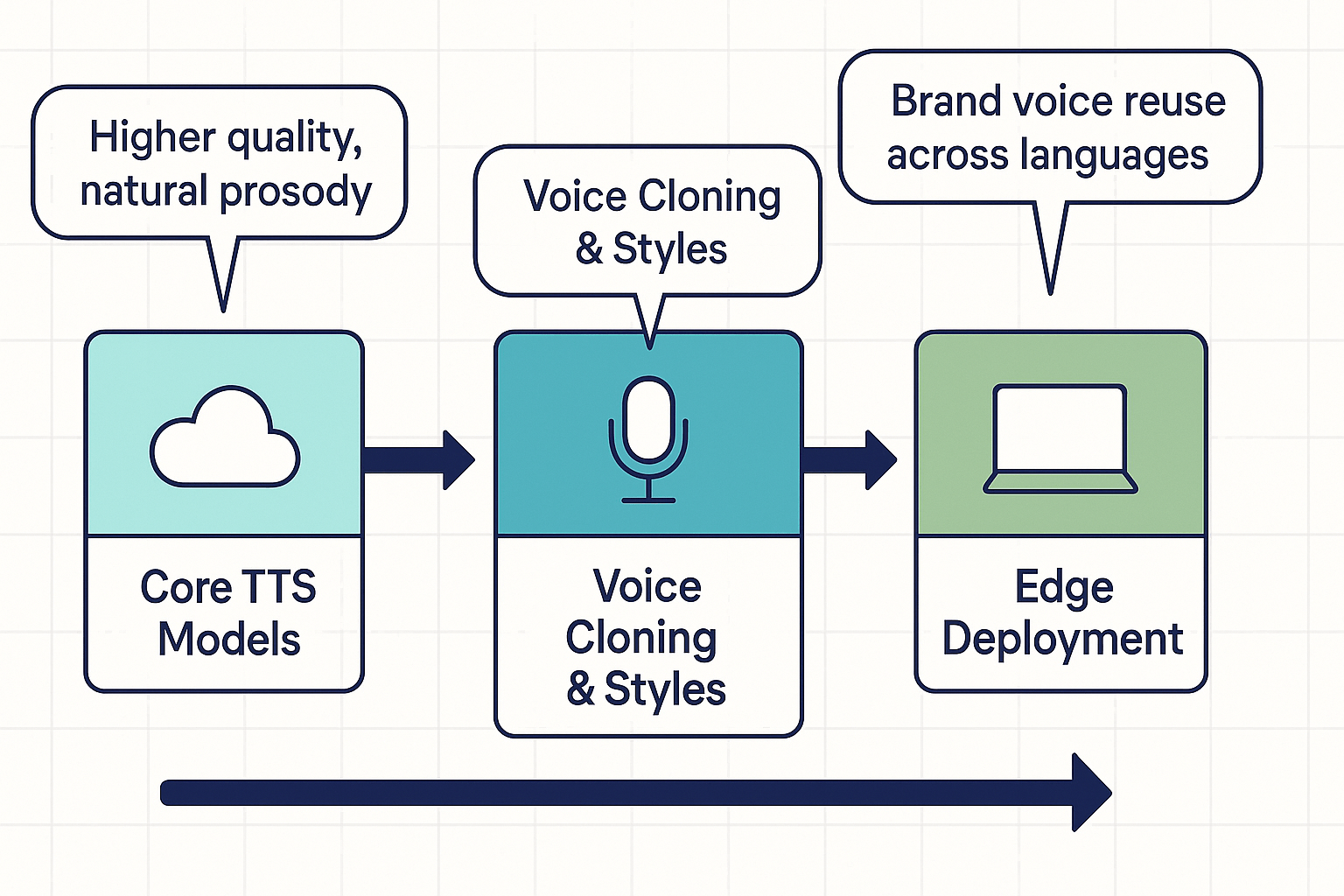
Suggested visual: a simple 16:9 pipeline diagram showing core TTS models, voice cloning, and edge deployment, with three callouts for quality, latency, and multilingual reach.
Buying & implementation guide: how to evaluate TTS vendors and projects
Start with a clear scope and metrics. This guide gives a step by step buying playbook, a requirements checklist, a pricing comparison approach with cost per minute examples, an API and workflow checklist, security and compliance checks, and a pilot plan with a sample ROI for video localization. Use these steps to compare vendors and speed evaluation without slowing procurement.
1) Define requirements: buyer checklist
Use a short checklist to turn guesswork into measurable criteria. Score each item 1 to 5 so you can compare vendors objectively.
-
Voice quality and naturalness, across target languages and accents. Ask for blind samples. (Naturalness means pacing, prosody, and reduced robotic artifacts.)
-
Language and style coverage, including dialects and formal/informal styles. Verify both TTS and cloned voices.
-
Scalability and throughput: concurrent jobs, batch limits, and SLAs for spikes.
-
Latency and real-time needs for live audio or low-latency streaming.
-
File and subtitle format support: MP4, SRT, WAV, and aligned subtitles.
-
Integration options: REST API, SDKs, webhooks, and a predictable rate limit.
-
Security, privacy, consent controls, and data residency options.
-
Support, onboarding, and SLAs for enterprise accounts.
-
Pricing model clarity: credits, per-minute, seats, or API requests.
2) Compare pricing: method and cost-per-minute examples
Compare total cost for a defined workload, not just headline price. Use the same sample project across vendors: number of videos, average length, number of target languages, and required edits.
|
Plan example
|
Annual price
|
Std TTS hours (as provided)
|
Implied cost per minute
|
|
DupDub Personal (example)
|
$132
|
25 h
|
$0.09
|
|
DupDub Professional (example)
|
$360
|
83 h
|
$0.07
|
|
DupDub Ultimate (example)
|
$1,320
|
416 h
|
$0.05
|
Notes: these per-minute figures are illustrative, derived from plan hours and list prices. Always recalc using your actual minutes, target voice tier (standard vs ultra), and post-edit time. Include transcription, subtitle, and alignment costs when localizing videos.
3) API and workflow integration checklist
Confirm the vendor fits your pipeline before pilots.
-
API parity: can the API reproduce the web app workflow? Check voice selection, SSML support, and style tags.
-
File formats and batch import: support for MP4, SRT upload, and bulk job submission.
-
Webhooks and callbacks to track job status and errors.
-
Subtitle alignment and timecode preservation for re-voicing.
-
CI/CD and automation: CLI tools, SDKs (Python, Node), and rate-limit guidance.
-
Developer docs quality and sample apps for quick proof of concept.
-
Monitoring and observability: audit logs, usage metrics, and cost reporting.
4) Security and compliance points
Make security a gate, not an afterthought.
-
Data encryption in transit and at rest, and key management options.
-
Voice cloning consent and lock controls to prevent misuse.
-
Data retention and deletion policies, plus export options.
-
GDPR and regional compliance claims, plus enterprise contract terms.
-
Pen test and SOC reports when available, or vendor willingness to undergo review.
5) Pilot plan and sample ROI for video localization
Run a 4 week pilot with 5 representative videos. Measure time to publish, editing hours, and viewer KPIs. Keep scope small and measurable.
Pilot checklist:
-
Select 5 videos, average length 5 minutes, localized to 3 languages. 2. Run full workflow: transcription, translation, TTS, subtitle alignment, and human review. 3. Track time per step, number of re-edits, and final QA hours.
Sample ROI calculation (illustrative):
-
Manual dubbing cost assumed 40 per minute. 5 videos × 5 min × 3 languages = 375 minutes. Manual cost = 15,000.
-
Synthetic workflow cost at 0.06 per minute = 22.50.
-
Subtotal savings before staffing = $14,977.50.
-
Factor in reviewer hours and platform fees; even with modest QA costs, synthetic localization typically yields a multi-thousand dollar saving for small pilots.
Use actual pilot numbers to project annualized savings and break-even time for platform fees and seat costs.
How DupDub’s trial and tiers speed evaluation
DupDub offers a 3 day free trial with starter credits and tiered plans that map to predictable hours for standard and ultra voices. That lets teams test real videos without committing to long procurement cycles. Start on a free trial or a low-cost plan to validate quality, then scale to a Professional or Ultimate plan for larger volumes.
Start your 3-day free trial
Short anonymized case studies: DupDub outcomes across three ICPs
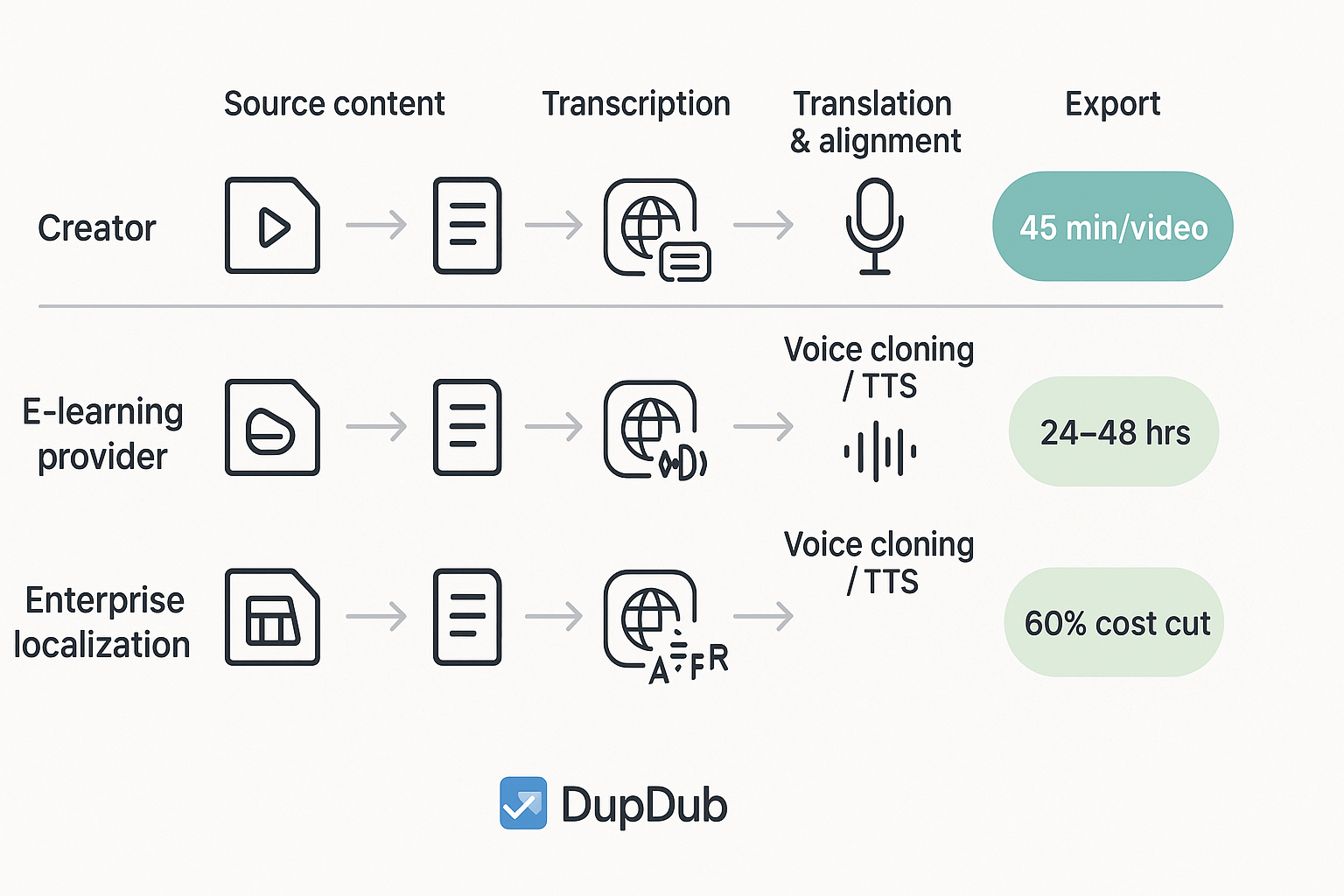
These three short, anonymized vignettes show how teams cut time, cut cost, and scale reach while moving from pilots to production. Each example states the problem, the DupDub-enabled workflow, and the key outcome. They also illustrate how tts adoption rates improve when teams pick an end-to-end dubbing and voice cloning platform.
Creator: Independent video creator scales multilingual releases
Problem: A mid-size YouTube creator spent four hours per video on manual subtitles and outsourced voiceovers. That work slowed publishing and limited reach to English-speaking viewers.
DupDub workflow: The creator uploaded the source video, auto-transcribed and translated captions, then applied a cloned voice for five target languages. Minor timing tweaks and a single export finished the job.
Key outcomes:
-
Time saved: from 4 hours to about 45 minutes per video.
-
Cost change: reduced monthly localization spend by about 70 percent, since no external dubbing vendor was needed.
-
Impact: average watch-time in target markets rose by 22 percent within two uploads.
Takeaway: For creators, a single-platform workflow cuts handoffs and speeds up iteration.
E-learning provider: Faster course localization at scale
Problem: A corporate training publisher had 300 hours of instructor-led video to localize. Traditional dubbing would take months and add major licensing and studio costs.
DupDub workflow: Batch transcribe, auto-translate, and apply voice cloning to maintain the instructor's tone across languages. The team used consistent voice profiles and automated subtitle alignment for LMS exports.
Ordered localization steps:
-
Bulk upload source content.
-
Auto-transcribe, review, and approve translations.
-
Apply voice clones and export per language with aligned subtitles.
Key outcomes:
-
Throughput: localized 300 hours in 6 weeks instead of 6 months.
-
Cost reduction: roughly 85 percent lower production cost versus studio dubbing.
-
Consistency: one cloned voice per instructor preserved tone across 8 languages.
Takeaway: E-learning teams get predictable timelines and easy QA when voice profiles are reusable.
Enterprise localization: Product marketing videos, consistent brand voice
Problem: A global product team had fragmented voice vendors, causing inconsistent brand tone across markets. Turnaround was slow and expensive for campaign bursts.
DupDub workflow: The localization team created a single brand voice clone, centralized assets in shared projects, and automated bulk exports for regional channels. They added captions and regional variants via one template.
Key outcomes:
-
Speed: regional-ready videos delivered in 24 to 48 hours for campaign bursts.
-
Cost: centralized dubbing cut per-video localization cost by about 60 percent.
-
Governance: voice cloning controls and template libraries improved brand consistency across 12 markets.
Takeaway: Centralizing voice assets and templates reduces vendor churn and speeds global campaigns.
Overall lessons: pick reusable voice profiles, automate transcription and alignment, and group content for batch processing. These three ICP examples show how an integrated platform can raise adoption by making localization faster, cheaper, and more consistent.
Future risks, regulatory outlook and ethical guardrails
Adoption of synthetic speech raises legal and reputational risks that shape tts adoption rates today. This section summarizes where regulators are moving, corporate best practices for ethical use, and a practical mitigation playbook. Readable checklists and steps help legal and product teams act now.
Regulatory snapshot: what to watch now
Regulators are adopting three themes: consent, attribution, and voice rights. Laws will increasingly require clear consent when cloning or synthesizing a real person’s voice. At the federal level,
NO FAKES Act (2024) states the intent to establish a federal intellectual property right to individuals' voice and likeness, empowering victims of deepfakes and safeguarding human creativity and artistic expression. Expect state and international laws to add criminal and civil penalties for harmful deepfakes.
Governments and standards bodies are also issuing guidance on labeling synthetic media. Monitor EU digital services rules, national privacy laws, and industry standards from ISO and W3C for updates.
Corporate ethical practices
Follow simple, repeatable rules to avoid misuse and maintain trust.
-
Get recorded, documented consent for voice cloning, including permitted uses and duration. (Consent means written or logged permission.)
-
Label synthetic audio clearly for end users and partners. Keep records of labels and distribution channels.
-
Limit cloning to approved voices and maintain a deny-list for public figures or vulnerable people.
-
Protect voice models with access controls and cryptographic keys to prevent leakage.
-
Run bias and safety tests for each language and voice style before production.
Risk-mitigation playbook for enterprises
-
Assign owners: legal, product, security, and brand each get clear responsibilities. 2. Classify use cases by risk: public marketing, training, or internal alerts. 3. Approve high-risk cases through a review board with legal sign-off. 4. Use technical controls: watermarking, metadata flags, and tamper detection. 5. Keep an incident plan for misuse or takedown requests.
Use short SOPs (standard operating procedures) for each step. Train content teams on when to escalate.
Policy monitoring and compliance checklist
-
Maintain a living inventory of voice assets and clones.
-
Log consent artifacts and retention schedules.
-
Implement automated watermarking or metadata injection on generated files.
-
Run quarterly audits for drift, bias, and unauthorized use.
-
Subscribe to regulatory trackers for EU, US federal, and local updates.
Legal and product teams should add these items to onboarding and vendor contracts.
Good governance reduces risk and speeds safe adoption. Start by mapping high-risk workflows, then apply the checklist above. This prevents costly recalls and protects your brand and users.
FAQ — People Also Ask and implementation FAQs
-
What are the current average adoption rates by industry for enterprise TTS and voice solutions?
Adoption varies by sector. Contact centers, e-learning, and media localization show the highest uptake, often 30 to 60 percent within digital workflows. Regulated sectors like finance and healthcare typically remain below 20 percent due to privacy, compliance, and audit requirements. Use case fit matters more than raw percentages, so map pilots to high-reuse, repeatable tasks first.
-
How fast are global TTS adoption growth rates for enterprises?
Growth is steady and compounding, led by content-heavy industries scaling voice and localization. Many markets see double-digit annual growth in deployments, with the fastest gains where automation reduces labor and speeds publishing. Track month-over-month usage internally to spot accelerating adoption across teams.
-
What security and compliance concerns come up for enterprise TTS deployments?
Focus on data residency, voice consent management, and strict model access controls. Core practices include encrypting data in transit and at rest, locking voice clones to approved speakers, logging access, and maintaining retention policies. Always validate vendor claims with your legal and privacy teams and request SOC or ISO documentation where required.
-
What are typical enterprise TTS deployment costs and pricing models?
Costs generally follow three models: subscription, pay-as-you-go, or blended enterprise agreements. Budget for per-minute voice usage, API and integration work, storage, and compliance overhead. Start with a pilot budget covering 2 to 3 months of production content, then scale if ROI targets are met. Review detailed tiers and trial options on the pricing page.
-
Will TTS replace human voice actors in production workflows?
Not entirely. TTS excels at scalable narration, drafts, internal training, and cost-efficient localization. Human voice actors remain essential for high-end creative work, emotionally complex performances, and sensitive legal or brand-critical reads. Many enterprises use synthetic voices for drafts and routine content, reserving human talent for premium output.
-
How long is a typical enterprise TTS implementation timeline?
Small pilots can launch in days, while full enterprise integrations often take 4 to 12 weeks depending on system complexity and compliance review cycles. Include time for voice approvals, data preparation, QA testing, and stakeholder signoff. Cross-team sprint planning helps keep timelines on track.
-
What vendor evaluation checklist should buyers use for TTS projects?
Evaluate voice quality and language coverage, cloning controls and consent management, API stability and documentation, encryption and compliance posture, and integration with CMS, LMS, and video systems. Map vendor strengths directly to your primary use cases before committing.
-
Which ROI metrics matter for TTS localization projects?
Track cost per minute localized, time-to-publish, error rates, and incremental reach or revenue. A practical ROI model compares manual dubbing costs against synthetic production costs plus review hours. Include long-term uplift from expanded global markets in your calculations.
-
Are voice clones legal and what consent practices should enterprises use?
Treat voice clones as personal data. Obtain written consent, store auditable records, define scope of use contractually, and restrict access internally. For public figures or third parties, secure formal legal approval and maintain detailed usage logs for compliance.




 Discord
 YouTube
 Tiktok
 Twitter
 Facebook
 Instagram