


TL;DR: What agencies need to know about TTS and multilingual accessibility
Deploying multilingual TTS (text-to-speech) helps agencies reach people who rely on spoken content. For public digital services, tts gov means turning notices, web pages, IVR prompts, and video into natural speech across priority languages to reduce barriers and boost uptake.
Run a low-risk pilot in 30 to 90 days. Start small: pick 2–3 target languages, choose an API or hosted widget, do a privacy and consent check, prepare 10–20 real prompts or pages, and run quick user tests with target communities.
Track a few clear metrics to decide next steps: reach (unique users served), comprehension (short surveys), task completion (form submissions or benefit claims), and time to resolution. Also monitor error rates, privacy incidents, and per-minute cost. Use two-week sprint reports to iterate or scale.
Why multilingual accessibility matters for public services
Public services fail when people can't understand how to apply, enroll, or appeal. Multilingual audio, clear TTS narration, and synced subtitles cut that friction. For digital teams, tts gov tools make spoken guidance and video help available in many languages fast.
Equity and outcomes
Language access is an equity issue. Clear audio and captions let low-literacy users, older adults, and people with limited English skills act on benefits. That raises uptake and trust, and it lowers repeat contacts.
Common, measurable benefits include:
-
Higher program uptake and fewer abandoned applications.
-
Fewer phone calls and in-person visits, saving staff time.
-
Fewer errors in applications, reducing rework and fraud risk.
-
Faster time-to-service, improving timely benefit delivery.
Legal and practical drivers
According to ADA Requirements: Effective Communication, The Americans with Disabilities Act (ADA) requires that state and local governments communicate effectively with people who have communication disabilities, ensuring that communication is as effective as with others. Beyond ADA, many federal and state language-access policies require reasonable steps to provide information in languages people use.
Standards matter too: follow WCAG guidance for captions and multilingual content, and pair TTS with human review for high-stakes messaging. Practically, agencies that invest in multilingual speech and captions often see lower service costs and better compliance with civil rights obligations.
What 'tts gov' means in practice: tech, channels, and use cases
Public agencies use tts gov to turn written messages into spoken audio across services. Start by separating core capabilities: TTS (text-to-speech) for narration, STT (speech-to-text) for transcription, dubbing for video localization, subtitle alignment for synced captions, and voice cloning for consistent speaker identity. This plain mapping helps program teams pick the right tech for each channel.
Core components and channels
TTS (text-to-speech): IVR systems, web pages, and push notifications. STT (speech-to-text): phone intake, recorded interviews, and multimedia captions. Dubbing: outreach videos, training, and multilingual social content. Subtitle alignment: SRT exports for web video and accessible transcripts. Voice cloning: repeated agent messages and consistent narrator for training, with strict consent controls.
High-impact use cases and trade-offs
High-impact uses include:
-
Notifications: timely, low-latency voice alerts in multiple languages.
-
Eligibility guidance: step-by-step audio explanations for complex forms.
-
Training and workforce onboarding: localized video and narrated modules.
-
Outreach and community engagement: culturally relevant dubs and captions.
Trade-offs to weigh: latency versus fidelity, automated translation accuracy versus human review, and the localization effort for dialects and cultural nuance. Plan pilots that balance speed with quality, and test fidelity on representative samples.
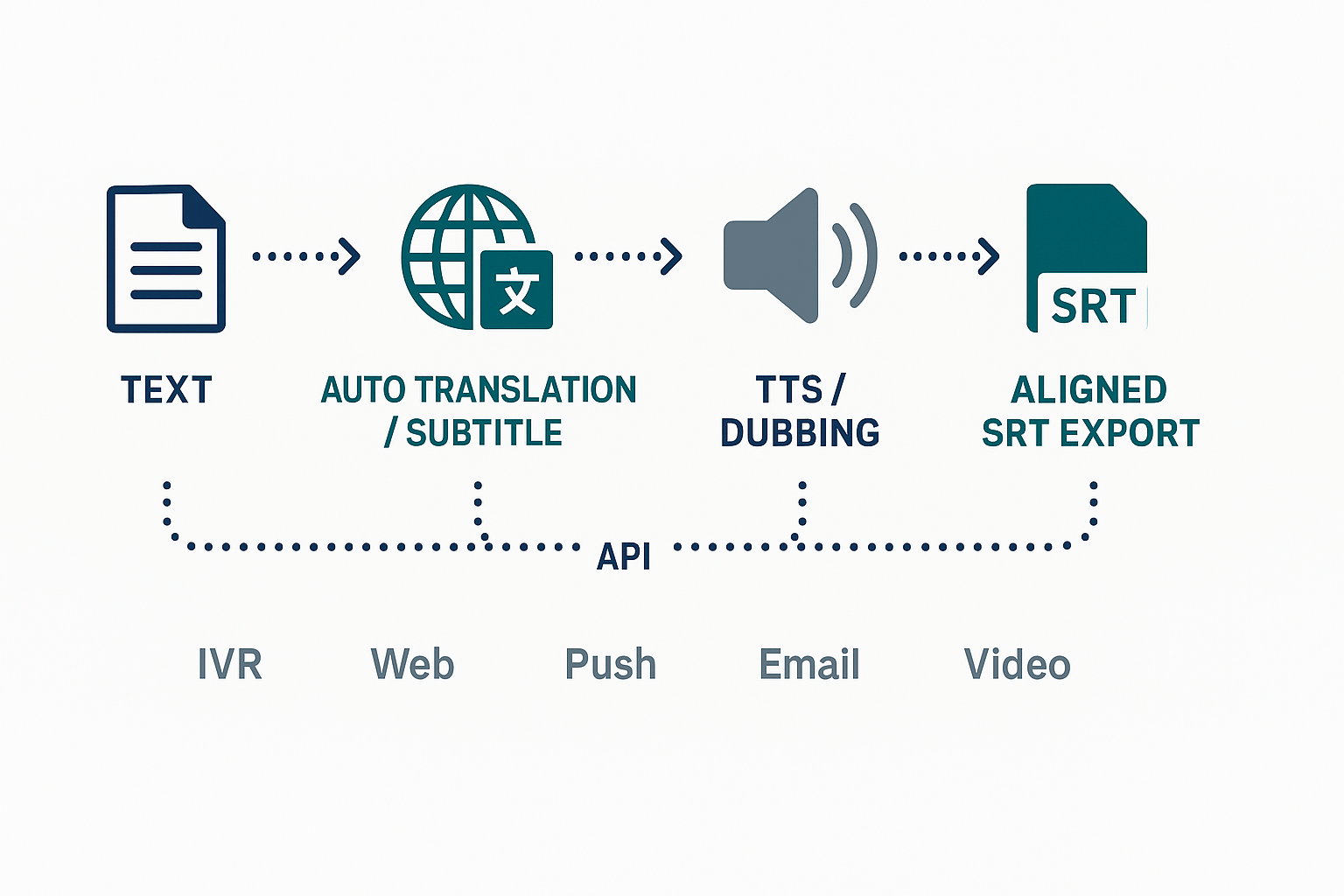
Why DupDub can fit government needs: features mapped to public-sector requirements
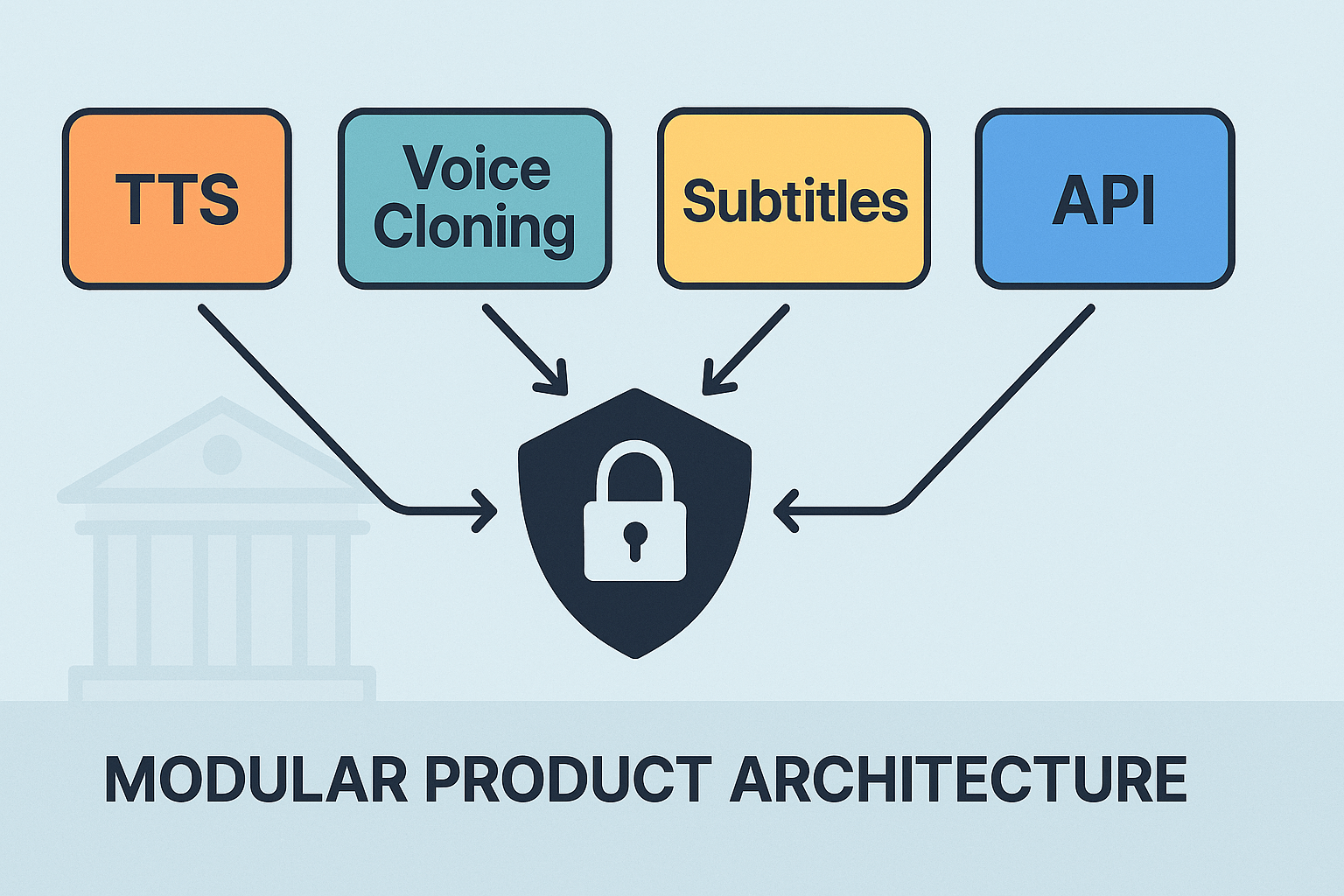
Multilingual text-to-speech is a practical tool for widening access to government services. For agencies exploring tts gov, the key questions are language coverage, accuracy of captions, voice-clone safety, and secure scaling. This section maps common public-sector requirements to DupDub capabilities, and explains how those features cut localization costs and speed pilots.
Match requirement: broad language and voice coverage
Agencies need high coverage for many languages and dialects. DupDub offers TTS in 90 plus languages and accents. That means you can serve common and less-common language communities without building many one-off pipelines. Wider coverage cuts per-message costs because you reuse one platform for many audiences.
Match requirement: subtitle alignment and editable captions
Accessible content needs tight subtitle timing (SRT files) and easy edits. DupDub exports SRT and aligns subtitles to speech automatically. That gives teams ready-to-publish captions, and saves transcription and timing work. Faster subtitle workflows shorten pilot timelines and reduce vendor coordination.
Match requirement: secure voice cloning controls
Some programs may need personalized voice options for outreach, but also strict consent and control. DupDub’s voice cloning is locked to the original speaker and includes guardrails (consent and usage controls). Those controls help meet ethical and privacy rules while enabling consistent voice experiences for communities.
Match requirement: APIs for automation and scale
Agencies want to automate messages across channels. DupDub provides API access for TTS, subtitles, and dubbing. API (application programming interface) workflows let digital teams generate audio for IVR, SMS audio links, and web pages at scale. Automation reduces manual steps and keeps messaging consistent.
Match requirement: security and procurement checks
Encrypted processing and stated GDPR alignment address basic data concerns. Still, agencies should verify enterprise-level SLAs, data retention policies, and export controls during procurement. Ask for written SLA terms, encryption-at-rest details, and a data processing addendum.
Quick benefits summary
-
Compliance support: language and consent features help meet accessibility laws.
-
Cost savings: one platform replaces multiple vendors and manual dubbing.
-
Faster pilots: SRT exports and APIs cut weeks from test runs.
DupDub maps directly to agency needs without forcing new custom builds. During procurement, validate SLAs and data policies, then use API-driven pilots to prove impact quickly.
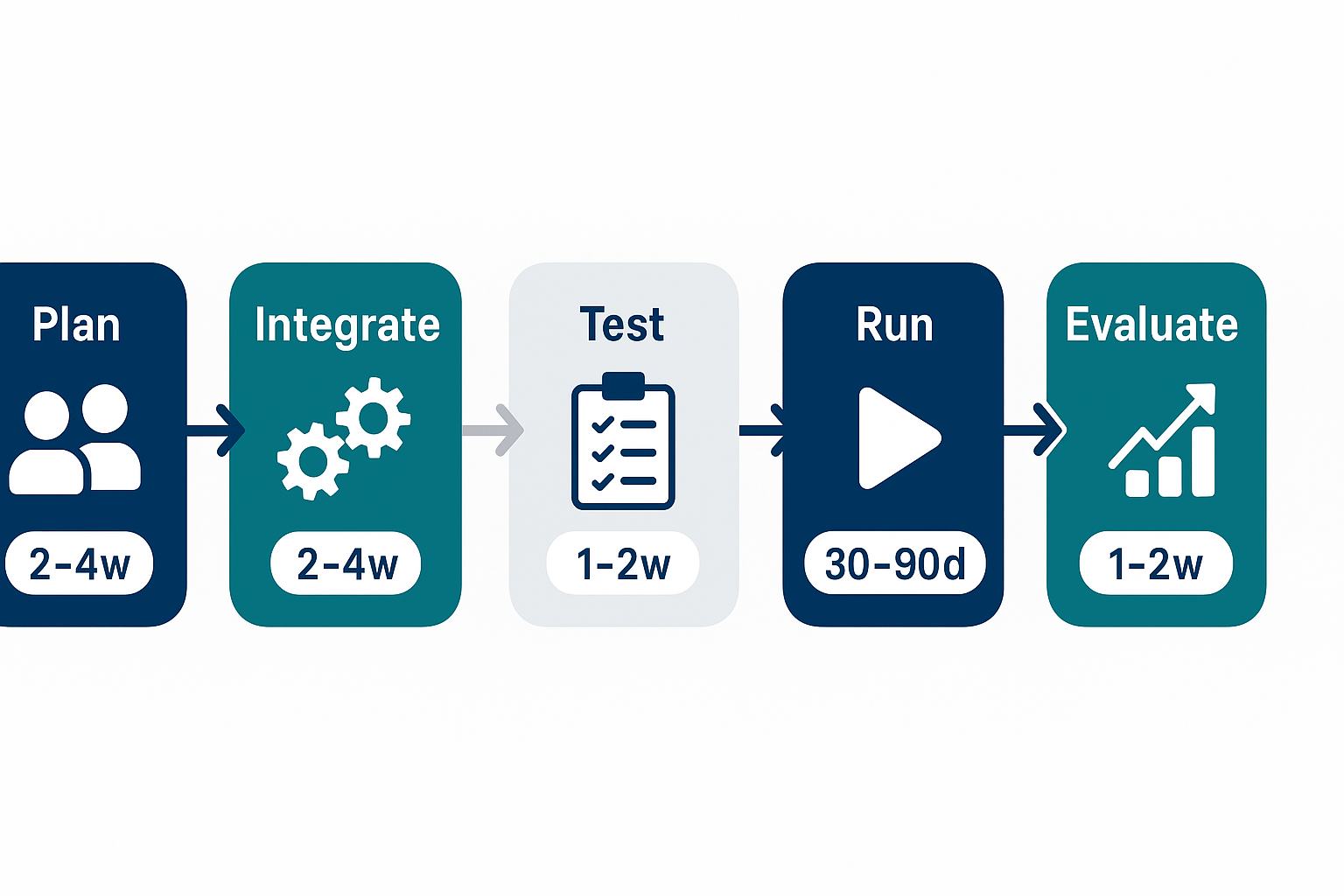
A step-by-step implementation roadmap for agency pilots
Start small, prove value, then scale. This roadmap shows how a government team can run a focused pilot for tts gov use cases, from aligning stakeholders and KPIs to a 30 to 90 day evaluation. It maps key actions, technical checks, privacy gates, and measurable success criteria so program managers can scope pilots for IVR, Notify.gov-style alerts, or web-native audio.
Plan: align stakeholders and define KPIs
Identify sponsors, data owners, and accessibility leads. Set 2 to 3 clear KPIs, for example reach (unique recipients), comprehension lift, and completion rate. Choose a narrow use case and channel: IVR (interactive voice response), emergency alerts, or on-page audio for applications.
Select content and scope small
Pick 5 to 10 representative messages or pages. Prefer short scripts, single-language originals, and consent-friendly user journeys. Decide success thresholds up front, and document fallback pathways for human translation.
Integrate: tech checklist
-
API access and authentication (test token flows).
-
SRT subtitle handling (upload, align, and export SRT files).
-
Audio formats (MP3, WAV) and video container needs (MP4 if used).
-
Endpoints for IVR or Notify-style push: audio file hosting, stream URLs, or SMS-with-audio links.
Include a privacy and consent review: confirm lawful basis, opt-in copy, voice-clone guards (if using cloning), and encryption at rest and in transit.
Test and pilot run
Run internal QA, then a live small cohort. Log delivery, playback success, and user feedback. Typical pilot length: 30 to 90 days depending on volume.
Evaluate: measure and decide
Collect KPI data, sample qualitative feedback, and error logs. Use a short decision memo: scale, iterate, or stop. Include recommended next steps and procurement notes.
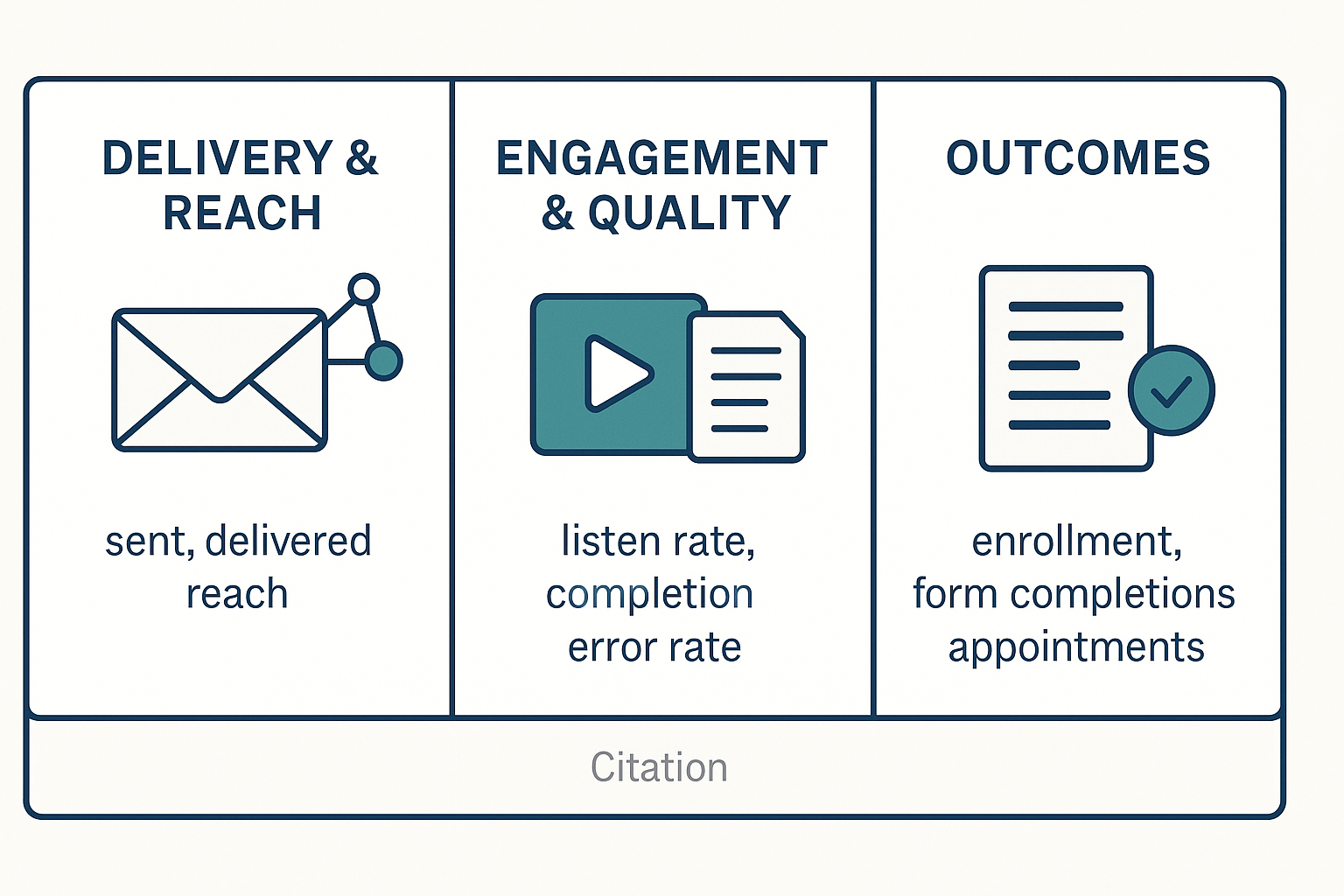
Measuring impact: suggested metrics, example case summaries, and data collection
Measuring success for tts gov projects means pairing delivery and reach with engagement, quality, and outcomes. According to A framework for digital health equity (2022), digital access, literacy, and infrastructure shape outcomes and should inform your measurement plan. This short playbook gives a tight metric set, two A/B test templates, and two anonymized pilot summaries you can replicate.
What to track: three metric groups
Track three clear buckets so results map to decisions:
-
Delivery & Reach: sent, delivered, delivery rate, unique recipients reached. These tell you coverage and technical success.
-
Engagement & Quality: play/listen rate, completion rate, subtitle reads, average listen time, transcript error rate (word error rate). These show whether recipients consume and understand audio content.
-
Outcomes: form completions, benefit applications submitted, appointment scheduling, call transfers avoided. These measure real service uptake.
Basic A/B test designs
-
Randomized user-level A/B: randomize eligible users to standard text notices or multilingual TTS messages. Compare completion and enrollment rates after 4 to 8 weeks.
-
Stepped-wedge rollout: phase in TTS by region or office. Use each site as its own control, then pool results for stronger causal claims.
For both designs capture baseline covariates, log delivery events, and predefine primary outcomes.
Short anonymized case summaries
-
County benefits pilot, N=1,200: added multilingual TTS audio to eligibility emails. Listen rate 48 percent, form completion rose 12 percent versus text-only.
-
Nonprofit call center pilot, N=600 callers: TTS callback messages cut call follow-ups by 18 percent and increased online intake starts by 9 percent.
Collect consent, minimize PII, and store hashes for deduplication. Use these metrics to power a decision: scale, iterate, or stop.
Technical & privacy considerations: integration patterns and risk mitigation
For agency teams evaluating tts gov tools, plan integrations and privacy controls together. Start with simple, testable patterns, and build safeguards for captions, cloning, and PII (personally identifiable information). This reduces risk and speeds approval.
Integration patterns to start with
Keep three practical workflows in your pilot plan: an API-first pipeline for programmatic TTS and asset management; batch SRT exports for subtitle alignment and human review; and realtime IVR streaming (WebRTC or SIP/RTP) for phone services. Each pattern has different latency, audit, and retention needs.
Caption alignment, consent, and encryption
Focus on caption alignment (timecodes and speaker tags) so transcripts map to audio and video. Require explicit consent for any voice cloning and capture a signed usage policy. According to Article 32 GDPR - Security of processing, Article 32(1)(a) of the General Data Protection Regulation (GDPR) mandates the pseudonymisation and encryption of personal data as appropriate technical and organisational measures to ensure a level of security appropriate to the risk.
Practical mitigations:
-
Use speaker-locked cloning: a cloned voice can only be created with verified source consent.
-
Retain transcripts minimally, purge after defined retention windows.
-
Encrypt data in transit and at rest, and log model inferences for audit.
-
Redact or pseudonymise PII before external processing where possible.
Verification steps and risk checks
Run a DPIA (data protection impact assessment), include NIST-aligned controls for federal systems, and require vendor evidence: SOC2, encryption specs, and a clear retention policy. Test a small pilot, review logs, then expand.
Best practices, common challenges, and ethical considerations
Start by centering users. For tts gov initiatives, pick voices that match dialects and local terms. Test with real users for clarity, naturalness, and comprehension. Always plan fallbacks like recorded human audio or language-specific hotlines when synthetic speech fails.
Prioritize language fit and user testing
-
Use dialect-appropriate voices and accents, not generic approximations.
-
Run short usability tests with native speakers and people with disabilities.
-
Validate screen reader, caption, and playback behavior in real-world conditions.
Manage ethical risks and set governance
Agencies should reduce synthetic-authority harm and bias with clear rules. Require consent flows when cloning voices or using personal data. Create a review board for voice approval and a schedule for ongoing bias testing. Log generation events and keep an appeal path for affected users.
Common challenges and practical fallbacks
-
Coverage gaps for low-resource languages and rare dialects.
-
Mispronounced names and domain terms.
-
Risk of deepfake misuse or impersonation.
Mitigations: use hybrid models, human-in-the-loop review, explicit voice labeling, and emergency fallback channels. Combine policy, testing, and user feedback to keep services accessible and trustworthy.
FAQs
-
How do we request a DupDub pilot or enterprise quote?
Email a procurement contact or use the vendor contact form. Include pilot scope, expected volume, target languages, and security needs.
-
What security and privacy standards apply to DupDub for government procurement?
Ask for a data processing addendum and encryption details. Confirm voice cloning consent controls and that processing is encrypted and not shared with third parties.
-
How do vendors and nonprofits get DupDub API access and technical onboarding?
Request API keys during trial sign-up or in your pilot consultation. Ask for sample integrations, rate limits, and a sandbox for testing.

 Discord
 YouTube
 Tiktok
 Twitter
 Facebook
 Instagram