tts mos is the human-ground truth score for perceptual voice quality. Run MOS when you need a defensible benchmark across voices, languages, or model versions. It finds artifacts and naturalness issues that automatic metrics often miss.
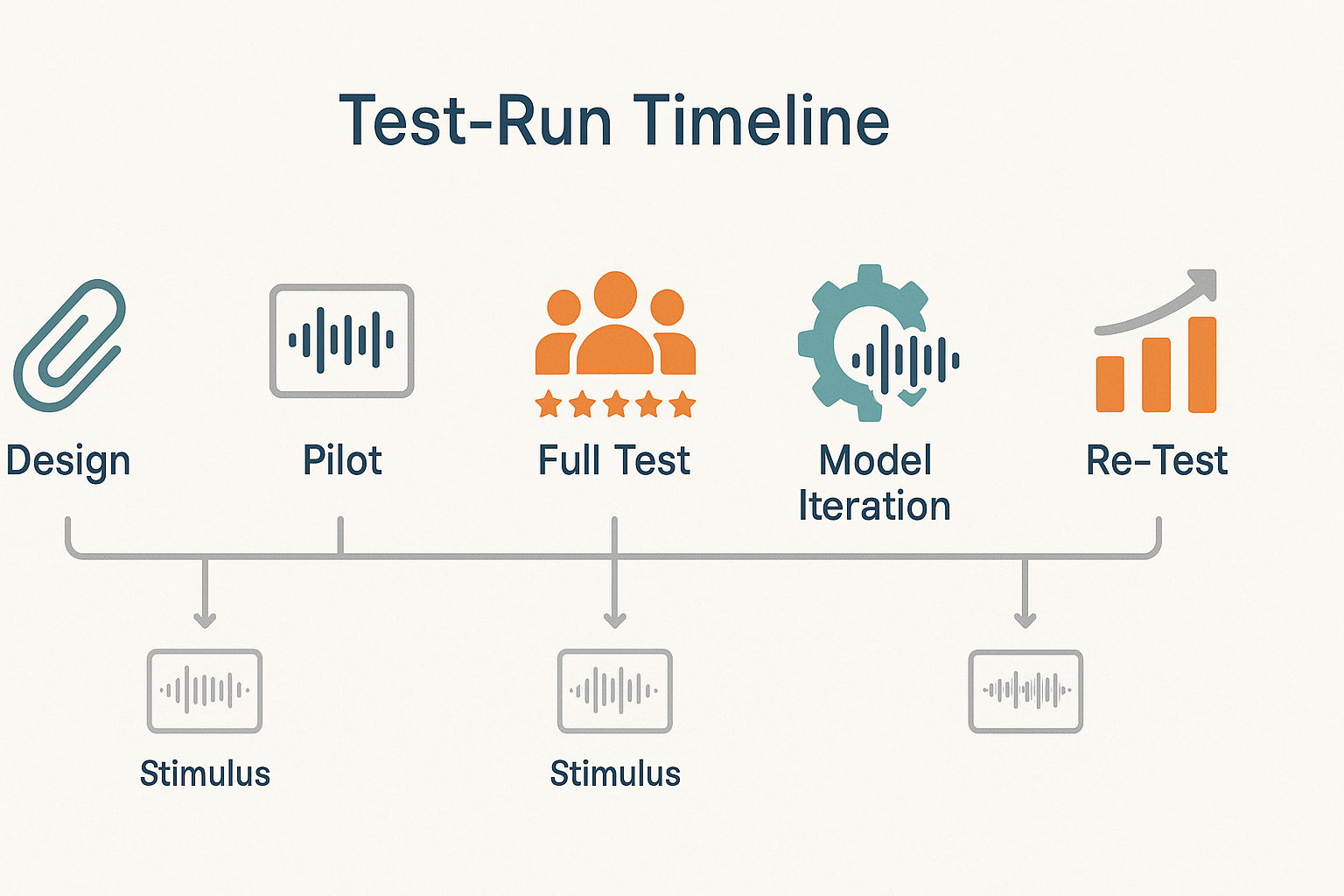
Run MOS at three moments: baseline (compare vendors), after major training or data changes, and before release. Small, early pilots catch regressions and save costly fixes later.
Pair MOS with objective metrics to speed triage. Use PESQ for distortion, MCD for spectral fit, and STOI for intelligibility; together they highlight likely root causes.
Action items:
-
Set product-specific MOS targets, for example 4.0+ for consumer-facing assistants.
-
Design tests with diverse listeners and aim for at least 30 unique ratings per clip.
-
Spin up a short 3-day free trial to generate test stimuli and speed pilot runs.
Mean Opinion Score, or MOS, is a simple listener scale for perceived speech quality. Test listeners rate short audio clips on a numeric scale, and the average score summarizes how natural and clear the voice sounds. For practical TTS teams, tts mos maps directly to user experience: it captures what real people actually hear, not just what an algorithm measures.
What MOS measures and why it still matters
MOS captures two human judgments in one number: naturalness and intelligibility. Naturalness is about prosody, timbre, and whether speech sounds human. Intelligibility is about how easily a listener understands the words. Automated metrics miss subtle rhythm, emphasis, or odd artifacts that make a voice feel synthetic, so subjective listening stays the gold standard for final-quality checks.
When to choose MOS versus telemetry or objective proxies
Use MOS for product-facing checks and release gates, like voice UX, dubbing quality, or brand voice approval. Run MOS on representative content types, accents, and noisy contexts you plan to ship. By contrast, use telemetry and objective metrics for fast iteration: automated proxies like MCD, PESQ, or word-error rates flag regressions and scale across thousands of samples.
Put simply: rely on objective metrics for development speed and broad coverage, and use MOS to validate real user perception before launch. That hybrid approach keeps engineering efficient, while ensuring the final model meets human expectations.
How MOS is calculated: test design, scales, sampling and stats
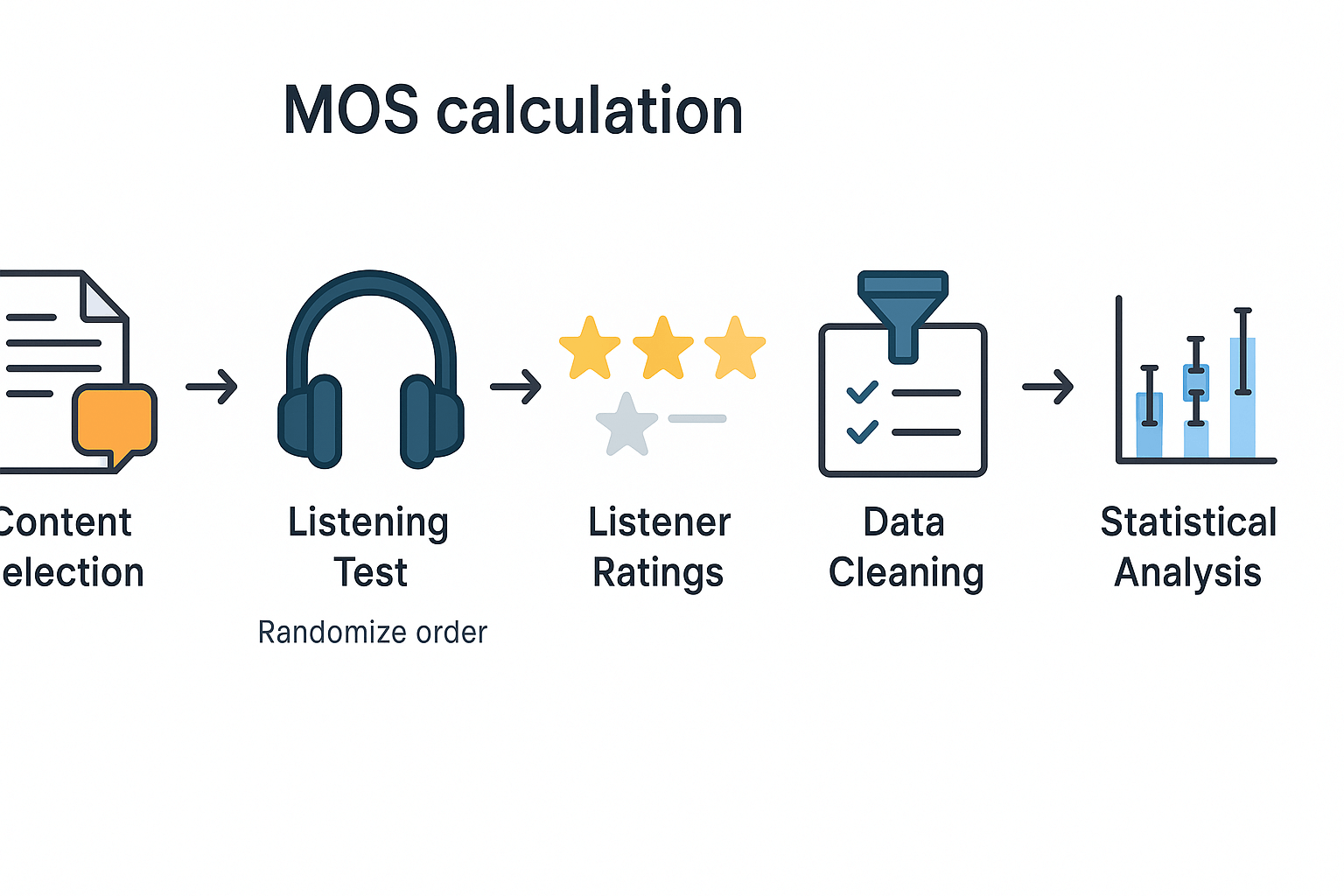
This section breaks down the end-to-end workflow teams use to calculate tts mos, from picking stimuli to reporting confidence intervals. You will get clear choices for test type, how to recruit listeners, how to clean data, and what stats to publish. Read on for pragmatic rules you can apply today.
Pick stimuli that match your product
Choose sentences or clips that reflect real usage: short prompts for assistants, long paragraphs for narration. Balance content for prosody, phonetic coverage, and speaker styles. Keep a core set of control items you reuse across runs for comparison.
Recruit and sample listeners with care
Aim for diverse listeners who match your target users. For stable MOS, plan for 20 to 40 qualified raters per condition when possible, and screen for attention. Randomize item order per listener and limit session length to avoid fatigue.
Choose the right rating scale
Use a 5 point MOS scale for general quality, with clear anchors (1 poor to 5 excellent). For fine-grained lab tests use MUSHRA style continuous scales when the task needs detailed ranking. A/B forced-choice is best for pairwise preference when you only need directional wins.
Test design, randomization, and balance
Counterbalance samples so each stimulus appears equally across positions. Mix hidden references and duplicates to check rater consistency. Always randomize order per listener to remove sequence bias.
Data cleaning and basic stats to report
Remove inattentive raters using control items and response-time filters. Compute the mean MOS per stimulus and add a 95% confidence interval. For pairwise comparisons, use a paired t-test or nonparametric alternative; report p values and effect sizes so teams can judge practical importance.
Recommendation ITU-T P.800 describes methods and procedures for conducting subjective evaluations of transmission quality, and is a good reference for test protocols and scoring (
ITU-T Recommendation P.800 (1996)).
Limitations and pitfalls of MOS (and how to mitigate them)
MOS gives a simple, useful read on perceived voice quality. But it has limits that can mislead teams. tts mos scores reflect human judgments that vary by rater, language, and context. Treat MOS as one instrument in a toolbox, not the sole truth.
Rater subjectivity and drift
Human listeners bring bias and inconsistency. Screen raters, use qualification tests, and add calibration items during the run. Track inter-rater reliability (agreement between raters) and remove low-agreement annotators.
Cultural and language effects
Ratings depend on native language, accent familiarity, and cultural norms. Use language-specific panels and recruit raters from the target locale. Localize prompts and use natural, conversational test items.
Ceiling effects and score compression
High-quality voices cluster near the top of the scale. That hides meaningful differences. Use finer scales, continuous rating sliders, or complementary tests like pairwise preference or MUSHRA-style comparisons.
Small deltas and statistical pitfalls
Small MOS changes may be noise, not real improvement. Use nonparametric comparisons such as Wilcoxon or bootstrap resampling. Always report confidence intervals and effect sizes.
Practical mitigations
-
Rater screening and periodic recalibration with gold anchors.
-
Language-specific panels and localized test scripts.
-
Mix MOS with objective checks, e.g., intelligibility measures and spectro checks.
-
Pre-register sample size and analysis plan to avoid p-hacking.
Pair MOS with objective metrics and qualitative review. That way teams avoid overinterpreting tiny MOS deltas and make robust product decisions.
When you need fast feedback in a voice development loop, automated measurements can speed work without replacing human judgment. In neural voice projects, tts mos gives final user-facing quality, while objective metrics let engineers catch regressions early and iterate quickly.
What each objective metric captures
-
PESQ (Perceptual Evaluation of Speech Quality): an end-to-end perceptual quality score. PESQ is standardized in
ITU-T Recommendation P.862 (2001), so it’s useful for comparing codec and transmission effects. It misses many modern neural artifacts like prosody oddities.
-
MCD (Mel Cepstral Distortion): a spectral distance measure that flags timbre and spectral mismatch. It’s sensitive to voice color but it doesn’t map directly to perceived naturalness.
-
STOI (Short-Time Objective Intelligibility): predicts intelligibility (how well words can be understood). It’s strong for noisy or low-bit-rate cases but not for voice style or expressiveness.
-
WER (Word Error Rate): a downstream ASR-based proxy for intelligibility. WER directly ties to task success for voice assistants, but it can be noisy if ASR errors aren’t speech-quality related.
When automated metrics help
Use objective metrics for fast regression tests, A/B prefilters, and CI gates. Run them on synthetic test suites to catch spectral drift, clipping, or intelligibility drops. They let you run thousands of clips cheaply and flag obvious failures before human testing.
Practical hybrid strategy for ongoing QA
-
Pilot MOS: run a small MOS panel on representative utterances to anchor your human baseline.
-
Correlate: compute PESQ, MCD, STOI, and WER on the same set and measure which metrics track MOS for your voice.
-
Set automated thresholds: pick metric thresholds that match acceptable MOS bands and add CI checks.
-
Continuous monitoring: run objective checks on every model change; fail fast on regressions.
-
Periodic MOS audits: sample weekly or monthly for drift, and re-calibrate thresholds when you change data or TTS architecture.
Mixing pilot MOS with automated monitoring gives the speed of metrics and the trust of human perception. That combination is the most practical way to keep neural TTS quality high without constant costly panels.
Practical guide: running MOS tests at scale (platforms, QA & tips)
Start with a clear goal, then build a test that maps to product outcomes. If you need a reliable user score, use tts mos to measure perceived naturalness and clarity. According to
Lechler et al. (2025), crowdsourced MUSHRA tests with non-expert listeners can reliably evaluate generative speech codecs, offering a scalable alternative to traditional expert-based assessments. That means you can scale fast without losing signal, if you add the right quality controls.
Choose crowd workers or experts
Decide tradeoffs: expert panels give consistent, diagnostic feedback. Crowdsourcing gives speed and diversity for product-facing metrics. Use experts for voice research and crowds for comparative A/B runs.
Write a tight script and pick stimuli
Keep instructions short and examples clear. Limit each HIT to 8 to 12 items so fatigue stays low. Pick representative stimuli that match real use, cover edge cases, and vary prosody and phonetic content.
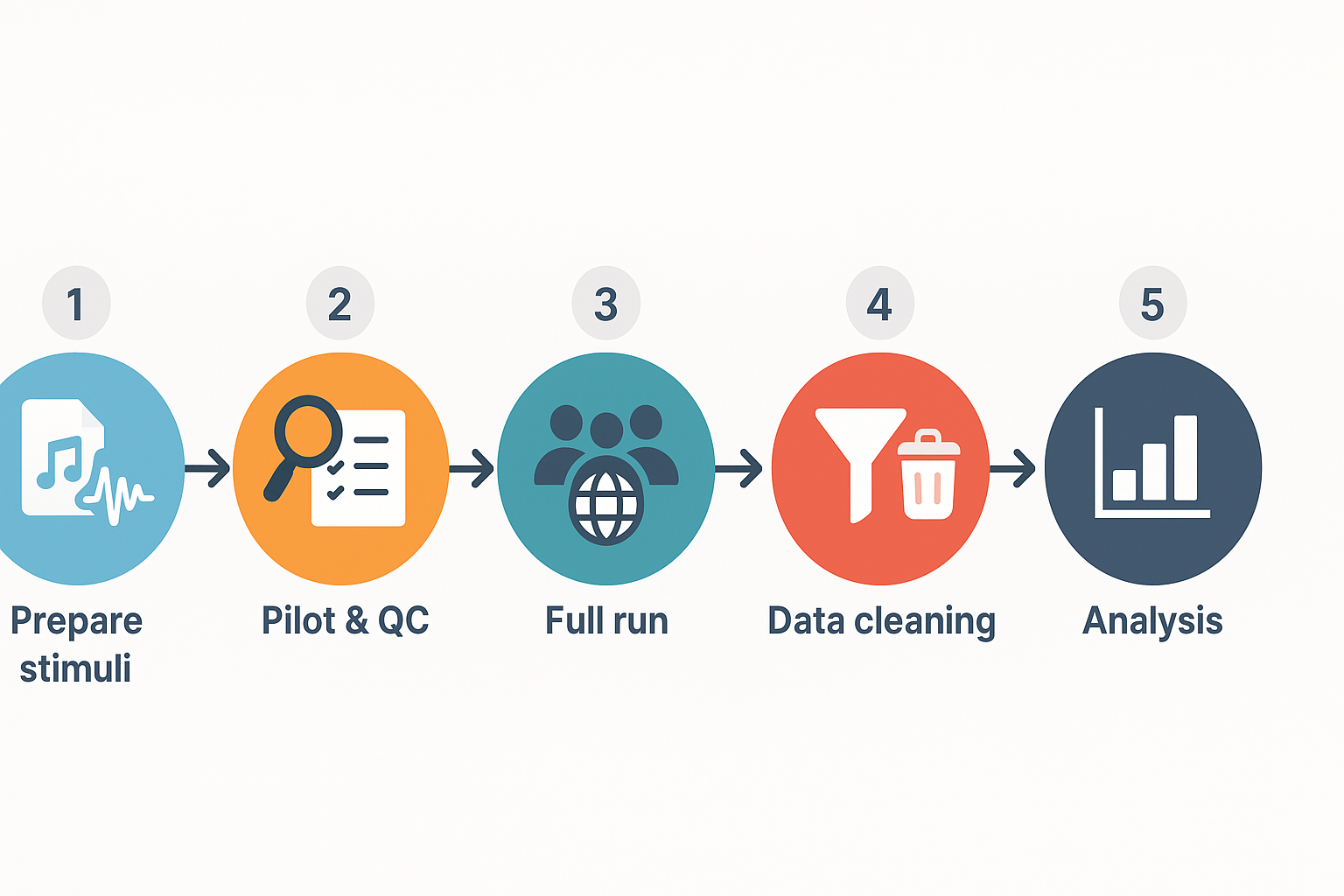
Pilot then scale: a 30 to 50 listener pilot finds problems fast. Then run the full study with stratified sampling by language and device.
-
Prepare stimuli: export clean WAVs, normalize levels, remove clips under 1 second. Include reference and variants.
-
Pilot and QC: run 30 to 50 listeners. Flag confusing items, tweak instructions, add golden items.
-
Full run: target 100+ unique listeners per condition for stable MOS. Randomize order per subject.
-
Data cleaning: remove failed attention checks, ultra-fast completions, and outliers. Balance by listener demographics.
-
Analysis: compute MOS means with confidence intervals and pairwise tests.
Quality controls and tips
-
Use attention checks and trap items, and insert golden items with known ratings.
-
Enforce headphone checks and minimum listening time per clip.
-
Log device, OS, and browser to filter bad sessions.
-
Repeat a small subset to measure intra-rater reliability.
Tooling and stimulus speedups
Use trusted crowdsourcing platforms like Prolific, Amazon Mechanical Turk, or Appen for reach. For fast stimulus creation, DupDub can export multilingual TTS clips, voice clones, and aligned captions for lab or crowd tests. That cuts iteration time, especially for multilingual pilots and voice-matching checks.
Case study — Using MOS to improve neural TTS (product-context vignette)
A mid-size e-learning publisher wanted clearer, more natural narration for localized courses. They used tts mos to benchmark three neural voices across English, Spanish, and Brazilian Portuguese. The team ran a paired MOS study to find where listeners heard gaps in prosody and clarity.
Experiment setup: clear and reproducible
We kept the design tight and reproducible. Listeners: 450 crowdsourced participants, balanced by language and age. Stimuli: 180 short clips per language, equal split across three voices and two prompt styles. Prompts: neutral narration, and expressive tutorial lines. Test details:
-
Audio format: 16 kHz WAV, normalized LUFS.
-
Listening protocol: headphone check, attention test, and 5-point MOS scale.
-
Sampling: stratified by language and device type.
Results and model changes
Baseline MOS varied: Voice A 3.7, Voice B 4.1, Voice C 3.2. Listeners flagged monotone phrasing and vowel smearing in Voice C. The team ran a focused iteration in two steps:
-
Data fixes: added 6 hours of expressive speech for underperforming voice. 2. Model updates: prosody fine tuning (pitch contours and pause placement), targeted data augmentation for rare phoneme contexts, and a new neural vocoder with anti-alias filtering.
After iteration, Voice C rose to 3.9 MOS, and Voice A to 4.0. The MOS lift was statistically significant at p < 0.05.
Impact and lessons
In production, the client replaced Voice C in lesson intros. They reported a 9% lift in average watch time on localized courses. Completion rates rose by 6% for Spanish modules. Key takeaways: use MOS to target the weakest perceptual issues, iterate fast, and combine human tests with small objective checks.
"Run targeted MOS tests early, fix data gaps, then tune prosody. Small changes yield clear listener gains," said the lead ML engineer on the project.
Benchmarks: target MOS by product type and business use-case
Use tts mos (Mean Opinion Score) to set realistic quality targets for each product type. MOS gives a single-number view of naturalness and acceptability, which helps teams pick launch goals and polish milestones. Start with realistic first-release targets, then raise standards for production and brand-critical experiences.
Target MOS ranges and release guidance
Recommended target ranges by use case: Voice assistants, conversational UI, media localization/dubbing, and accessibility experiences each need different thresholds. Aim for these bands: Voice assistants 3.5–4.2, conversational UI 3.8–4.4, media localization and dubbing 4.2–4.6, accessibility experiences 4.0–4.5. For first release, target the lower half of the band to ship faster and collect user data. For production polish, aim for the upper half: reduce errors, tune prosody, and validate with domain users.
Translate MOS targets into engineering priorities
Use MOS targets to rank work and budget. If you need to raise MOS by 0.3 or more, prioritize data and modeling choices like voice cloning for speaker match, style transfer for emotional fit, or multi-pass dubbing for timing and lip-sync. Practical priorities:
-
Fix high-impact audio defects first: noise, clipping, and alignment.
-
Add prosody and style fine-tuning when MOS stalls.
-
Invest in cloning or multi-pass dubbing if the use case needs identity match or tight sync.
These steps map MOS wins to clear engineering tasks and help product teams decide where to invest next.
Implementation checklist and recommended workflow (with diagrams)
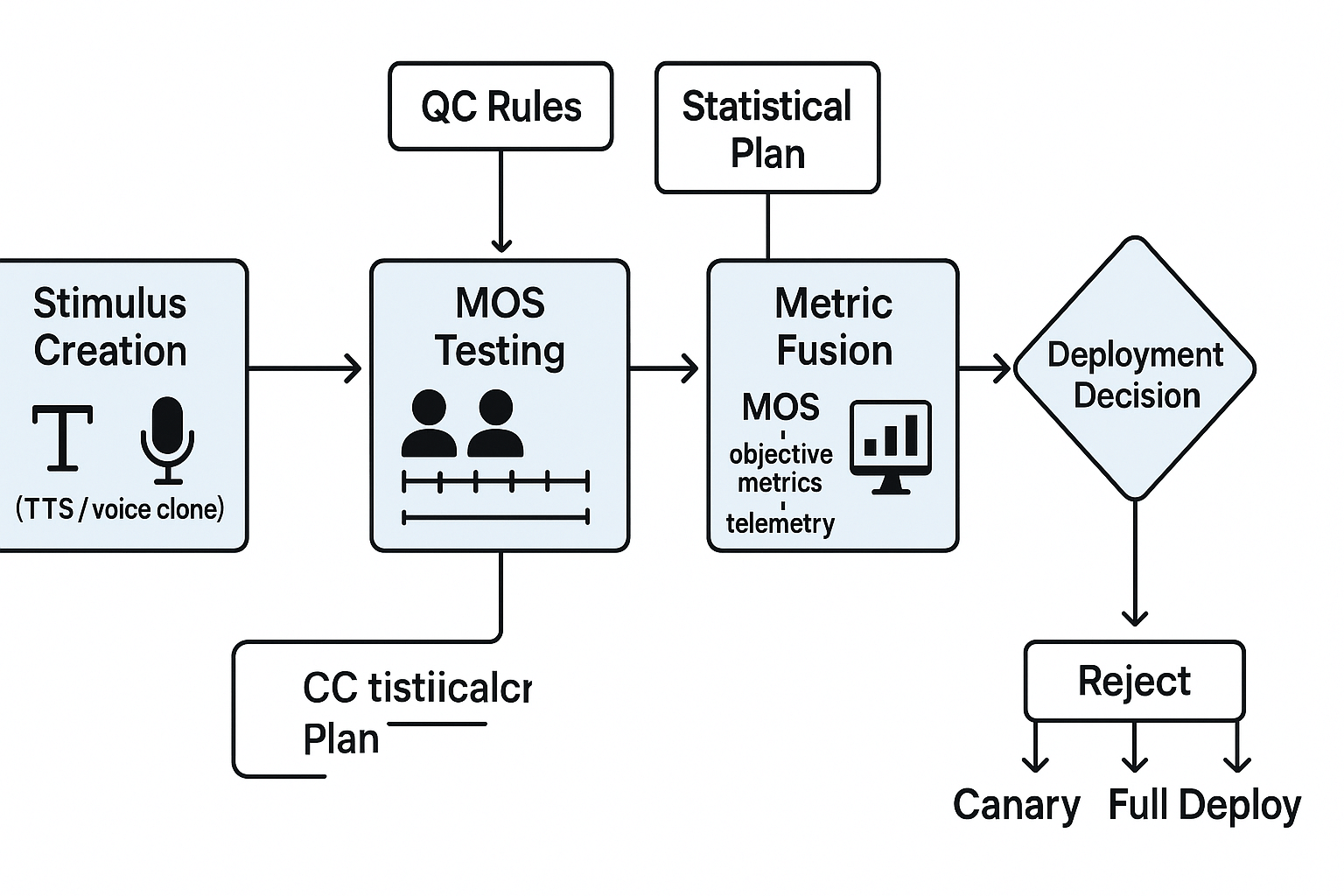
Use this compact checklist to plan and run reliable tts mos studies, and to tie results to deployment gates. It covers pre-test setup, post-test cleanup, QC rules, statistical plans, and telemetry so teams can move from evaluation to safe rollout.
Pre-test checklist
-
Define objectives and pass/fail MOS thresholds. State effect size you care about.
-
Stimuli: 40–120 utterances, balanced by length and domain, include clones and reference recordings.
-
Listeners: quota by locale and demographic, 20+ unique listeners per condition, qualification test, 3 judgments per item.
-
QC: attention checks, gold-standard items, blacklist low-quality raters.
-
Stats: power analysis, report MOS with 95% confidence intervals, pre-register comparisons.
-
Telemetry: capture utterance id, voice model, prompt, locale, audio file, device, browser.
Post-test checklist and QC rules
-
Clean responses, remove failed attention checks, flag outliers. Compute MOS and CIs per slice. Fuse MOS with objective metrics and production telemetry before decisions.
-
Action rules: block release if MOS drops below threshold, require A/B or canary if change is marginal, and log rollback criteria.
Recommended workflow: MOS plus automated gates
-
Generate stimuli (TTS and clones) and labels. 2. Run MOS panels with embedded QC. 3. Merge MOS, objective scores, and telemetry. 4. Apply decision rules (reject, canary, full deploy). 5. Monitor live telemetry and user feedback, iterate.
FAQ — common questions about MOS and neural TTS evaluation
-
How many listeners are needed for reliable MOS tests for neural TTS?
For TTS MOS tests, aim for 30 to 100 unique listeners per system variant. Use 30 as a practical minimum for early iterations, and 50 to 100 for robust comparisons and tighter confidence intervals. Prefer more listeners over more samples per listener, and stratify by native language and device type to lower variance.
-
Can automatic metrics replace MOS in TTS evaluation?
No, automatic metrics shouldn’t replace human MOS, but they’re useful for fast triage. Use objective scores (PESQ, MCD, STOI) to flag regressions and narrow candidates. Then run MOS on the shortlisted systems to capture naturalness, prosody, and subtle artifacts humans detect.
-
What counts as a good MOS for different product types and business use cases?
Target ranges vary by use case: consumer assistants and audiobooks aim for 4.2 or higher, e-learning and marketing voiceovers often need 3.8 to 4.2, and internal tools or rough prototypes can accept 3.5+. Focus on meaningful deltas, not absolute numbers: a 0.2 MOS gain is usually perceptible. For next steps, see the Neural TTS Technology cluster and benchmarking posts for detailed matrices and examples.




 Discord
 YouTube
 Tiktok
 Twitter
 Facebook
 Instagram