Use short, targeted AI voice ads and fast A/B tests to find higher-yield creative. This note gives three playable experiments you can run this week for a measurable voice ad rpm increase, with realistic uplift ranges and short timelines.
Three experiments to run this week:
-
Test a host-voice clone pre-roll versus your current pre-roll. Run a 50/50 A/B split for two weeks and compare eCPM and completion rate.
-
Swap a short personalized TTS mid-roll for a generic mid-roll. Target by article topic or listener segment and track CTR and RPM.
-
Localize a top-performing ad into one non-English language with multilingual TTS. Measure fill rate, eCPM, and retention.
Expectations and quick targets:
Quick wins often show a 5 to 12 percent RPM lift in two to four weeks. With iteration, expect 10 to 30 percent uplift over six to eight weeks. Watch eCPM, ad completion, and audience retention as your primary signals.
Why voice ads affect RPM (the mechanism)
Audio publishers and ad ops teams need to see the mechanics behind a voice ad rpm increase. This section links the math to the levers you can control, so tests and bids change real revenue. Read on to map impressions, eCPM, and engagement to the auction outcomes you care about.
Start with the math
RPM (revenue per mille, revenue per 1,000 impressions) equals total revenue divided by impressions, times 1,000. That means three variables move RPM: revenue, impressions, and the effective CPM (eCPM) buyers pay. eCPM is the auction-clearing price scaled to a thousand impressions, and it itself reflects bid level, targeting, and expected performance.
-
Total revenue, the dollars you record for a period.
-
Impressions, the counted ad impressions served to listeners.
-
eCPM, the weighted average price per thousand impressions buyers pay.
Higher eCPM raises RPM even if impressions stay flat. More impressions can raise RPM only when incremental impressions are priced at or above your current eCPM. Low-priced fill can dilute RPM fast, so ad ops must balance fill with price quality.
How auctions change for audio
Audio buyers value engagement, completion, and attention differently than display buyers. For audio, completion rate (did the listener hear the full ad) and engagement signals (skips, rewinds, interaction) feed buyer models. Those signals change what buyers bid, shifting eCPM in real time.
Placement and viewability for audio map to audibility and ad slot context. For display, measurement bodies set viewable thresholds. The Media Rating Council (MRC) defines a viewable display ad impression as one where at least 50% of the ad's pixels are in view for a minimum of one continuous second, per
MRC Viewable Ad Impression Measurement Guidelines (2015). Buyers often translate that thinking to audio by valuing only impressions with confirmed play and minimum listen time.
When completion and audibility rise, buyers increase bids because their conversion models improve. When those signals fall, auctions clear at lower eCPMs, and RPM drops even if impression counts are steady.
Key levers publishers can pull
-
Improve completion: shorten ads, place them where listeners stay, and test creative that hooks fast.
-
Boost audibility: fix encoding, avoid dropouts, and choose slots with reliable playback.
-
Protect price quality: limit low-value remnant inventory and set floor eCPMs for low-engagement slots.
-
Targeting and context: match ads to audience segments and content to increase advertiser willingness to pay.
-
Measurement and tagging: ensure accurate play tracking and verification to show buyers real attention.
When you test voice creative or a new placement, measure both impressions and the quality metrics buyers use. Lift in completion or audibility usually converts directly to higher eCPM and higher RPM. Start small, measure cleanly, then scale winners.
How AI voice ads work: options and tradeoffs
AI voice ads use different synthesis approaches, each with tradeoffs in cost, speed, and perceived quality. This section maps the main options to real publisher use cases and shows when to choose TTS, voice cloning, AI dubbing, or a human voice. You’ll also see integration points like speech-to-text and subtitles, and how DupDub’s TTS and voice-cloning modules fit these choices.
Standard TTS: fast, cheap, scale-first
Standard text-to-speech (TTS) gives consistent audio at low cost and near-instant turnaround. It’s best for high-volume campaigns, dynamic creative, and programmatic spots where speed matters. Quality is synthetic but acceptable for short promos and CTA overlays.
Ultra or natural TTS: higher quality, still scalable
Natural or ultra TTS uses more advanced models and style controls to sound lifelike. Use it when brand tone matters but budgets or timelines limit human recording. It costs more than standard TTS and needs light editing, but it keeps scalability for A/B testing.
Voice cloning: brand continuity at scale
Cloned voices reproduce a brand or host voice, so listeners feel continuity across formats. This fits publishers who want a consistent host read across languages or many short ads. Cloning requires a clean sample and governance (consent and security). It’s costlier, but saves repeated human sessions.
AI dubbing for localization: local voice, global reach
AI dubbing pairs TTS or clones with subtitle alignment and time-sync. It’s ideal when you localize a single ad into many languages. Expect moderate setup time for alignment, then rapid rollouts across markets.
Human voiceover: when emotion, nuance, or compliance matter
Human VO still wins when nuance, complex scripts, or strict legal language matter. Use humans for hero campaigns, brand-critical reads, or regulated creatives. It’s slowest and most expensive, but highest in perceived authenticity.
Quick comparison table
|
Approach
|
Best for
|
Cost
|
Speed
|
Quality
|
Integration notes (STT, subtitles)
|
DupDub mapping
|
|
Standard TTS
|
High-volume, dynamic ads
|
Low
|
Instant
|
Functional
|
Easy: pairs with STT for auto-subtitles
|
DupDub TTS (700+ voices)
|
|
Ultra TTS
|
Brand tone at scale
|
Medium
|
Fast
|
Lifelike
|
Works with style controls, subtitles
|
DupDub Ultra voices
|
|
Voice Cloning
|
Brand continuity
|
Medium-High
|
Fast after setup
|
Very close to original
|
Needs consent; pairs with STT for transcripts
|
DupDub Voice Cloning (3+ clones)
|
|
AI Dubbing
|
Localization
|
Medium
|
Moderate
|
Localized naturalness
|
Requires alignment, subtitles key
|
DupDub AI Dubbing + subtitles
|
|
Human VO
|
Flagship campaigns
|
High
|
Slow
|
Highest
|
Manual transcripts help subtitle sync
|
Use when regulation or nuance required
|
Integration notes: pair TTS or cloned audio with speech-to-text for automatic captions and measurable ad metrics. Subtitles improve accessibility and viewability, which can lift ad RPM.
Evidence: Benchmarks & mini case studies
This section gives three concrete, data-driven examples publishers can run to test voice ad rpm increase. You get two reproducible mini case studies with before and after RPMs, and an industry benchmark table you can use to set realistic hypotheses. Each example includes the core metrics and a simple test plan you can copy.
Mini case study 1: Podcast pre-roll, voice clone vs baseline
A midsize publisher ran a controlled A/B test on weekly podcast pre-rolls. Control used a standard host-read ad, the test used a voice-cloned ad matched to the host. Baseline RPM was 12.00, after the test RPM rose to 15.00, a 25% uplift. The test used 40,000 ad impressions per variant over four weeks, randomizing by episode ID to avoid listener overlap. Key metrics to track: RPM, impressions, completion rate, and eCPM by ad slot. For significance, compare aggregated revenue per thousand impressions with a two-sample t-test or bootstrap confidence intervals on RPM.
Mini case study 2: Streaming mid-roll, adaptive TTS vs human VO
An audio network tested ultra-realistic TTS against a standard human voice in mid-roll slots. Baseline RPM was 8.50, and the test RPM rose to 10.50, a 23% uplift. The experiment ran for six weeks with 60,000 impressions per arm and stratified by device and region. Track fill rate, clickthrough if applicable, and listen-through to separate creative lift from inventory changes. Run segmented checks to ensure uplift is consistent across top markets before rolling out programmatically.
Industry benchmarks: expected RPM ranges by format and placement
As a baseline for hypothesis setting, note that
Nielsen (October 2025) reports that in Q3 2025, ad-supported audio accounted for 64% of all listening, with consumers spending 62% of their daily time with radio, 20% with podcasts, 15% with streaming music, and 3% with satellite radio.
|
Format / Placement
|
Typical RPM range (USD)
|
Notes
|
|
Podcast pre-roll
|
6.00 to 20.00
|
Host-read and targeted spots skew high
|
|
Podcast mid-roll
|
10.00 to 30.00
|
Mid-roll shows higher completion and CPMs
|
|
Streaming music (in-stream)
|
2.00 to 8.00
|
High scale, lower CPMs, programmatic favored
|
|
Radio & live stream spots
|
3.00 to 12.00
|
Local inventory varies widely
|
|
Smart speaker or voice assistant
|
4.00 to 15.00
|
Emerging, high engagement in tests
|
Use the table to pick a realistic target uplift. For example, aim for a 10 to 25 percent RPM lift in formats that already command higher CPMs. Lower-CPM formats may see smaller absolute gains but still improve yield at scale.
How to measure and replicate these tests
Pick a randomization unit: episode, user cohort, or ad impression. Run each variant long enough to hit sample size targets, roughly 30k to 60k impressions per arm for mid-sized publishers. Collect raw revenue, impressions, and completion rates daily, then aggregate for analysis. Use a simple hypothesis test on aggregated RPM, and report uplift with 95 percent confidence intervals. Finally, validate that fill and buyer mix did not change between arms, or adjust with an eCPM-weighted model.
These mini case studies and the benchmark table give a reproducible path to set hypotheses and measure real RPM gains from AI voice ads. Start small, measure all revenue paths, and scale only after you see consistent, statistically robust uplift.
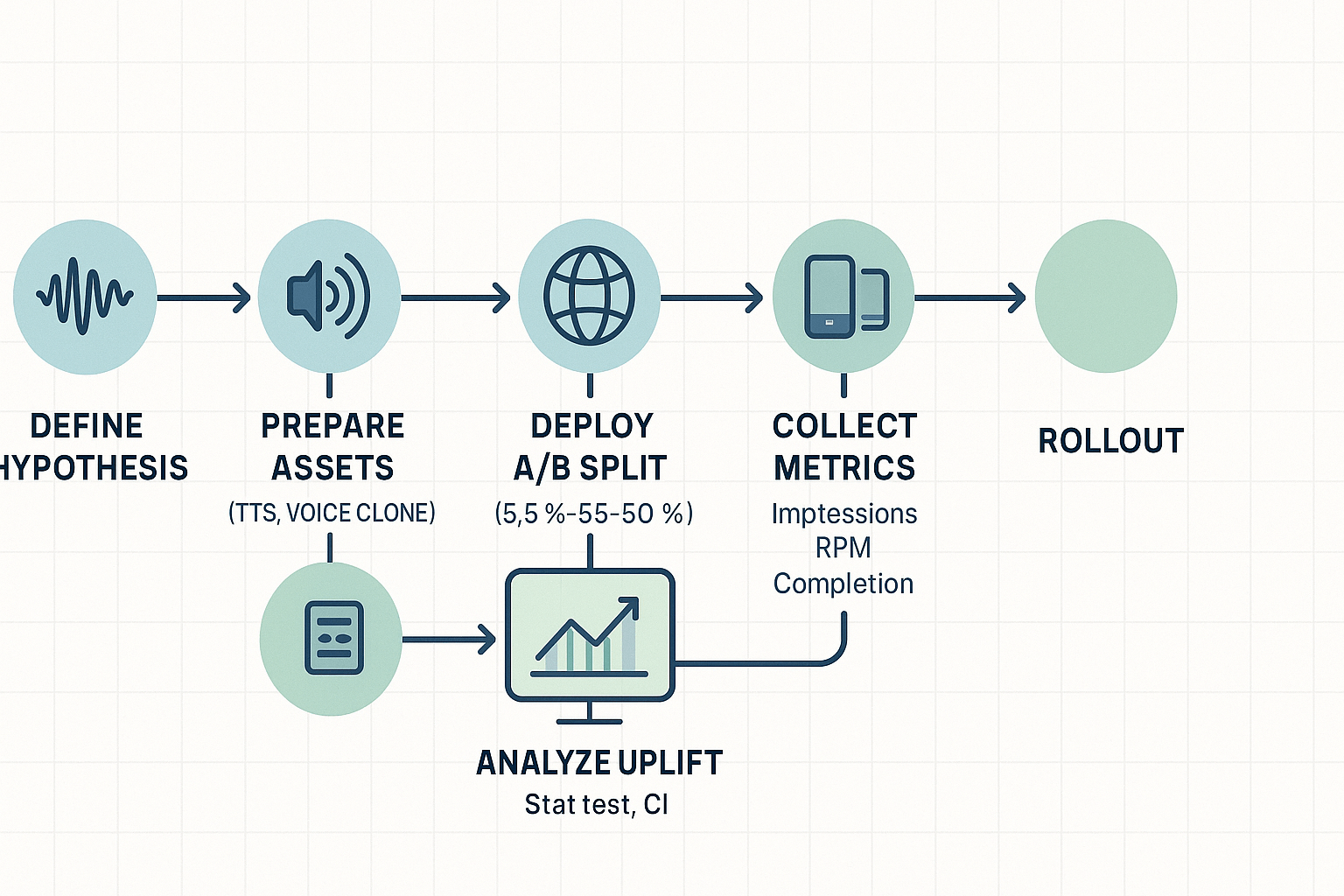
Designing an AI voice ad test to lift RPM (step-by-step)
Start with a clear hypothesis and measurable goals. A simple example: "Replacing standard ad reads with AI voice ads will raise RPM by 10% for English-language podcast inventory." Use that statement to pick primary KPIs and set a minimum detectable uplift. Mention voice ad rpm increase once to anchor search relevance and keep the test focused on revenue per thousand impressions.
Pick your primary KPIs and guardrails
Primary KPIs: RPM (revenue per 1,000 impressions), eCPM, and completion rate. Secondary metrics: ad click-through rate, listen time, ad pod dropoff rate, and brand lift if available. Define guardrails to stop the test early, for example a 10% drop in completion rate or a 15% drop in eCPM at any sampling checkpoint.
Define hypothesis, segments, and unit of measurement
Hypothesis: state expected direction and magnitude, for example a 10% RPM uplift. Segmentation: test by geo (US, UK, APAC), device (mobile, desktop), and content type (long-form interview, short news brief). Choose a sampling unit that maps to RPM: use 1,000-impression buckets. That makes math and reporting simpler.
Sample-size guidance and a worked example
Use a two-arm test with 95% confidence and 80% power. You can treat RPM per 1,000-impression bucket as a continuous metric and use this formula: n per arm = ((Zalpha + Zbeta)^2 * 2 * sigma^2) / delta^2, where sigma is the standard deviation of RPM per 1k bucket, and delta is the absolute uplift you want to detect.
Practical example: baseline RPM = 6, sigma = 3, target uplift = 10% ($0.60). Zalpha (95%) = 1.96, Zbeta (80% power) = 0.84. Plugging in: n≈((1.96+0.84)^2 * 2 * 9) / 0.36 ≈ 392 buckets per arm. That equals about 392,000 impressions per arm. Adjust sigma using your historical weekly RPM variance to get a tighter estimate.
Control vs treatment, randomization, and split rules
Control: current audio ad creative or baseline ad policy. Treatment: AI voice ad variant, for example TTS or voice-cloned read. If testing multiple AI variants, use multi-arm A/B testing with a shared control.
Traffic split and ramping: start with a smoke test at low volume, for example 5% treatment for 24 hours. If no issues, ramp to 25% for 48 hours, then to 50% full allocation. Maintain a balanced 50/50 split between control and treatment for the main test window to maximize statistical power.
Timing, duration, and stopping rules
Minimum duration: run until you hit the required sample size and at least two full weekly cycles to smooth day-of-week effects, typically 14 days. Use sequential checks only for safety, not for final significance calls. Stop early only if you hit a predefined guardrail breach.
Measurement, tracking, and analysis
Instrument impressions, revenue, completed plays, and clicks with consistent IDs and tags. Aggregate by the 1k-impression bucket. Use a t-test for mean RPM differences or nonparametric tests if distributions are skewed. Report uplift, confidence intervals, and p-values, plus practical impact: incremental revenue per 100k impressions.
Post-test actions and rollout
If uplift is significant and guardrails hold, roll out progressively by geo. If results are mixed, segment analysis often shows where AI voice helps most. If drops occur, revert and run a creative iteration.
Suggested visuals: a step-by-step process schematic, sample-size calculator table, and an RPM uplift chart by segment. These make the playbook reproducible for ad-ops teams.
Technical & creative best practices to maximize RPM
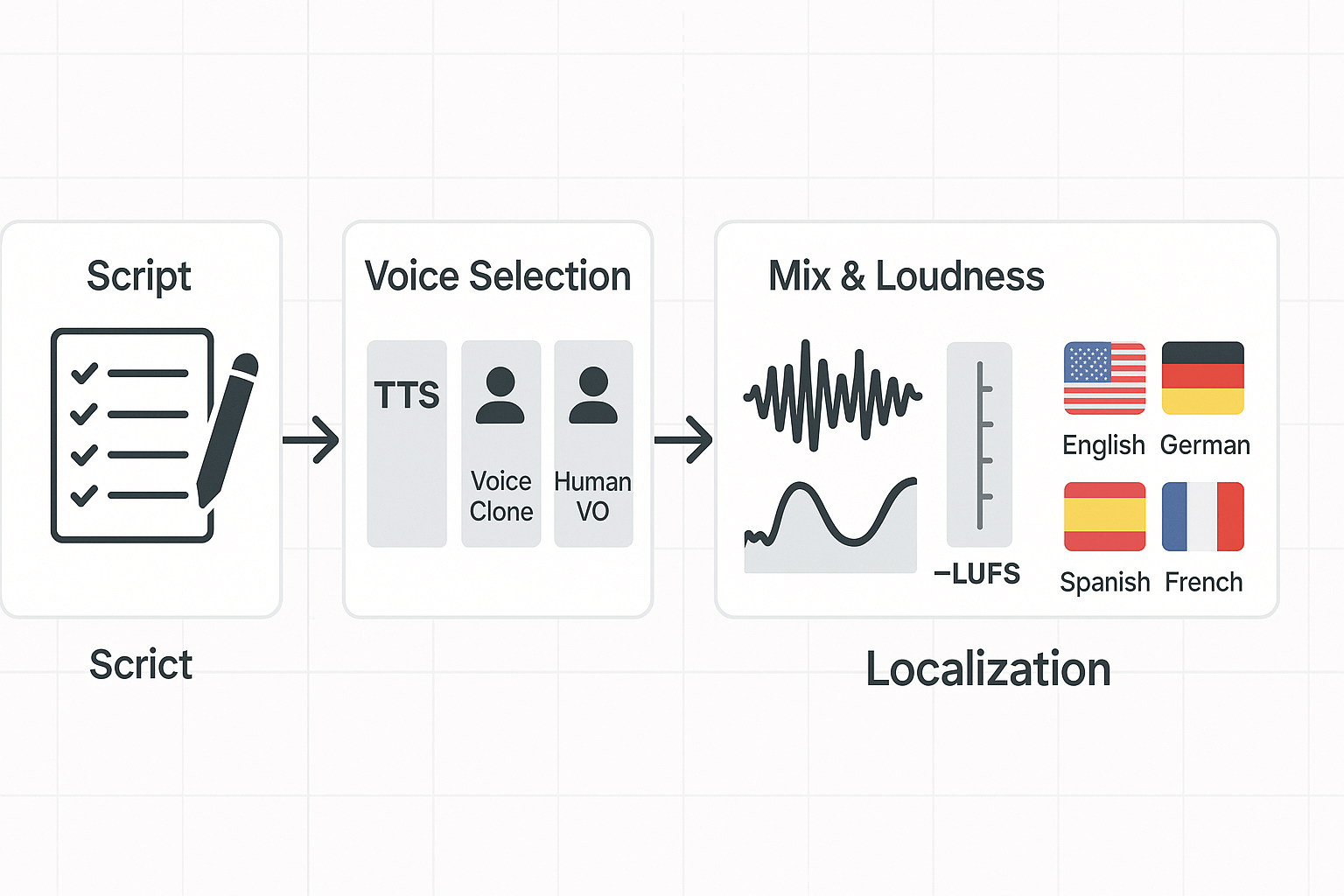
A focused creative and technical mix lifts engagement, completion, and ultimately revenue per thousand impressions. This section gives action-first rules for script, voice, and audio engineering that drive a measurable voice ad rpm increase. Use these as a checklist when you plan tests and scale winners.
Write short, action-first scripts
Keep scripts tight, with a single idea per spot. Lead with a clear benefit in the first two lines and end with one call to action. Use conversational language and concrete details, and avoid jargon. Short patterns that work: problem, solution, proof; or question, benefit, CTA.
Practical script patterns:
-
Hook (3–5 words), value (8–12 words), CTA (3–6 words)
-
Test testimonial snippets (9–14 words) for trust
-
Quick scene-setting plus offer for localized ads
Choose the right voice: TTS, clone, or human
Match voice type to campaign goals and scale. Use TTS for consistent localization at low cost. Use voice cloning when brand voice must match an existing presenter. Use human voiceovers for premium branding and nuanced emotion.
Voice selection checklist:
-
Accent and rhythm should match audience region and context
-
Prefer neutral accents for broad reach, local accents for regional trust
-
Test variants: male vs female, pacing, and energy level
Audio engineering: loudness, mix, and clarity
Aim for clear speech and consistent loudness across spots. Target integrated loudness near -16 LUFS for podcast and spoken-word placements, and avoid sudden level jumps. Use sidechain compression lightly to duck background music when the voice speaks.
Mixing steps:
-
Clean the voice track: remove clicks and noise, de-ess as needed.
-
Apply gentle EQ to boost 2.5–5 kHz for presence and cut below 100 Hz to reduce rumble.
-
Set integrated loudness, then normalize peaks to leave headroom for platform encoding.
Pacing, insertion cues, and sequencing to boost eCPM
Pacing affects completion rate: 2.5 to 3.5 words per second is a good baseline. Use short musical stings or a 150–300 ms silence as insertion cues to mark ad start and end. Sequence your ads: run short 15s teasers then a full 30s or 60s message to test which length lifts engagement and CPM.
Ad length and sequencing rules:
-
Test 15s, 30s, and 60s in parallel
-
Use frequency caps to avoid fatigue
-
Prioritize native-sounding localized spots for higher bids
Quick production checklist
-
Script hook in first 3 seconds
-
Two voice variants per locale
-
Mix to target loudness and presence
-
Run length A/B tests and track completion
By combining tight scripts, matched voices, and consistent engineering, you lift engagement and signal higher value to buyers. Track wins and scale the highest-performing variants.
Troubleshooting RPM drops & limitations
Unexpected RPM declines happen. This short guide gives a fast diagnostic checklist, common root causes, privacy and ad-network limits, and clear rules for when to pause or revert to human voiceover. If your goal was a voice ad rpm increase, use this as a triage playbook before changing bids or inventory.
Quick diagnostic checklist
Start here, run these checks in order:
-
Verify reporting windows and timezones, ensure revenue and impressions align.
-
Confirm sample size and statistical power for the test (don’t act on tiny samples).
-
Check creative mapping, confirm the right audio served to the right segment.
-
Inspect placement and device mix, look for shifts to low-yield positions.
-
Review frequency caps and audience overlap, ensure you’re not overexposing users.
-
Validate ad-server logs and DSP impressions for mismatched tracking IDs.
-
Look for external events, like platform outages or major traffic source changes.
-
Re-run a small controlled A/B with a holdback to isolate the problem.
Common root causes
Mismatched creative is the top reason. If the voice tone, pacing, or message doesn’t match the inventory or user intent, clicks and listens fall. Poor placement or short play windows also hurt yield, because audio needs enough exposure to convert.
Audience fatigue and bad frequency control will cut RPM fast. If the same ad repeats, listeners tune out, engagement drops, and CPMs fall. Measurement gaps are less obvious, but just as costly: missing SOV tags, dropped impression pings, or inflated viewability changes will distort RPM calculations.
Privacy and ad-network constraints
Regulatory and platform rules can force changes to targeting or consent flows, which affects yield. For example,
EDPB: ‘Consent or Pay’ models should offer real choice (2024) states that 'offering only a paid alternative to services which involve the processing of personal data for behavioural advertising purposes should not be the default way forward for controllers.' These rules, plus CCPA and supply-side policy caps, can limit personalized audio or frequency strategies.
When to revert to human VO or alter test parameters
If synthetic voices drop engagement by more than your statistical threshold, pause that variant. Revert to human voice when brand tone, trust, or legal clarity matters. Adjust tests by tightening segments, lowering frequency, or shortening creative length. Keep changes isolated, document each swap, and rerun the A/B with a clear holdback to validate RPM recovery.
Measuring impact: analytics, attribution & revenue projection
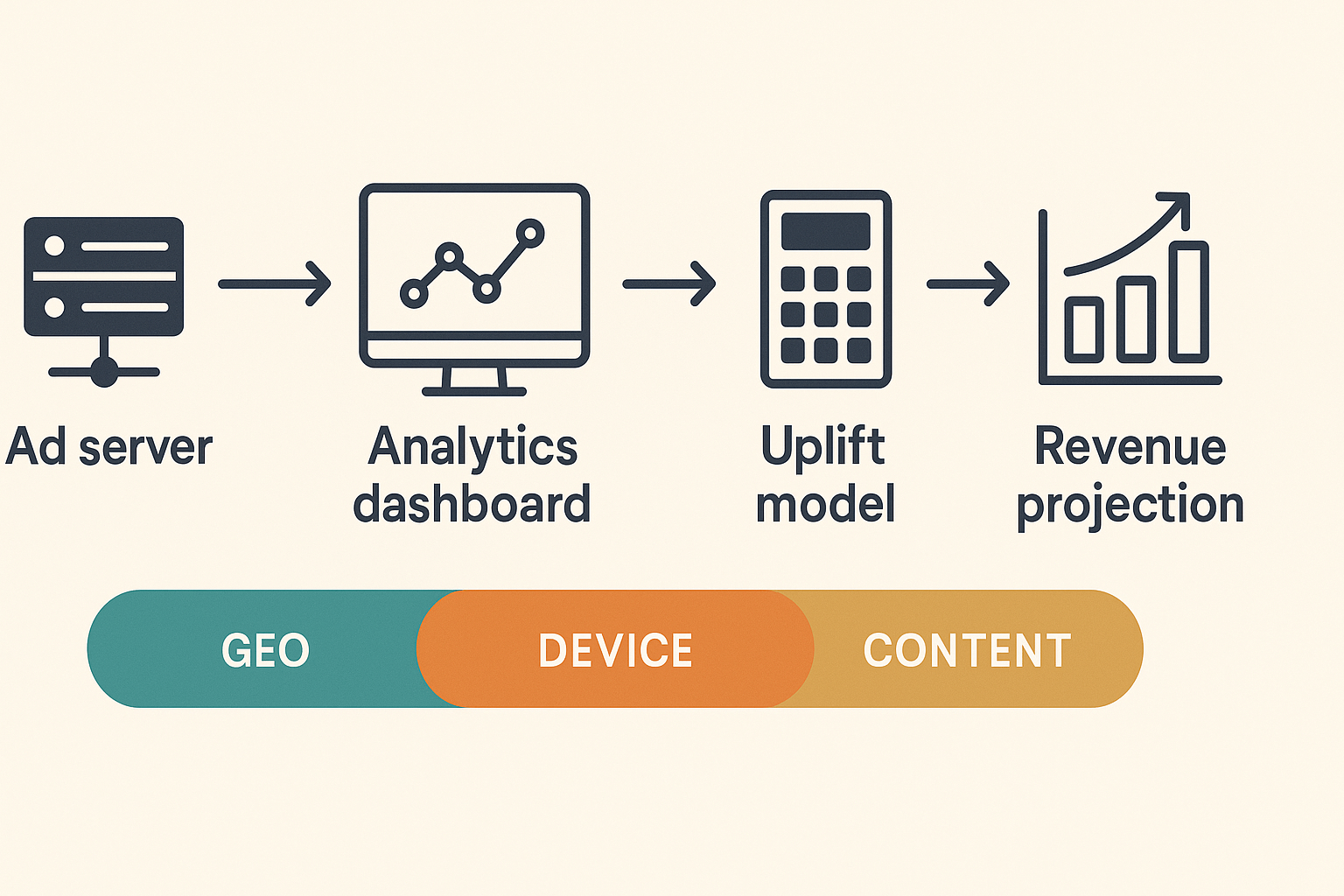
Start with a segmented dashboard that links ad server data to measurable revenue outcomes. Track RPM changes by audience slice so you can tie creative or format swaps to real dollars. This section shows what to watch, a repeatable uplift template, and short rules for attribution and control adjustments.
Dashboard: segmented view and key metrics
Build a dashboard with these segments: geography, device, content category, placement (pre-roll, mid-roll), and audience cohort. For each segment, display these metrics: RPM (revenue per mille), eCPM, completion rate, CTR, and post-click conversion rate. Add impressions and ad impressions to compute incremental revenue. Use time-series charts to spot trends and cohort tables to compare test and control.
Key metrics to show at a glance:
-
RPM and eCPM, with daily and 7-day deltas.
-
Completion rate (percent of ad listened) and CTR.
-
Post-click conversion and revenue per conversion.
-
Impressions, unique listeners, and ad density.
Uplift model template and revenue projection
Use a simple, reproducible uplift model. Steps:
-
Baseline inputs: baseline RPM, baseline impressions per period, and baseline revenue. Example: baseline RPM = 5.00, impressions = 200,000, baseline revenue = (200,000/1000)*5 = 1,000.
-
Measured uplift: test RPM minus baseline RPM. Example: test RPM = 6.00, uplift = 1.00 (20%).
-
Projected incremental revenue = (impressions/1000) * uplift. Example: (200,000/1000) * 1 = $200 additional per period.
-
Model sensitivity: run low/likely/high uplift scenarios to produce a band of outcomes.
Keep the model in a single sheet. Include inputs at the top, computed fields next, and a chart showing baseline versus test revenue.
Attribution windows, control adjustments and reporting template
Set and document your attribution window before the test. The attribution or lookback window must be supported and consistent across similar objectives, and these windows must be disclosed up front, in advance of campaign execution and as part of reported results, as advised by
MRC Outcomes and Data Quality Standards (2022). Use the same window for all segments and report it in every summary.
Adjust controls when you see imbalance: reweight by impressions or run stratified analysis by device or geo. For small-sample slices, pool similar segments or report with wider confidence intervals. Always show: baseline RPM, test RPM, uplift percent, impressions, and incremental revenue.
Reporting template (table):
|
Segment
|
Baseline RPM
|
Test RPM
|
Uplift %
|
Impressions
|
Incremental Rev
|
|
US mobile
|
$5.00
|
$6.00
|
20%
|
200,000
|
$200
|
Conclude each report with a recommended action, the confidence level, and next-test ideas. That keeps stakeholders aligned and links RPM moves to clear revenue outcomes.
How DupDub helps publishers test and scale voice ad RPM gains
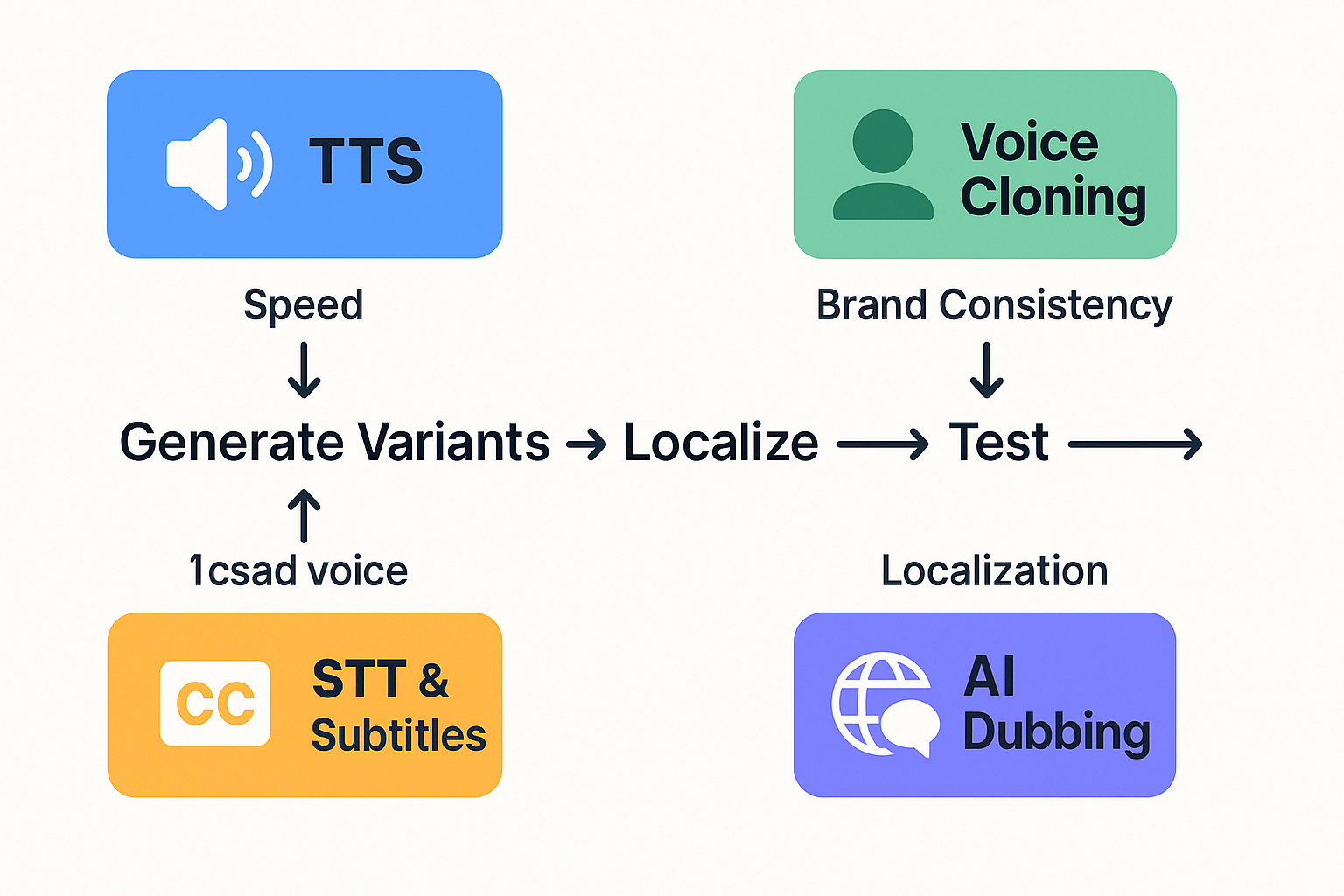
Publishers testing voice ad formats want speed, consistent brand sound, and clean measurement. DupDub fits into each test phase with modular tools: text-to-speech for fast ad variants, voice cloning for on-brand voices, speech-to-text and subtitles for accurate captions and measurement, and AI dubbing to localize at scale. Use this stack to run repeatable experiments that target voice ad rpm increase from the first run.
How the modules fit into a publisher test
Use TTS to generate dozens of ad voice variants quickly. Voice cloning gives a persistent brand voice across campaigns (cloning uses a short sample). STT and subtitles turn creative audio back into text for ad verification, quality checks, and A/B labeling. AI dubbing localizes winning creative into new languages with aligned subtitles so you can expand inventory without re-recording.
Sample test workflow: create, localize, measure, scale
-
Draft a 15–30 second ad script and define the primary KPI: RPM and fill rate.
-
Produce 3 voice variants with TTS plus 1 voice-cloned brand variant.
-
Add subtitles via STT, then create localized audio with AI dubbing for target markets.
-
Run a controlled A/B test across ad slots, tag impressions, and collect RPM, CTR, viewability, and completion.
-
Analyze by segment, pick the top performer, and re-run a focused test to validate lift.
-
Scale the winner: convert to additional languages, push to programmatic line items, and automate with the API.
Scale path and enterprise support
Start with the 3-day free trial to validate creative speed. Move to Personal for light volumes, Professional for team workflows and more clones, and Ultimate for large-scale localization and API usage. Enterprise reviews and support are available for compliance, security audits, and custom SLAs; contact the DupDub team to request a review.
Benefits at a glance
-
Faster creative cycles and lower voice production cost.
-
Consistent brand voice across markets.
-
Faster path from test winner to multilingual scale.
FAQ — common questions on voice ad RPM increase
-
Realistic uplift ranges for voice ad RPM increase
Expect 5 to 30 percent RPM improvement in short tests, depending on audience, ad format, and creative quality. Smaller sites usually see 5 to 12 percent; highly targeted, localized voice reads or premium host-clone spots can reach 15 to 30 percent. Always validate with an A/B test on your inventory.
-
Ad-network compliance for voice ads and RPM
Most networks permit synthetic or TTS ads if they meet creative and disclosure rules. Check each network's terms of service and advertiser policies, preserve tracking pixels and VAST wrappers, and label paid content when required. When in doubt, run a compliance review before scaling campaigns.
-
Expected test costs for voice ad experiments
A lean test often costs under $200 for voice generation, quick edits, and trafficking. Using AI TTS or a short voice clone reduces production time and cost; DupDub offers a 3-day free trial for fast experiments. Don’t forget analytics and sample-size budgeting.
-
Cross-language voice cloning for ad scaling and RPM
Cloning across languages maintains a consistent brand voice and can lift CPMs in new markets. Obtain explicit consent for voice clones, localize scripts for cultural fit, and run language-pair A/B tests before broad rollout. Start small, measure revenue lift, then scale.




 Discord
 YouTube
 Tiktok
 Twitter
 Facebook
 Instagram